Rio Grande Valley · Year-round Resident
White-tipped Dove
Leptotila verreauxi · Paloma arroyera
Resident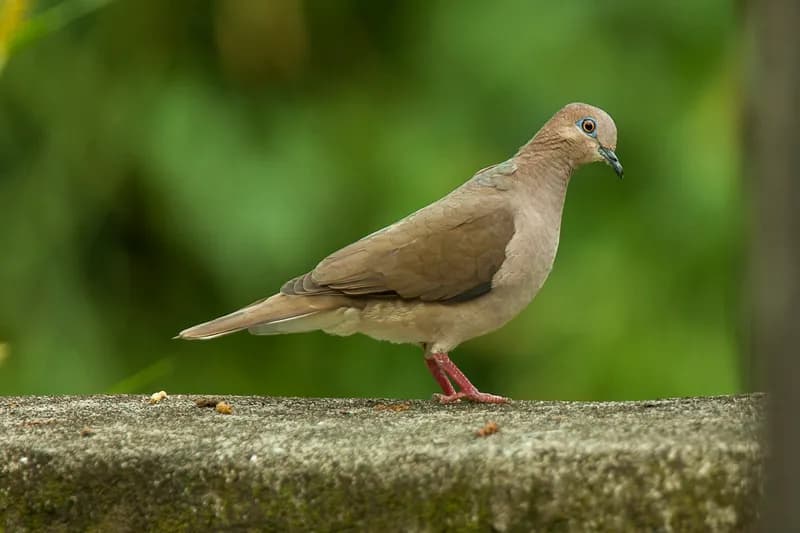
Photo: Wikimedia Commons
Overview
The White-tipped Dove is one of the quintessential birds of the lower Rio Grande Valley — a plump, ground-walking dove of shaded woodland floors whose deep, hollow hoot is among the most evocative sounds in any RGV nature reserve. Walk a trail at Santa Ana or Bentsen on a warm morning and the call — like blowing across the top of a large bottle — drifts from the undergrowth at regular intervals. It is a tropical species that reaches its northern range limit here, barely extending into the United States.
Identification
A large, rotund dove — noticeably bigger and heavier than a Mourning Dove — with plain brownish-gray upperparts and clean pinkish-buff underparts. The head is pale gray with a faint pinkish flush on the face. Look for the bright red orbital ring around the eye and the reddish-orange base to the bill, both diagnostic. In flight, the white corners of the rounded tail are conspicuous — the namesake “white-tipped” field mark.
On the ground, birds walk steadily with a nodding gait, usually keeping to deep shade beneath the canopy. The call is the best long-range identification cue: a single low, resonant wooo repeated at slow intervals, carrying surprisingly far through the brush.
Habitat & Range
In South Texas, White-tipped Doves occupy the shaded floor of dense Tamaulipan thornscrub and riparian woodland, particularly areas with a well-developed canopy that provides deep shade at ground level. They are frequently encountered beneath the feeders at Valley nature centers, where they walk quietly among fallen seeds. Unlike most doves, they seldom venture into open areas.
Their U.S. range is restricted to the lower Rio Grande Valley. The species is widespread from Mexico through Central and South America, inhabiting forest understory, woodland edges, and shaded gardens across an enormous range.
Behavior & Diet
White-tipped Doves are almost entirely ground foragers, walking slowly through leaf litter in search of seeds, fallen fruits, and berries. They are less gregarious than most doves, typically seen singly or in pairs rather than flocks. At feeders they move quietly beneath other birds, picking up spillage.
Pairs breed from March through August, building a flimsy stick platform nest low in a shrub or tree, typically two to five feet off the ground. Clutch size is almost always two eggs. Both parents incubate and feed the young. The species is a year-round resident and does not migrate; pairs remain on territory throughout the year.
Where to See in South Texas
Santa Ana National Wildlife Refuge
Alamo
Salineño Wildlife Preserve
Salineño
Bentsen-Rio Grande Valley State Park
Mission
Resaca de la Palma State Park
Brownsville
Listen for the deep hollow hoot from shaded areas. Check the ground beneath feeder stations at nature centers — they regularly walk in to pick up fallen seed.
Best Time to See
Year-round— White-tipped Doves are permanent residents of the Valley's woodlands and easy to see at Valley nature centers. The best strategy is to sit quietly near the ground-level feeder stations at Bentsen, Santa Ana, or Estero Llano Grande in the early morning: they walk deliberately beneath the feeders, picking up fallen seed. Listen for the deep, resonant single-note hoot from dense shade — once you learn the call it is the easiest way to detect them before you see them.
Conservation Status
IUCN: Least ConcernStable and widespread across its large Latin American range. In South Texas, the species depends on intact riparian woodland and thornscrub — habitats under persistent pressure from brush clearing and development. The protected reserves of the lower Rio Grande Valley provide essential refugia for the U.S. population.
Fun Fact
The White-tipped Dove's call is so unlike a typical dove vocalization that first-time visitors to the Valley often spend considerable time searching for the mysterious “mystery owl” they've been hearing — only to eventually discover that the haunting hollow hoot is coming from a dove walking quietly on the ground nearby.
In the News