Texas Gulf Coast · Year-round Resident
Reddish Egret
Egretta rufescens · Garceta rojiza
Resident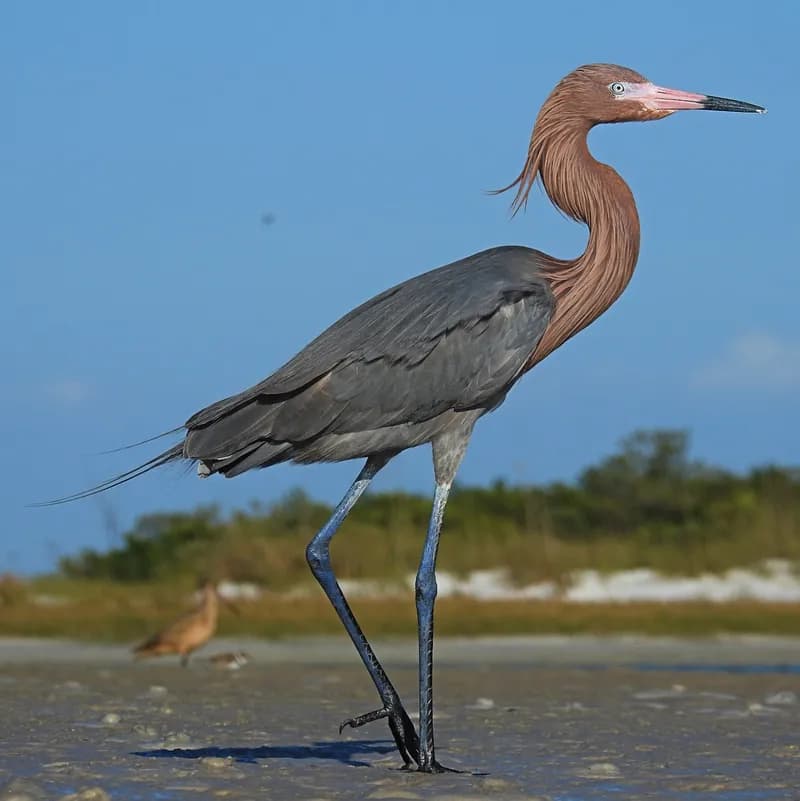
Photo: Wikimedia Commons
Overview
The Reddish Egret is among the rarest herons in North America, and one of the most entertaining birds on the Texas coast. Where other herons stalk motionlessly and strike with precision, the Reddish Egret dances — sprinting, lurching, spinning, and spreading its wings in a canopy display that startles fish into panicked motion. Once nearly extirpated by the plume trade, the species has recovered but remains uncommon. Texas holds a significant portion of the entire U.S. breeding population, making the coastal lagoons from Corpus Christi south to the Rio Grande an important stronghold.
Identification
The dark morph — by far the most common form in Texas — is unmistakable: a slate-blue body with a shaggy, wine-red head and neck, shaggy plumes on the breast and back, and a distinctive two-toned bill that is pink at the base and black at the tip. Legs are blue-gray. In breeding plumage the shaggy neck feathers are especially pronounced.
A white morph also exists — pure white with the same pink-and-black bill and blue-gray legs — and is much rarer, accounting for a small percentage of the population. No other white heron in Texas has this distinctive bill pattern. The dancing, lurching foraging style immediately identifies any Reddish Egret regardless of morph.
Habitat & Range
Reddish Egrets are strictly coastal birds, tied to shallow saltwater — tidal flats, open coastal bays, salt lagoons, and the margins of barrier island beaches. They nest colonially on coastal islands, often with other herons and spoonbills, and forage in the shallowest water they can find: typically less than a foot deep.
In the U.S., breeding is concentrated along the Texas coast, with smaller populations in Florida. They are year-round residents in South Texas, though some dispersal occurs after breeding. The species also breeds along the Gulf coast of Mexico, the Caribbean, and the Bahamas.
Behavior & Diet
The Reddish Egret's foraging behavior is unique among North American herons. It actively chases fish through shallow water, running and wheeling with wings spread in a canopy pose that shades the surface and reduces glare — making fish easier to see and reducing their ability to spot the predator. It also uses its wings as a herding tool, startling fish into shallower water.
Diet is almost entirely fish, supplemented occasionally by shrimp and other small aquatic invertebrates. Reddish Egrets are aggressive territorial foragers and will actively chase other herons away from productive feeding areas.
Where to See in South Texas
South Padre Island Birding & Nature Center
South Padre Island
Laguna Atascosa National Wildlife Refuge
Rio Hondo
Estero Llano Grande State Park
Weslaco
Scan shallow coastal flats and the edges of tidal lagoons. The dancing foraging display is visible from a distance and immediately distinctive.
Best Time to See
Year-round — Reddish Egrets are resident along the Texas Gulf Coast and can be found any month. The best viewing is at low tideon open tidal flats where they actively hunt — the dancing, wing-spreading foraging display is visible from considerable distance and is unlike anything else. The South Padre Island Birding & Nature Center bayside deck and the tidal flats along Laguna Atascosa NWR's shoreline are top sites. Numbers increase slightly October–April when northern birds augment the resident population.
Conservation Status
IUCN: Least ConcernThe global population is estimated at around 2,000 breeding pairs — making it genuinely rare despite its Least Concern listing. Texas coastal development, disturbance at nesting colonies, and sea-level rise affecting tidal flat habitat are ongoing concerns. The Texas coast hosts a critical share of the U.S. breeding population.
Fun Fact
The Reddish Egret's canopy-spread foraging technique — wings open, body hunched over the water — creates a patch of shade that eliminates surface glare and may also mimic a floating object to fish below. It is one of the most sophisticated active hunting behaviors of any bird in North America.
In the News