Texas Coast · Year-round Resident
Roseate Spoonbill
Platalea ajaja · Espátula rosada
Resident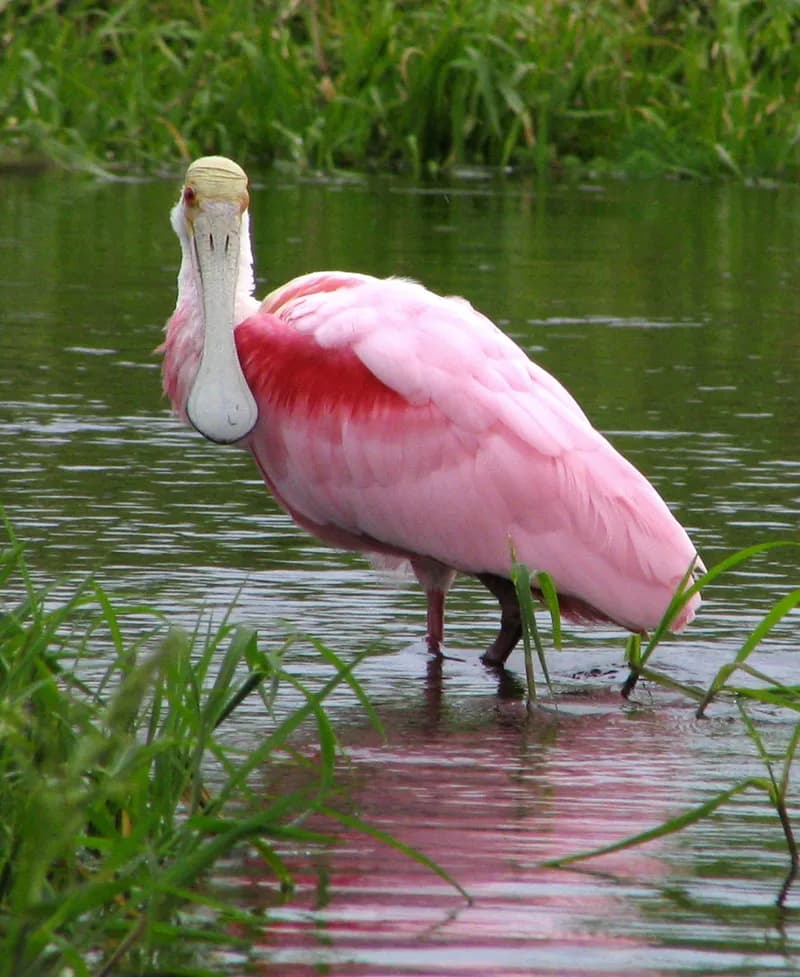
Photo: Wikimedia Commons
Overview
The Roseate Spoonbill is impossible to mistake and impossible to ignore — a shock of flamingo-pink wading through the coastal marshes and resacas of South Texas. Despite the visual resemblance, it is not related to flamingos; the pink color comes from carotenoid pigments in the crustaceans it eats, the same pigment source as the flamingo. After being hunted nearly to extinction in the United States by the early 20th century — their feathers were prized for decorative fans — spoonbills have made a strong recovery and now nest colonially in good numbers along the Texas coast.
Identification
Adults are unmistakable: brilliant pink wings and body, white neck and back, a bare greenish head, and the distinctive spatula-shaped bill that gives the species its name. The pink deepens to a rich rose on the wing coverts and there is an orange-red wash on the tail. In flight, the outstretched neck — unlike herons, which retract their necks — and the spoon-shaped bill are conclusive at any distance.
Immatures are paler overall, with feathered (rather than bare) heads and less intense pink, but the distinctive bill shape is evident from hatching. Size is large — about 80 cm (32 in) tall with a wingspan up to 130 cm (51 in). Often seen in small flocks or in mixed colonies with herons and egrets.
Habitat & Range
Roseate Spoonbills use a variety of shallow wetland habitats: coastal bays and tidal lagoons, freshwater resacas, managed impoundments, and flooded agricultural fields. They nest colonially in mangroves and coastal shrubs on islands and barrier peninsulas. The Texas coast from the Coastal Bend south to the Rio Grande Valley hosts a significant share of the U.S. breeding population.
Beyond Texas, the species occurs along the Gulf Coast of Mexico, the Caribbean, and through Central and South America south to Argentina. It was extirpated from Florida and Louisiana by plume hunters but has since recolonized both states.
Behavior & Diet
Feeds by wading slowly through shallow water and sweeping the slightly open spatula bill from side to side — a tactile method that works even in turbid water where visual detection of prey is impossible. When the sensitive bill tip contacts prey, it snaps shut reflexively. Diet includes small fish, shrimp, crayfish, aquatic insects, and other invertebrates.
Colonial nesters: builds bulky stick platform nests in mangroves or coastal shrubs, typically laying two to three eggs. Both sexes share incubation and feed young by regurgitation. The pink carotenoid pigments must be continuously replenished through diet; birds deprived of carotenoid-rich prey gradually fade.
Where to See in South Texas
Best Time to See
Year-round along the coast, but post-breeding dispersal from July through September brings Roseate Spoonbills to inland sites they don't typically use during the breeding season. The largest concentrations are at Aransas NWR and the Laguna Madre shallows from late summer through early winter. South Padre Island Birding Center is excellent any month, particularly at high tide when birds concentrate in the viewing pond.
Conservation Status
IUCN: Least ConcernAfter near-extinction from plume hunting in the early 20th century, legal protection under the Migratory Bird Treaty Act allowed a strong recovery. The Texas coastal population is now healthy. Ongoing threats include loss of foraging habitat from coastal development and altered hydrology in estuaries.
Fun Fact
Roseate Spoonbills are born white. The pink color develops gradually as young birds begin eating carotenoid-rich crustaceans — the same class of pigments that color flamingos and give cooked shrimp their orange hue. A spoonbill raised in captivity on a diet lacking carotenoids will remain white throughout its life.
In the News