Texas Gulf Coast · Year-round Resident
Tricolored Heron
Egretta tricolor · Garceta tricolor
Resident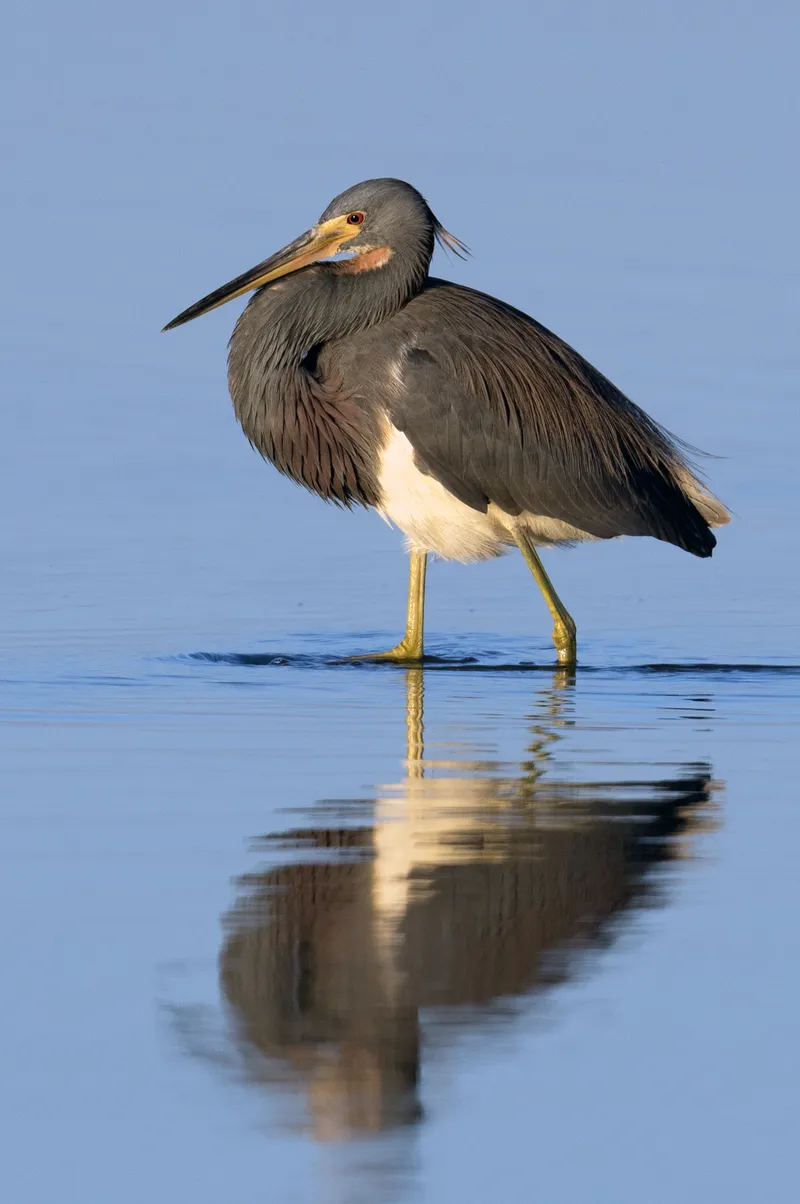
Photo: Wikimedia Commons
Overview
The Tricolored Heron is a common and energetic resident of South Texas coastal wetlands — the only heron in the United States with a sharply contrasting white belly set against slate-blue upperparts. Fast and aggressive in its foraging, it rushes through shallow water in short sprints rather than standing and waiting like most of its relatives. It is one of the most frequently seen herons along the Texas Gulf Coast, from resacas in the Rio Grande Valley to the tidal marshes of the Laguna Madre.
Identification
Adults are slate-blue on the back, wings, and neck, with a white stripe down the front of the neck and white underparts — the three-color pattern that gives the species its name. The bill is long and yellow with a darker tip; legs are yellow to yellowish-green. In breeding plumage, the neck acquires reddish-brown streaks and the back develops long, wispy plumes. A white rump patch is visible in flight.
Immature birds are browner on the neck and wing coverts, with a rufous wash, but still show the white belly. The combination of slate-blue body and white underparts is unique among herons in its range and makes identification straightforward at any age.
Habitat & Range
Tricolored Herons occupy a broad range of wetland types: coastal marshes, tidal flats, estuaries, mangroves, resacas, ponds, and the margins of freshwater lakes. They are equally at home in brackish and freshwater habitats and are among the most versatile herons in the region.
In the U.S., they breed along the Gulf and Atlantic coasts from Texas to Maine, with the largest concentrations in the Gulf states. In South Texas, they are year-round residents, common along the coast and on larger inland water bodies. The species also ranges widely through the Caribbean and coastal Latin America south to northern Brazil.
Behavior & Diet
More active and dynamic than most herons, the Tricolored Heron forages by running through shallow water in short bursts, stabbing rapidly at fish. It may also use a canopy spread similar to the Reddish Egret — wings partially open to reduce glare — though it does so less consistently. The diet is primarily small fish, supplemented by frogs, crustaceans, and aquatic invertebrates.
Tricolored Herons nest colonially, often in mixed-species colonies with other herons, egrets, spoonbills, and cormorants. Nests are built in mangroves, willows, or other shrubby vegetation over water. Pairs raise one brood per year, typically two to four eggs. Both parents share incubation and chick-rearing.
Where to See in South Texas
Best Time to See
Year-round along the coast — Tricolored Herons are permanent residents of South Texas coastal wetlands and estuaries. They are easiest to observe at low tide, when exposed tidal flats concentrate feeding birds in the open. South Padre Island Birding and Nature Center, Laguna Atascosa NWR, and Estero Llano Grande all provide reliable sightings. Breeding colonies are active from March through July at coastal rookeries, including those at Aransas NWR.
Conservation Status
IUCN: Least ConcernPopulations are generally stable. Coastal wetland loss and disturbance of nesting colonies are the primary threats along the Texas coast. The species rebounded strongly after the end of the plume trade in the early 20th century and is now one of the more numerous herons in the Gulf region.
Fun Fact
The Tricolored Heron was formerly known as the Louisiana Heron — a name that persisted for decades in field guides before being changed to reflect the species' much broader range across the Caribbean and Latin America. Long-time birders still occasionally use the old name.
In the News