Rio Grande Valley · Year-round Resident
Neotropic Cormorant
Nannopterum brasilianum · Cormorán neotropical
Resident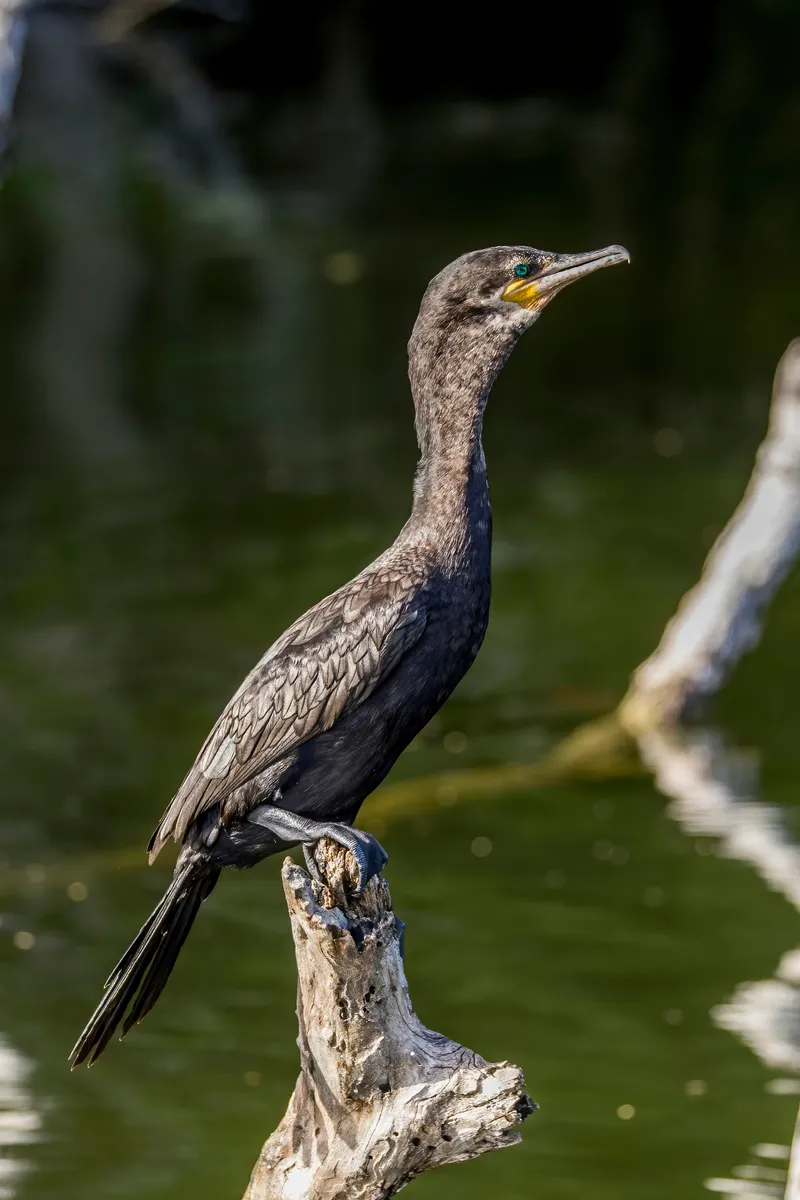
Photo: Wikimedia Commons
Overview
The Neotropic Cormorant is the most abundant cormorant in the Americas by total population and a ubiquitous presence on South Texas waterways. Smaller and slimmer than the familiar Double-crested Cormorant, it is the species you will almost always encounter on Valley resacas, ponds, and rivers. Look for them perched in groups on dead snags or low branches overhanging water, wings spread in the classic cormorant sun-drying pose. The species was formerly known as the Olivaceous Cormorant.
Identification
Adults are glossy black with a long, thin tail and a slender bill. The key field mark separating it from the Double-crested Cormorant is the facial skin: tan or buff-colored on the Neotropic (versus bright orange-yellow on the Double-crested), bordered by a narrow white edge that forms a pointed V behind the bill in breeding birds. The Neotropic is also noticeably smaller and proportionally longer-tailed.
In flight the long tail and smaller overall size are helpful cues. Immatures are brownish with pale underparts. Both species often occur together on South Texas waterways, making direct comparison possible and instructive.
Habitat & Range
Neotropic Cormorants occupy virtually any open water — resacas, ponds, rivers, coastal bays, reservoirs, and flooded agricultural fields. They are equally comfortable in fresh and brackish water and are often found alongside herons, egrets, and spoonbills in colonial nesting rookeries.
In the U.S., they breed from Texas west to Arizona and are year-round residents in South Texas. Their range extends south through Mexico, Central America, and South America to Tierra del Fuego, making them one of the most widely distributed water birds in the Western Hemisphere.
Behavior & Diet
Like all cormorants, Neotropics dive from the surface and pursue fish underwater, propelled by their powerful webbed feet. They lack waterproofing oils in their feathers — an adaptation that reduces buoyancy and makes diving easier — which is why they must spread their wings to dry after swimming.
Diet is almost entirely small fish. They nest colonially, often in the same trees as herons, egrets, and spoonbills. Nests are built of sticks, typically in trees or shrubs overhanging water. Both parents share incubation and feeding of chicks.
Where to See in South Texas
Best Time to See
Year-round — Neotropic Cormorants are permanent residents throughout South Texas and increasingly common. They are easiest to observe at ponds and resacas where they perch on exposed snags to dry their wings. Any water feature at the Valley nature centers will typically have both Neotropic and Double-crested Cormorants for direct comparison. Winter brings the largest concentrations, when cormorant flocks gather at productive fishing areas on the Rio Grande and coastal bays.
Conservation Status
IUCN: Least ConcernAbundant and expanding. The Neotropic Cormorant has increased significantly in Texas over the past several decades and is not a conservation concern. Its ability to exploit a wide variety of wetland habitats makes it resilient to many forms of habitat change.
Fun Fact
Unlike most waterbirds, cormorants do not have waterproofing oils in their feathers. This is not an evolutionary flaw — it's a trade-off. Wettable feathers reduce buoyancy, making underwater pursuit of fish easier. The famous wing-spreading pose is how they compensate: drying out between dives so they can fly again.
In the News