Rio Grande Valley · Year-round Resident
Least Grebe
Tachybaptus dominicus · Zambullidor menor
Resident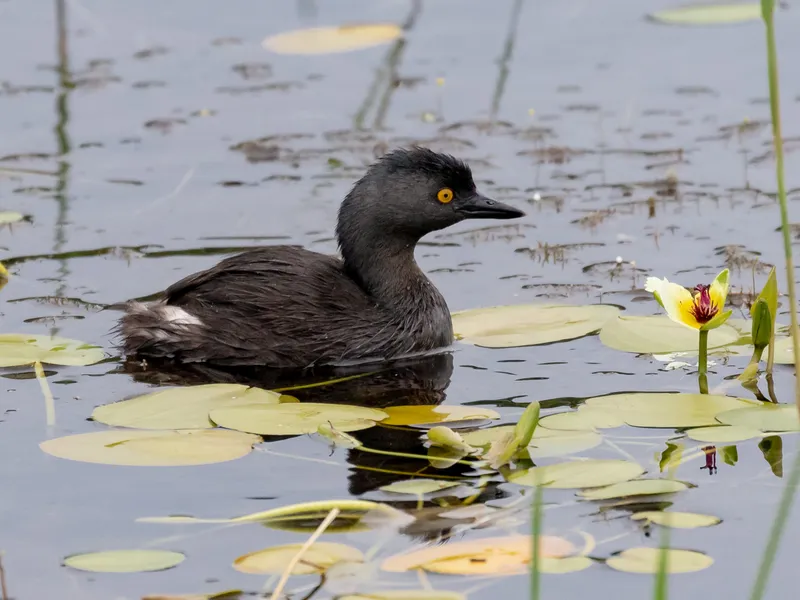
Photo: Wikimedia Commons
Overview
The Least Grebe is the smallest grebe in the Western Hemisphere — a tiny, round-bodied diving bird that bobs on the surface of resacas and ponds like a dark fishing cork. It is common on still water throughout the Rio Grande Valley year-round, and once learned it is easy to find on virtually any small water body in the region. The combination of tiny size, sooty dark plumage, and penetrating golden eyes set against a dark face gives this bird a surprisingly intense expression for something barely larger than a tennis ball.
Identification
Very small (23–27 cm / 9–10.5 in), with a rounded body, very short neck, and the characteristic “sawed-off” look of a grebe — no visible tail, the body seeming to end abruptly at the rear. Breeding plumage: dark sooty gray-black on the head and neck, contrasting white throat, and brilliant yellow eyes. Non-breeding plumage is similar but with a white throat and slightly paler overall tones. The bill is short, pointed, and bluish-gray.
Distinguished from the Pied-billed Grebe — the other common grebe in the Valley — by much smaller size, darker overall plumage, conspicuous golden eye, and the slender (not thick and chicken-like) bill. The Least Grebe's call is a descending trill, frequently given from cover.
Habitat & Range
Resacas, ponds, slow-moving streams, and roadside ditches with emergent vegetation — any small body of calm, shallow fresh water with bordering vegetation will do. The Least Grebe is less tied to open water than larger grebes, often hiding and nesting in dense emergent plants at the water's edge.
In the U.S., restricted to South Texas; the range extends through Mexico, Central America, and South America to Bolivia and Argentina, with a separate population in the Caribbean and southern Florida. Throughout its range it occupies a variety of small, shallow freshwater habitats.
Behavior & Diet
Dives repeatedly for small fish, aquatic insects, crustaceans, and tadpoles. Like all grebes, it dives smoothly from the surface and can remain submerged for 10–20 seconds. Between dives it rides low in the water with the body nearly awash. The nest is a floating platform of aquatic vegetation anchored to emergent plants; eggs are covered with nest material when the incubating bird departs, providing camouflage and some insulation.
Least Grebes can breed in any month of the year in South Texas, which is unusual for a North American bird, and multiple clutches per year are common. Pairs form bonds that may persist across seasons on the same territory.
Where to See in South Texas
Best Time to See
Year-round — Least Grebes are permanent residents of the Valley's ponds, resacas, and slow-moving waterways. They are most easily seen at calm, clear ponds with emergent vegetation — any park pond, resaca, or wetland at Estero Llano Grande, Resaca de la Palma, or Bentsen can hold them. Early morning visits with flat, reflective water offer the best viewing. Listen for a rapid, nasal buzzing call that betrays their presence in dense vegetation.
Conservation Status
IUCN: Least ConcernCommon and stable throughout its range. In South Texas, the primary threats are pollution and destruction of small wetland habitats through drainage, development, and agricultural conversion. The species adapts readily to artificial ponds and managed wetlands where water quality is maintained.
Fun Fact
Least Grebes are among the most opportunistic breeders of any North American bird — pairs can begin nesting within days of a new pond filling with water, and can raise up to three clutches in a single year. This rapid response to available water makes the species unusually resilient in the dynamic, seasonally variable wetland landscape of South Texas.
In the News