Rio Grande Valley · Summer Resident
Elf Owl
Micrathene whitneyi · Tecolotito enano
Summer resident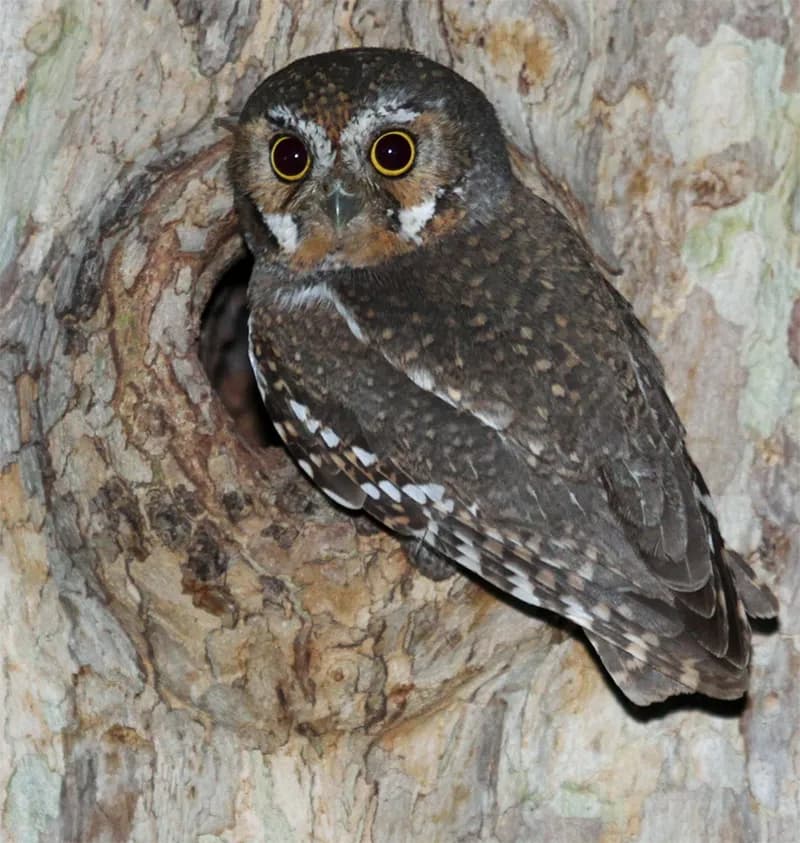
Photo: Wikimedia Commons
Overview
The Elf Owl is the world's smallest owl by weight — at about 40 grams (1.4 oz), lighter than a golf ball. A summer resident in South Texas, it arrives from its Mexican wintering grounds in spring and announces itself at dusk with a rapid, high-pitched series of yipping calls from the riparian forest along the Rio Grande — a sound like a small puppy. Despite this vocal performance, the bird itself is nearly impossible to spot during daylight hours, roosting motionless in a woodpecker cavity and emerging only after dark to hunt by night.
Identification
Tiny: only 12–14 cm (4.7–5.5 in) — roughly the size of a large sparrow. Round-headed with no ear tufts, brown and gray above with whitish spotting, pale gray-brown below with diffuse rufous-brown streaking. The white eyebrows and yellow eyes give the face an unexpectedly intense expression for such a small bird. The tail is very short relative to body size.
The call is the most practical identification tool: a rapid, high-pitched series of yips and chatters, accelerating toward the end, given repeatedly from a concealed roost just after dark. At Bentsen SP in late April through June, multiple birds can often be heard calling simultaneously from the hawk watch platform at dusk.
Habitat & Range
Riparian woodland and thornscrub with large trees containing old woodpecker cavities for nesting. In South Texas, closely associated with mature riparian forest along the Rio Grande where Ladder-backed Woodpecker cavities are abundant. In the Sonoran Desert of Arizona and New Mexico, strongly tied to saguaro cactus and Gila Woodpecker cavities.
Winters in western Mexico, returning to South Texas in late March and April. The U.S. breeding range includes South Texas and the Sonoran Desert region. The species departs the Valley by September and is absent through winter.
Behavior & Diet
Almost entirely insectivorous: moths, beetles, crickets, scorpions, and other large arthropods make up the diet. Elf Owls are crepuscular and nocturnal foragers, catching insects in flight or gleaning them from vegetation. Despite their tiny size, they readily take scorpions — apparently immune to or able to avoid the sting.
They are entirely dependent on old woodpecker cavities for nesting — they cannot excavate their own. Breeding season is April through June; typically three to four eggs per clutch. The male calls persistently from near the nest hole in the evenings, making the cavity's location apparent to patient observers.
Where to See in South Texas
Best searched at dusk, late April through June. The hawk watch platform at Bentsen SP is ideal for hearing multiple calling birds as darkness falls over the river forest.
Best Time to See
Late April through August — Elf Owls are summer visitors to South Texas, arriving in late March and departing by October. The best viewing window is April through June, during the breeding season when males call persistently at dusk. They're strictly nocturnal; plan a after-dark visit to Bentsen-Rio Grande Valley State Park or Santa Ana NWR starting 30–45 minutes after sunset. Listen for a rapid, puppy-like yipping call from saguaro or tree cavities.
Conservation Status
IUCN: Least ConcernIn South Texas, loss of mature riparian trees containing existing woodpecker cavities is the primary threat. The species cannot excavate its own cavities and is entirely dependent on the woodpecker community for nest sites. Preservation of large riparian trees is the most direct conservation measure.
Fun Fact
When threatened at close range, Elf Owls play dead — a behavior called thanatosis. If flushed from a roost hole or caught in the hand, the bird goes limp and motionless for several minutes before suddenly reviving and escaping. Playing dead is far more common in insects than in birds, making this one of the more unusual defensive behaviors documented in any North American owl.
In the News