South Texas · Year-round Resident
Greater Roadrunner
Geococcyx californianus · Correcaminos mayor
Resident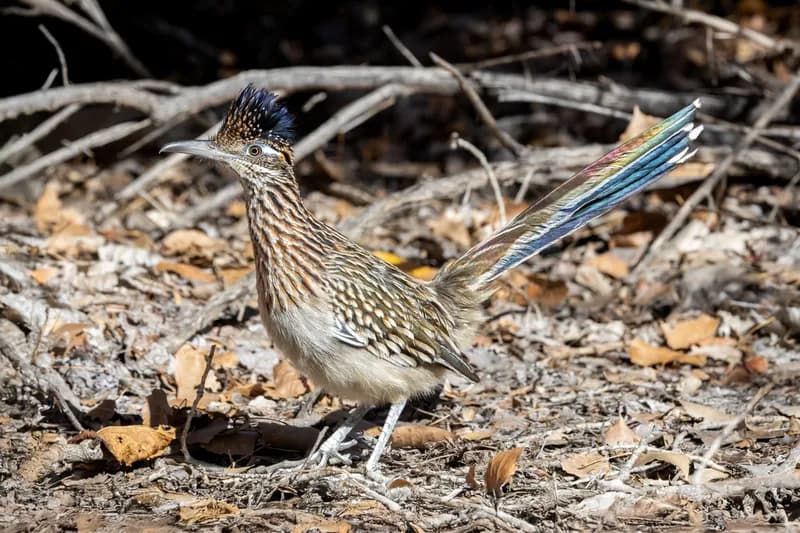
Photo: Wikimedia Commons
Overview
The Greater Roadrunner is perhaps the most iconic bird in Texas — a large, shaggy, ground-dwelling cuckoo that has become a cultural symbol of the Southwest. In South Texas it inhabits dry brushland, chaparral, and open thornscrub from the Rio Grande Valley north through the brush country. True to its name, the roadrunner regularly crosses roads at a sprint, reaching speeds of up to 20 mph. Unlike its cartoon counterpart, the real bird is a formidable predator capable of killing rattlesnakes, which it dispatches with a hard beak strike to the head.
Identification
Unmistakable — a large, ground-dwelling bird with a long tail held horizontally, a heavy bill, and a shaggy crest that can be raised or lowered. Plumage is heavily streaked brown, black, and white above; pale and streaked below. A bare patch of blue and red skin behind the eye is often visible at close range. The zygodactyl feet leave distinctive X-shaped tracks in soft ground.
It is the only large, long-tailed, terrestrial bird in its range and cannot be confused with any other species. Vocalizations include a series of descending, dove-like coos — surprisingly mellow for such a predatory bird.
Habitat & Range
In South Texas, roadrunners favor dry, brushy habitat — thornscrub, chaparral, desert scrub, and open woodland with thickets for concealment. They avoid dense forest but will use woodland edges and suburban areas with brushy cover. They are year-round residents throughout their range and do not migrate.
The range extends across the American Southwest from California east to Louisiana, and south through Mexico. In Texas, roadrunners occur statewide except in the wetter eastern forests.
Behavior & Diet
Roadrunners are opportunistic predators with a remarkably varied diet: lizards, snakes (including venomous species), small mammals, birds, insects, scorpions, centipedes, and carrion. They typically run prey down on the ground, using the bill to batter prey into submission.
On cold mornings, roadrunners use a behavioral thermoregulation strategy: they expose a patch of dark skin on the back to the sun, raising their feathers to maximize heat absorption — essentially solar-basking to warm up before becoming active. Pairs mate for life and defend year-round territories.
Where to See in South Texas
Bentsen-Rio Grande Valley State Park
Mission
Laguna Atascosa National Wildlife Refuge
Rio Hondo
Santa Ana National Wildlife Refuge
Alamo
Estero Llano Grande State Park
Weslaco
Look for roadrunners trotting across trails and roads at any brushy hotspot. Laguna Atascosa's upland scrub areas are particularly reliable for encounters.
Best Time to See
Year-round — Greater Roadrunners are permanent residents that don't migrate. They are most active and visible in the early morning (first 2–3 hours after sunrise), when they warm themselves by spreading their back feathers to expose dark skin patches to the sun. This sunning behavior makes them conspicuous and approachable. Laguna Atascosa and Santa Ana NWR trails are reliable spots, especially in drier upland areas with open scrub and rocky ground.
Conservation Status
IUCN: Least ConcernCommon and stable across its range. The roadrunner has adapted reasonably well to human presence and continues to occupy most of its historical range. Local habitat loss from brush clearing and agriculture poses some pressure in South Texas.
Fun Fact
To kill a rattlesnake, roadrunners work in pairs: one bird distracts the snake while the other attacks from behind, pinning the head and beating it against the ground. They can swallow a snake longer than they are — running around with the tail hanging out of their bill while the rest slowly digests. It takes as long as it takes.
In the News