Rio Grande Valley · Year-round Resident
Plain Chachalaca
Ortalis vetula · Chachalaca Norteña
Resident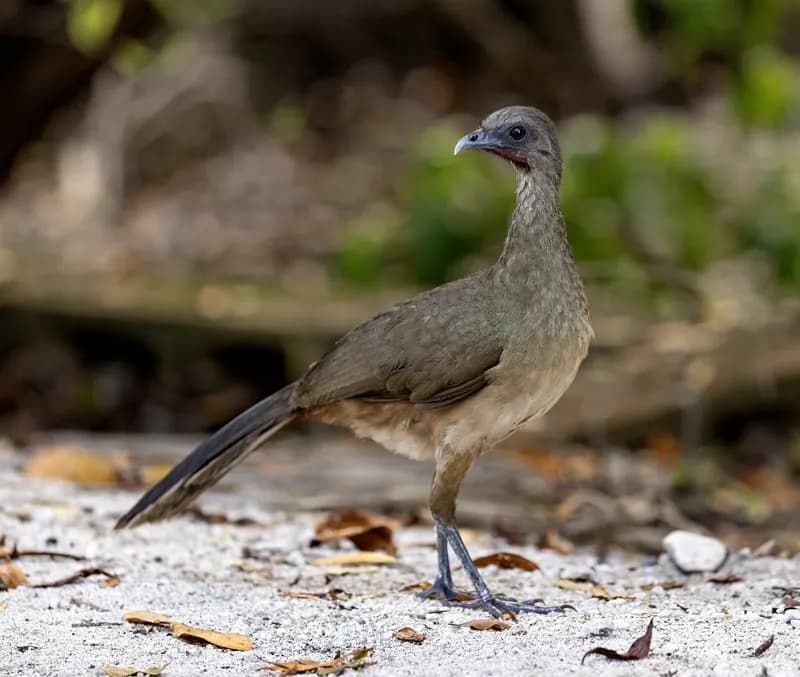
Photo: Wikimedia Commons
Overview
The Plain Chachalaca is the only member of the family Cracidae — a tropical group of large, hen-like birds that includes the curassows and guans of Central and South America — naturally occurring in the United States. South Texas is its entire U.S. range. If you have spent a morning in the Rio Grande Valley, you have almost certainly heard one before you saw it: the pre-dawn chorus of a group of chachalacas, voices overlapping in thunderous synchrony from the treetops, is one of the defining sounds of the region. Despite all the noise, the birds themselves are surprisingly easy to miss in the dense brush they call home.
Identification
A large, slender, long-tailed bird — about 53–58 cm (21–23 in) from bill to tail tip — with a small rounded head, long neck, and the overall shape of a hen pheasant. Plumage is plain olive-brown above, slightly paler below, with a graduated tail tipped white. The bare red throat patch (dewlap) is visible at close range and is larger in males. Short, rounded wings reflect the species' preference for scrambling through canopy over sustained flight.
Sexes look alike; males are slightly larger. Juveniles resemble adults but are duller with finer barring on the upperparts. In South Texas there is no similar bird: the combination of size, shape, plain brown plumage, and habitat (dense brush, often near feeders) is distinctive. Groups moving through the canopy often betray themselves by the sound of crashing branches as much as by their calls.
Habitat & Range
In South Texas, Plain Chachalacas occupy dense Tamaulipan thornscrub, riparian forest along the Rio Grande and its resacas, and woodland edges. They adapt readily to suburban parks and nature center grounds with mature native vegetation, and are common visitors to feeding stations that offer corn or milo on the ground.
The U.S. range is limited to the Lower Rio Grande Valley, from Starr County east to Cameron County. The species is far more widespread in Mexico, ranging from Tamaulipas and Nuevo León south through the Gulf lowlands of Central America to northwestern Costa Rica, where it inhabits tropical and subtropical forest edges and disturbed woodlands at low to moderate elevations.
Behavior & Diet
Chachalacas are primarily herbivores, feeding on fruits, leaves, buds, flowers, and seeds gleaned from shrubs and trees, with insects taken occasionally. They forage mostly in the canopy and mid-story, moving through branches with surprising agility for their size. At feeding stations they readily come to the ground for corn, milo, and other grains, often forming groups of six to twenty or more birds.
They are intensely social and roost communally in dense vegetation. The famous dawn chorus — a near-deafening, overlapping cha-cha-LAC-a call — is a group performance: multiple birds call simultaneously with different individuals covering different syllables in near-perfect synchrony. Nesting runs from March to June; the female builds a flat platform of twigs and leaves in dense brush, typically 2–5 meters up, and lays two to four eggs.
Where to See in South Texas
Best Time to See
Year-round — Plain Chachalacas are permanent residents and among the most reliably encountered birds at any Valley nature center. They are most vocal and active in the first hour after dawn, when groups produce their remarkable group chorus (cha-cha-lac) that carries across the thornscrub. Feeders at Bentsen, Santa Ana, and Estero Llano Grande draw multiple individuals throughout the day. Winter visitors often get their most memorable chachalaca experience at dawn, when a forest edge erupts in chorus from multiple groups.
Conservation Status
IUCN: Least ConcernThe species is stable across its broad range and adapts well to disturbed and suburban habitats. In South Texas, ongoing brush clearing for agriculture and development reduces available habitat, but the population remains healthy. The protected corridor of reserves along the Rio Grande provides core habitat for the U.S. population.
Fun Fact
“Chachalaca” is one of the few English bird names that is fully onomatopoeic — it is a direct phonetic transcription of the call itself. During the dawn chorus, different birds in the group take different syllables simultaneously, producing an overlapping roar loud enough to carry over a mile through the brush.
In the News