Rio Grande Valley · Year-round Resident
Buff-bellied Hummingbird
Amazilia yucatanensis · Colibrí Vientre-canelo
Resident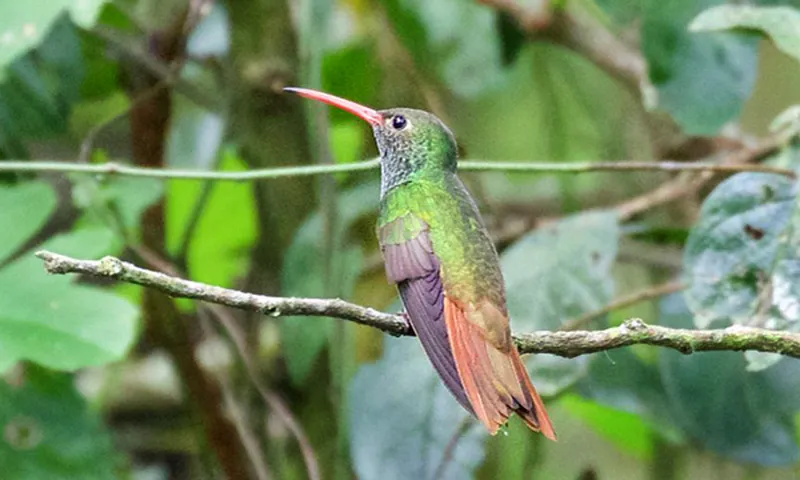
Photo: Wikimedia Commons
Overview
The Buff-bellied Hummingbird is the only hummingbird species that regularly breeds in South Texas, making it the anchor of the Rio Grande Valley's hummingbird scene year round. While a parade of other species passes through during migration, the Buff-bellied is the one that stays — nesting from spring through summer and holding its territory through winter. A bird of subtropical woodland edges and flowering gardens, it is relatively easy to find at feeders and plantings of native salvias and Turk's cap throughout the Valley, and the bold red bill makes it instantly recognizable.
Identification
The bright red-orange bill with a black tip is the single most reliable field mark — visible at a glance and shared by no other hummingbird in Texas. The body is iridescent green on the back and breast, warming to a buffy cinnamon on the belly (giving the species its name). The tail is rufous-chestnut and is frequently pumped while hovering. At about 10–11 cm (4 in) it is medium-sized for a hummingbird, noticeably larger than a Ruby-throated.
Sexes are similar, with females slightly duller and showing less iridescence on the throat. The combination of red bill, green-and-buff body, and rufous tail is unique among regularly occurring U.S. hummingbirds. Ruby-throated and Black-chinned Hummingbirds — the migrants most likely to cause confusion — both have dark bills and lack the warm buff belly.
Habitat & Range
In South Texas, Buff-bellied Hummingbirds use a wide range of habitats: woodland edges, Tamaulipan thornscrub, riparian forest, and — perhaps most accessibly — gardens, nature center grounds, and urban parks planted with native flowering species. They are strongly associated with plants that produce tubular red or orange flowers, particularly Turk's cap, red salvia, tropical sage, and anacua.
The breeding range spans South Texas and the Gulf Coast of northeastern Mexico south through Tamaulipas and Veracruz to the Yucatán Peninsula. After the breeding season, many birds disperse northeastward along the Gulf Coast — a reversal of the direction most U.S. hummingbirds migrate — reaching Louisiana and occasionally Mississippi and Alabama before returning to South Texas the following spring.
Behavior & Diet
Nectar is the primary fuel, supplemented by small insects and spiders caught in flight or gleaned from foliage — a critical protein source, especially during nesting. Males are fiercely territorial at nectar sources and will chase off larger hummingbirds, including Baltimore Orioles that raid feeders. Despite their small size, Buff-bellied Hummingbirds are among the more aggressive hummers at a feeder station.
The female builds the nest alone: a compact cup of plant down and fibers bound with spider silk and camouflaged with bits of lichen, typically placed on a low horizontal branch 1–3 meters above the ground. She lays two white eggs and raises the young without help from the male. Breeding in South Texas runs from March through July, and some pairs raise two broods in a season.
Where to See in South Texas
Best Time to See
Year-round — Buff-bellied Hummingbirds are permanent residents of the Rio Grande Valley and don't migrate south. Activity peaks during the flowering seasons: April through June (spring) and August through October (fall). In summer the Valley population expands northward along the coast, and some Valley birds make a post-breeding dispersal to the upper Texas coast. Feeders at Estero Llano Grande, Bentsen, and Santa Ana draw birds daily.
Conservation Status
IUCN: Least ConcernThe species is stable across its range. In South Texas, the main pressures are loss of native flowering plants through development and herbicide use, and the replacement of native gardens with non-flowering ornamentals. Planting native nectar species — Turk's cap, red salvia, anacua — is one of the most direct ways to support the local breeding population.
Fun Fact
The Buff-bellied Hummingbird migrates in the wrong direction — at least by most hummingbird standards. After nesting in South Texas, many birds disperse northeastward along the Gulf Coast into Louisiana and beyond, rather than heading south like their relatives. They are one of the only U.S. hummingbirds known to perform this post-breeding northward shift.
In the News