South Texas · Year-round
Vermilion Flycatcher
Pyrocephalus rubinus · Mosquero cardenal
Resident / winter visitor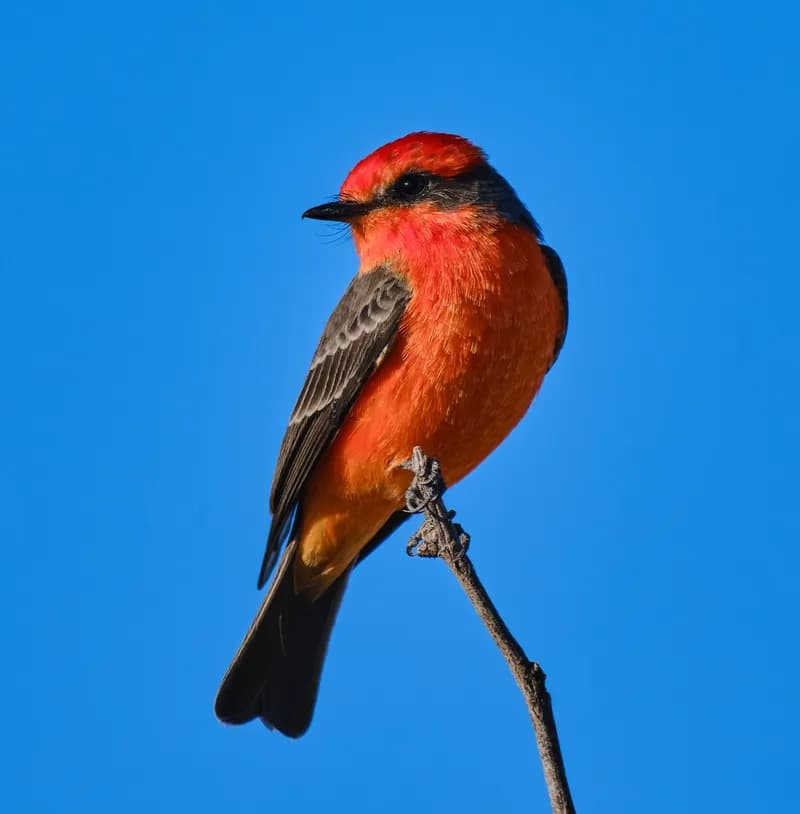
Photo: Wikimedia Commons
Overview
The male Vermilion Flycatcher is one of the most brilliantly colored birds in North America and one of the most reliably found at parks and open areas throughout South Texas. The combination of a blazing red crown and underparts against a jet-black back, wings, and tail creates a bird that seems almost too vivid for the muted tones of the Texas scrub. It sits conspicuously on exposed wires, branches, and fence posts, making short sallies into the air to catch insects — a textbook demonstration of the flycatcher hunting style.
Identification
The adult male is unmistakable: brilliant vermilion-red crown (often puffed into a crest when excited) and underparts, with jet-black back, wings, tail, and eyeline. In sunlight the red is nearly incandescent. Female and immature birds are brown above, white below with fine dark streaking, with a peachy-salmon wash on the lower belly and undertail — subtle but enough to hint at the male's color. First-year males show a patchy transition.
Size is small — about 13–14 cm (5 in) — compact, with the characteristic upright posture of a flycatcher on an exposed perch. No other small bird in South Texas shares the male's red-and-black combination. The female's peachy wash and streaked underparts separate it from other small female flycatchers.
Habitat & Range
Prefers open or semi-open areas near water: brushy fields, riparian edges, pond margins, parks, roadsides, and ranch country. Water is the key habitat element — Vermilion Flycatchers are almost always found near permanent or semi-permanent water sources, particularly where open ground or low grass provides hunting terrain.
In South Texas, residents are present year-round; the wintering population is augmented by birds from more northern breeding areas. The breeding range spans the southwestern U.S. south through Mexico and Central America to Bolivia and Argentina.
Behavior & Diet
A classic aerial flycatcher: perches on an exposed post or wire, watches for insects, then makes a short aerial sortie to catch them before returning to the same perch. Diet is almost entirely insects — beetles, bees, flies, and grasshoppers. The male's conspicuous, colorful plumage makes every hunting foray a visible event.
Males perform a spectacular aerial display during the breeding season: a slow, butterfly-like flight with the red crest puffed and wings spread, delivered high above the territory while singing. Nests are small, neat cups of plant fibers placed on a horizontal branch, typically 1–6 meters high.
Where to See in South Texas
Best Time to See
October through April — Vermilion Flycatchers are winter residents in South Texas, arriving from more northern breeding grounds in October and departing by early May. Numbers peak in December and January, when brilliant adult males are easiest to spot perched on exposed branches near water. Any park pond or resaca in the Valley is worth checking. Estero Llano Grande and Bentsen both reliably host multiple individuals throughout winter.
Conservation Status
IUCN: Least ConcernPopulations in Texas appear stable, though declines have been documented in some western populations possibly linked to changes in riparian habitat. The species benefits from the open agricultural and ranch land of South Texas that provides abundant hunting habitat near water.
Fun Fact
Male Vermilion Flycatchers offer their mates elaborate “nuptial gifts” during courtship — a brightly colored butterfly or other large insect, presented in a fluttering aerial display. The quality of the gift appears to influence female mate choice, making this one of a small group of birds where insect presentation is a documented courtship behavior.
In the News