Rio Grande Valley · Year-round Resident
Great Kiskadee
Pitangus sulphuratus · Luis bienteveo
Resident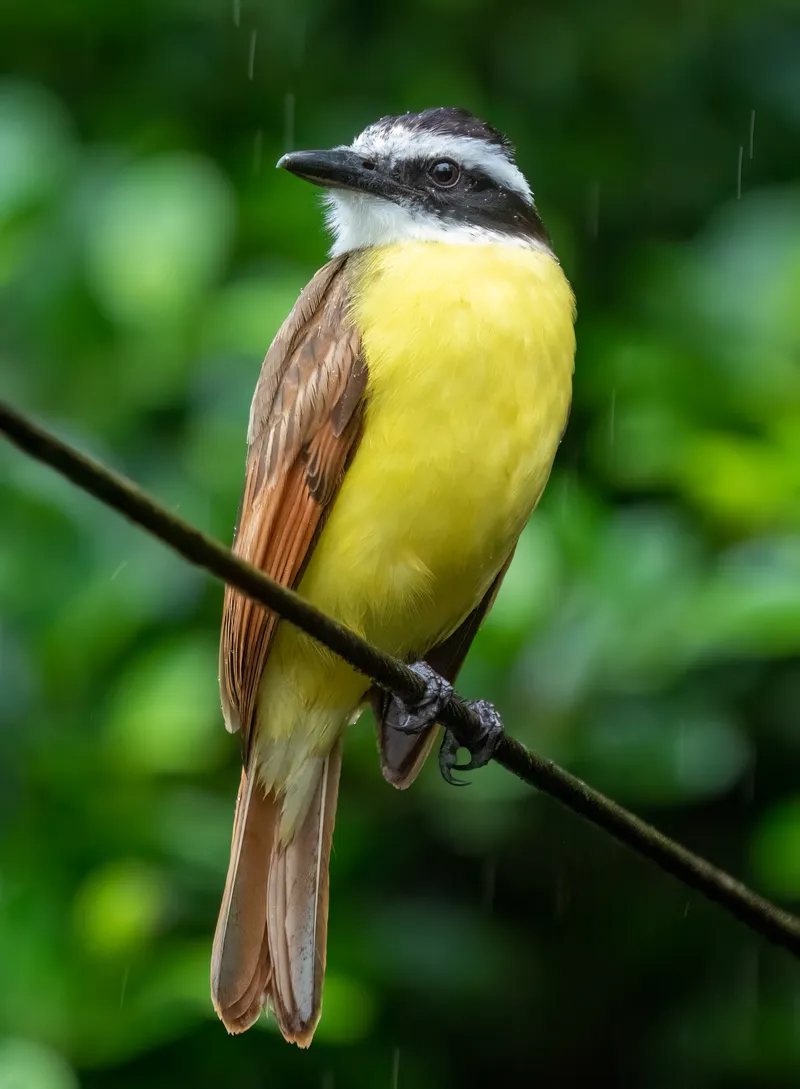
Photo: Wikimedia Commons
Overview
If there is one bird that defines the soundscape of the Rio Grande Valley, it is the Great Kiskadee — loud, abundant, and relentlessly conspicuous. Its name is an English transcription of its own call (KISS-ka-DEE), which it delivers constantly from dawn until dusk from the tops of tall trees, telephone wires, and feeder stations alike. This large, boldly patterned flycatcher is equally at home catching insects in midair, diving for fish in a resaca, stealing food from other birds, or raiding a nest — a dietary adventurism that distinguishes it from the more specialized members of its family.
Identification
A large, robust flycatcher (22–25 cm / 9–10 in) with a massive black bill. Bold patterning throughout: bright yellow underparts, white throat, and a striking head pattern of black mask and cap, white supercilium, and white collar. The back and wings are rufous-brown. The black crown conceals a bright yellow coronal patch revealed only when the bird is excited or displaying.
The rufous-brown wings distinguish it from the similar-patterned Social Flycatcher, which is smaller with gray-brown wings. In the Valley, the Kiskadee's loud voice and large size make confusion with any other species unlikely once the bird is seen well.
Habitat & Range
Remarkably adaptable: Great Kiskadees occur in riparian forest, open woodland, resaca margins, suburban parks and gardens, roadsides, and anywhere with a few trees near water. They are among the most habitat-tolerant birds in the Valley and are genuinely difficult to avoid once you are in suitable habitat anywhere in the region.
In the U.S., found in South Texas; the broader range extends from northeastern Mexico south through Central America to central Argentina — one of the most widespread flycatchers in the Western Hemisphere. The species is expanding northward in Texas, colonizing areas along the Nueces River drainage.
Behavior & Diet
A dietary opportunist of the first order: Great Kiskadees catch flying insects aerially, pick fruit and berries from foliage, plunge into shallow water for small fish and tadpoles, steal food from other birds, and occasionally take eggs or nestlings. This dietary flexibility is exceptional among flycatchers and accounts for the species' success across a wide range of habitats.
Bulky, domed nests of grass and plant fibers are built in trees, on utility poles, or in cacti. Pairs often use the same site across multiple seasons. The species is bold and will aggressively mob raptors and other perceived threats near the nest.
Where to See in South Texas
Best Time to See
Year-round — Great Kiskadees are permanent residents throughout South Texas. They are among the most conspicuous birds at any Valley nature center, perching openly on wires and branches and announcing themselves constantly with the loud kis-ka-dee! call. No special timing is needed — any visit to Bentsen, Estero Llano Grande, Santa Ana, or Quinta Mazatlán will produce Great Kiskadees. April through July is the breeding season, when pairs are particularly vocal and active.
Conservation Status
IUCN: Least ConcernOne of the most abundant and adaptable birds in its range. In South Texas the population is stable and expanding. The species benefits from human-modified landscapes that provide open areas near water — essentially the same habitat produced by parks, golf courses, and suburban gardens.
Fun Fact
The Great Kiskadee is one of the very few flycatchers that regularly plunges into water to catch fish. It has been filmed diving into ponds and resacas for small fish and tadpoles — a feeding behavior typically associated with kingfishers. It even selects perch sites that offer a clear view of the water surface below, just as a kingfisher would.
In the News