Rio Grande Valley · Rare Resident
Rose-throated Becard
Pachyramphus aglaiae · Cabezón degollado
Rare Resident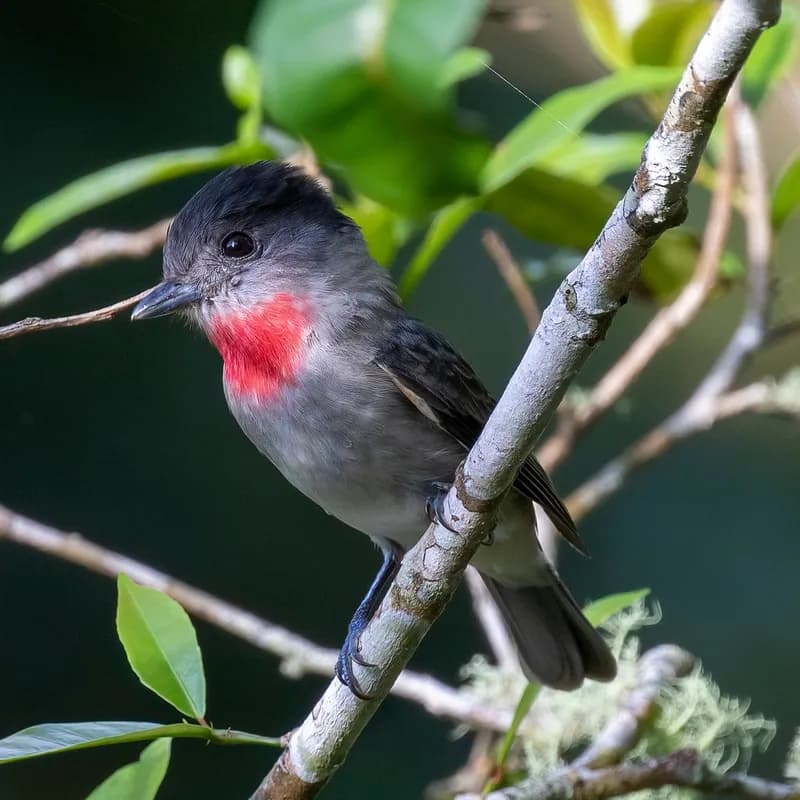
Photo: Wikimedia Commons
Overview
The Rose-throated Becard is one of the most coveted rarities for birders visiting the lower Rio Grande Valley. A tropical species that barely reaches the United States, it has maintained a small, erratic breeding presence in South Texas for decades — primarily in dense riparian woodland along the Rio Grande. The male's brilliant rose-pink throat patch against slate-gray plumage makes it one of the most striking small birds on the continent, but the species can be remarkably difficult to actually see. Birders often locate it first by its distinctive pendulous nest.
Identification
Males are distinctive: dark slate-gray above, paler gray below, with a large rounded head and a striking rose-pink throat patch that can appear almost luminous in good light. The bill is thick and slightly hooked — the becard head shape is distinctive, giving the bird a large-headed, compact appearance.
Females are browner and buffier, with a rusty crown, buffy underparts, and dark brownish upperparts — superficially resembling a large vireo. Both sexes tend to remain high in the canopy, making observation difficult. The call — a thin, descending whistle — is worth learning as a locating tool.
Habitat & Range
In South Texas, Rose-throated Becards occupy mature riparian forest — the tall cottonwood, willow, and ebony woodland that lines the Rio Grande and its resacas. They favor areas with a high, dense canopy where they move slowly through the upper levels in search of food.
Their U.S. presence is at the very northern edge of a range that extends through Mexico and Central America to Costa Rica. In Texas, nesting is irregular — some years pairs are present at established sites, other years absent. Arizona has also hosted occasional breeding records.
Behavior & Diet
Rose-throated Becards are slow, methodical foragers of the mid- to upper canopy, searching foliage for large insects, caterpillars, and small fruits. They are not particularly active birds and can be easily overlooked even when present. Patient scanning of the canopy is often required.
The nest is remarkable — a large, globular, pendulous structure of grass, bark strips, and plant fibers hanging from the tip of a high branch, with a side entrance hole. It can be 18–24 inches long and is often conspicuous long after the birds themselves have departed. Finding a nest is frequently the first indication that becards are present at a site.
Where to See in South Texas
Presence is irregular year to year — check local birding reports before visiting specifically for this species. The distinctive nest is often the easiest thing to find.
Best Time to See
Irregular — check eBird first — Rose-throated Becards are one of the most unpredictable South Texas specialties. When present, they are usually found at sites along the Rio Grande — Bentsen SP, Santa Ana NWR, and occasionally Salineño. The easiest way to locate a becard is to find its remarkable hanging nest: a bulky, globular structure suspended from the tip of a high branch and visible from a considerable distance. Local birding reports are the essential resource; when a pair is confirmed, word spreads quickly and the site is usually productive for weeks.
Conservation Status
IUCN: Least ConcernGlobally stable across its broad Latin American range. In South Texas, the tiny U.S. population is vulnerable to loss of mature riparian woodland — a habitat that has declined significantly along the Rio Grande due to clearing, invasive species, and reduced river flows.
Fun Fact
The becard's nest is so distinctive that it is frequently spotted by visitors who were not even looking for the bird — and its presence in a given year is often first announced on birding listservs not with a sighting, but with a report of the unmistakable hanging structure spotted high in a riverside tree.
In the News