South Texas · Summer Resident
Scissor-tailed Flycatcher
Tyrannus forficatus · Tijereta rosada
Summer Resident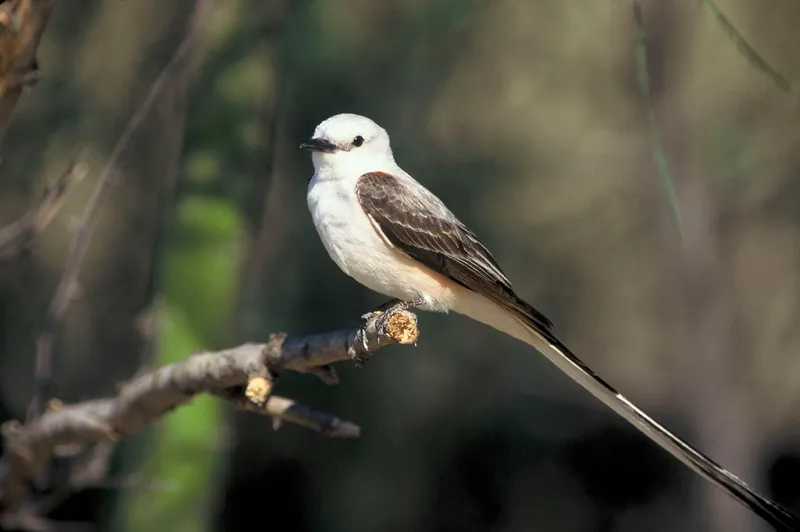
Photo: Wikimedia Commons
Overview
The Scissor-tailed Flycatcher is one of the most immediately recognizable and beloved birds in Texas — a pale, salmon-flanked flycatcher with an extraordinary forked tail that can exceed the length of its own body. It arrives in South Texas in early spring and becomes a conspicuous presence on utility wires, fence posts, and exposed perches across the region through summer. Oklahoma's state bird, but deeply associated with the Texas landscape. Spectacular aerial displays during courtship — diving, zigzagging, and opening that scissored tail — are among the finest aerial shows in North American birdwatching.
Identification
Unmistakable in adult plumage. Pale gray on the head, back, and breast; bright salmon-pink on the sides and flanks; white below. The tail — the defining feature — is deeply forked with extremely long outer feathers that are black above and white below, opening and closing in flight like scissors. Males have longer tail streamers than females. A concealed patch of red-orange at the base of the wings is visible during displays.
Immature birds have shorter tails and duller salmon coloring but still show the distinctive shape and pale gray-and-white plumage. No other bird in South Texas has remotely similar proportions.
Habitat & Range
Scissor-tailed Flycatchers are birds of open country — pastures, grasslands, agricultural fields, and roadsides with scattered trees, poles, or fences for perching. They avoid dense woodland but use isolated trees for nesting. In South Texas they are common across coastal prairie and farmland from spring through early fall.
The breeding range centers on Oklahoma, Texas, and Kansas. Birds winter from Mexico south through Central America. Migrants can be found throughout Texas, and large pre-migratory flocks sometimes form in fall — hundreds of birds roosting communally before heading south.
Behavior & Diet
An aerial insectivore, the Scissor-tailed Flycatcher sallies from a perch to catch large insects in flight: grasshoppers, beetles, dragonflies, and cicadas. It also drops to the ground occasionally to snatch prey. The long tail is used dynamically in flight — spread wide for braking and tight cornering while pursuing insects.
Courtship displays are elaborate: males perform zigzagging dives, rapid rolls, and aerobatic loops while fully opening the forked tail. Both sexes are aggressive in defense of the nest, readily chasing much larger birds.
Where to See in South Texas
South Padre Island Birding & Nature Center
South Padre Island
Laguna Atascosa National Wildlife Refuge
Rio Hondo
Coastal prairie roads, Cameron & Willacy counties
Coastal Bend
Present spring through fall; scan utility wires and fence posts along any open road in the Valley. Large communal roosts may form in September before migration.
Best Time to See
April through September — Scissor-tailed Flycatchers arrive in South Texas in early spring and depart by October. Peak visibility is May through August, when birds are established on territories and highly active. Any open road in Cameron or Willacy County with utility wires will typically have multiple birds perched in view. In September, watch for pre-migratory communal roosts of hundreds of birds gathering in riparian trees before heading south.
Conservation Status
IUCN: Least ConcernCommon and stable across its range. The species adapts well to agricultural landscapes and is not considered threatened. Some local declines have been noted in areas of intensive farming where large insects have become scarce.
Fun Fact
A male Scissor-tailed Flycatcher's tail streamers can reach 15 inches — roughly twice the length of the bird's body. Far from being a handicap, the tail is a precise aerodynamic tool: spread wide it acts as a brake and turning aid during insect-catching maneuvers, and its length correlates with breeding success.
In the News