Rio Grande Valley · Uncommon Resident
Tropical Kingbird
Tyrannus melancholicus · Tirano tropical
Uncommon resident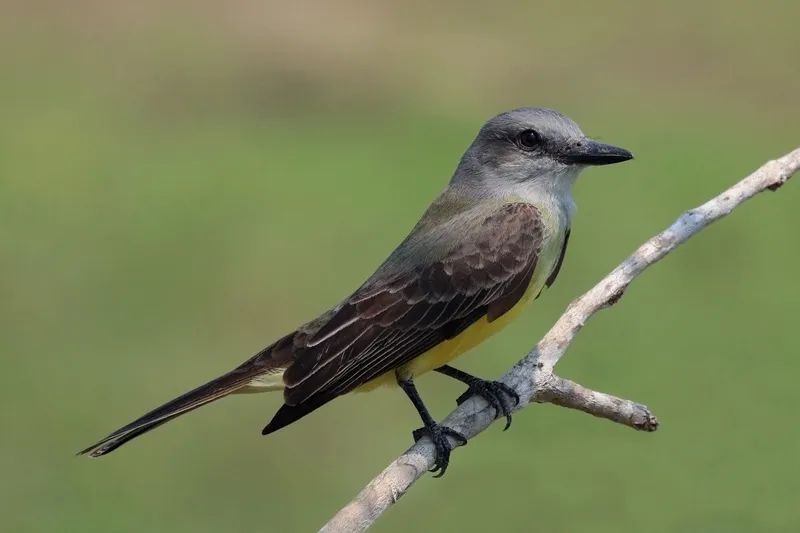
Photo: Wikimedia Commons
Overview
The Tropical Kingbird is a split-second identification challenge masquerading as a large yellow flycatcher. In the Rio Grande Valley it overlaps extensively with the virtually identical Couch's Kingbird, and the two species have puzzled birders since they were split into separate species in 1983. The call is the definitive separation: the Tropical gives a rapid, twittering pip-pip-pip, while the Couch's produces a rolling, nasal breeeer. Knowing this distinction is the price of admission to one of the more interesting identification problems in North American birding.
Identification
A large, heavy-billed flycatcher (22 cm / 8.5 in) with a gray head, olive-green back, bright yellow underparts, and a dark, moderately notched tail. Nearly identical to Couch's Kingbird in all plumage features. The tail shape is the most-cited visual distinction: the Tropical has a slightly more notched tail with narrower outer feathers — both differences are subtle and variable enough to be unreliable in the field.
In practice, the call is definitive: the Tropical Kingbird gives a high, rapid twitter (pip-pip-pip-pip), while Couch's gives a drawn-out nasal breeer or breeert. Silent birds photographed without a recording are best logged as Tropical/Couch's Kingbird — an honest acknowledgment that the identification is unresolvable without the voice.
Habitat & Range
Open areas near water, woodland edges, roadsides, and towns — essentially the same broad habitat as Couch's Kingbird. In the Valley, the Tropical is considerably less common than Couch's and tends to favor areas closer to water or more open habitat near the river corridor.
The U.S. range is essentially limited to South Texas as an uncommon resident and occasional visitor elsewhere along the Gulf Coast. The broader range is enormous — from Mexico and Central America through virtually all of South America to northern Argentina — making it one of the most widespread flycatchers in the world.
Behavior & Diet
Catches insects in aerial sallies from exposed perches, much like other kingbirds. Aggressive toward intruding raptors, harassing hawks and falcons much larger than itself in swooping attacks near the nest. Diet is primarily flying insects, supplemented by some berries during certain seasons.
Nesting in South Texas is less well documented than Couch's Kingbird; the species likely nests in open trees near water bodies. The best time to confirm identification is whenever the bird calls — which, fortunately, kingbirds do frequently and loudly throughout the day.
Where to See in South Texas
Best Time to See
April through October — Tropical Kingbirds are breeding-season visitors to South Texas, present from spring through fall. The difficulty is separating them from the very similar Couch's Kingbird, which is far more common: listen carefully for the distinctive call (a rapid, chittering trill vs. Couch's nasal breeeer). Check open perches near water and utility lines at Bentsen and Estero Llano Grande, and check eBird for recent sightings before visiting.
Conservation Status
IUCN: Least ConcernPopulations are stable across the enormous global range. In South Texas, the relatively small resident population makes any local habitat loss potentially significant. The species benefits from open areas near water — a habitat type that persists in the Valley's network of protected reserves.
Fun Fact
The Tropical Kingbird and Couch's Kingbird were considered a single species until 1983, when researchers showed they were genetically distinct with calls too different to be geographic variation. Even today, silent birds in South Texas are sometimes logged as “Tropical/Couch's Kingbird” by careful observers — an acknowledgment that some identification problems simply cannot be resolved without hearing the bird.
In the News