Rio Grande Valley · Year-round Resident
Ferruginous Pygmy-Owl
Glaucidium brasilianum · Tecolotito ferruginoso
Resident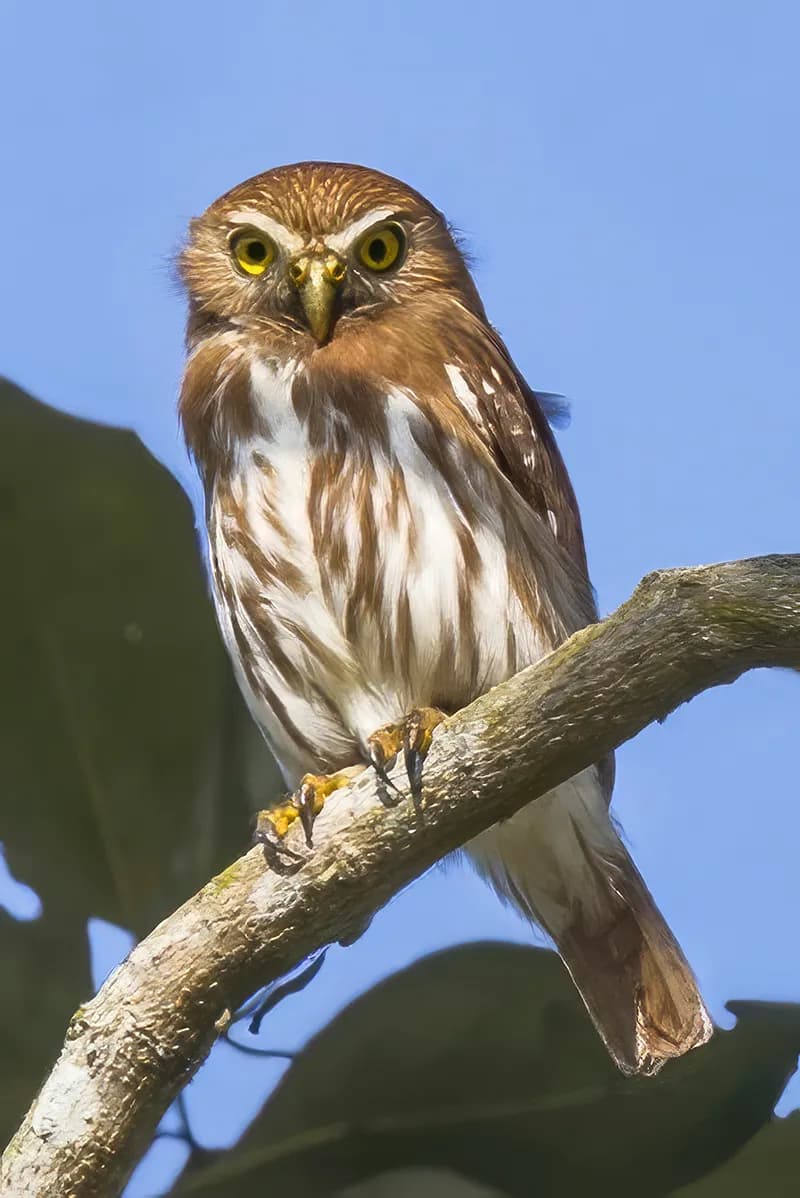
Photo: Wikimedia Commons
Overview
The Ferruginous Pygmy-Owl is tiny, fierce, and one of the most sought-after birds in the Rio Grande Valley. Barely larger than a sparrow, this largely diurnal owl hunts birds, lizards, and large insects with an aggression completely out of proportion to its size — it will attack prey several times its own weight. It is perhaps best located by the commotion it creates: when discovered by songbirds, the local population mobs the owl with alarm calls and swooping attacks, producing a noisy avian commotion audible from some distance.
Identification
A very small owl (15–17 cm / 6–6.5 in) with a relatively long, banded tail and no ear tufts — the latter distinguishing it from the similar-sized Eastern Screech-Owl. Plumage varies from rufous (reddish-brown) to gray-brown above, with white underparts heavily streaked dark brown. The facial disc is poorly defined; the eyes are yellow. The back of the head shows two black spots with pale edges — “false eyes” that give the impression of a face looking both forward and backward.
The call — a monotonous series of whistled toots at roughly two per second — is the key to finding one. Birds respond readily to imitations of this call, and the response of scolding songbirds often reveals the owl's location even before it is heard directly.
Habitat & Range
Dense Tamaulipan thornscrub and riparian woodland in South Texas, particularly areas with large trees or cacti containing old woodpecker cavities for nesting. Also uses woodland edges and areas with scattered trees. In the U.S., limited to the Lower Rio Grande Valley with a separate population in southern Arizona and New Mexico.
The broader range extends from the southwestern U.S. and Mexico through Central America to Bolivia and central Argentina. Resident throughout its range.
Behavior & Diet
Despite its tiny size, the Ferruginous Pygmy-Owl is an aggressive predator: it takes lizards, small snakes, large insects, and birds up to its own size or slightly larger. It is largely diurnal — most active in the early morning and late afternoon — making it far more findable than most owls.
Nests in old woodpecker cavities in trees and fence posts; nest cavities are also used for nighttime roosting. Breeding runs from March to June in South Texas. The male calls persistently from perches near the nest cavity, and this calling is the most reliable way to locate a breeding pair.
Where to See in South Texas
Best Time to See
Year-round, but the Ferruginous Pygmy-Owl is easiest to find during the breeding season (March–June), when males call persistently from within dense thornscrub early in the morning — sometimes even before dawn. Listen for a rapid, hollow toop toop toop repeated dozens of times. Salineño Wildlife Preserve, Santa Ana NWR, and the thornscrub tracts around Bentsen are the most reliable sites. Visiting with a local birding guide significantly improves success rates for this challenging-to-spot species.
Conservation Status
IUCN: Least ConcernLeast Concern globally, but the Texas population is locally sensitive to habitat loss. Heavy clearance of native thornscrub for agriculture and development reduces nesting and foraging habitat. Listed as a Species of Greatest Conservation Need in the Texas State Wildlife Action Plan.
Fun Fact
The two black spots on the back of the Ferruginous Pygmy-Owl's head are not decorative — they function as “false eyes,” making the owl appear to face in two directions simultaneously. Predators approaching from behind are confronted with what looks like a face, which may deter attack. This false-eye feature appears independently in several small owl species across the world.
In the News