Rio Grande Valley · Year-round Resident
Green Jay
Cyanocorax yncas · Chara verde
Resident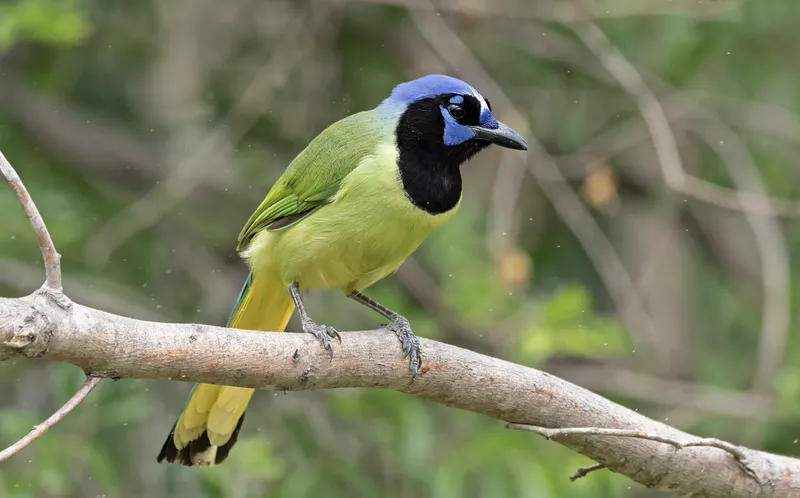
Photo: Wikimedia Commons
Overview
The Green Jay is one of the most sought-after birds in the United States — and with good reason. Nowhere north of the Rio Grande does this tropical jay live as a year-round resident, making the Rio Grande Valley the only place in the country to reliably see one. Brilliant in every sense, it combines electric plumage with a bold, curious personality and a surprisingly complex social life.
Identification
Unmistakable at rest: vivid grass-green on the back, wings, and belly; cobalt blue on the head, nape, and throat; black on the face and breast; and a bright yellow lower belly. The bill is black and sturdy — a corvid's tool. In flight, watch for the distinctive yellow outer tail feathers flashing as the bird banks through the canopy.
Size is roughly that of a Blue Jay (about 27 cm / 10.5 in), with a long tail and strong legs built for moving through dense thornscrub. Sexes look alike. Juveniles are duller and show less distinct facial patterning, but are still easily identified by shape and the characteristic green plumage.
Habitat & Range
In South Texas, Green Jays occupy Tamaulipan thornscrub — the dense, spiny subtropical brushland of the Rio Grande Plain — as well as riparian woodland along the Rio Grande and its resacas. They adapt readily to parks, nature centers, and suburban gardens with mature native vegetation.
The U.S. range is essentially the Lower Rio Grande Valley, from Starr County east to Hidalgo and Cameron counties. The species is far more widespread in Mexico, Central America, and South America, where it inhabits a range of tropical and subtropical forest types.
Behavior & Diet
Green Jays are omnivores: insects, spiders, small lizards, berries, seeds, and the occasional egg or nestling. They visit feeders readily, especially those offering sunflower seeds or fruit. Notably, they are one of the few North American birds documented using tools — individuals have been observed using sticks to pry bark from trees in search of insects.
They breed cooperatively: offspring from a previous year remain with the family group and help raise the next clutch, typically laid between March and June. Family groups of four to six birds are the norm, and the birds communicate with a varied repertoire of calls — harsh rattles, soft churring notes, and surprisingly musical whistles.
Where to See in South Texas
Best Time to See
Year-round— Green Jays are permanent residents of the Rio Grande Valley and don't migrate. They are equally visible in any season, but November through March is prime time for Valley birding overall, and feeders at Bentsen-Rio Grande Valley State Park and Santa Ana NWR reliably draw jays every morning. Family groups remain together through the summer, making June and July productive for seeing juveniles alongside adults.
Conservation Status
IUCN: Least ConcernThe species is stable across its broad Latin American range. In South Texas, habitat loss from brush clearing and agriculture is the primary local pressure. Protected reserves in the RGV — Santa Ana, Bentsen, Resaca de la Palma — are critical refugia for the U.S. population.
Fun Fact
Green Jays have been documented using sticks as tools to extract insects from bark — placing them among a small group of birds, alongside crows and woodpecker finches, known to use objects as implements in the wild.
In the News