Rio Grande Valley · Summer Resident
Groove-billed Ani
Crotophaga sulcirostris · Garrapatero piquiliso
Summer resident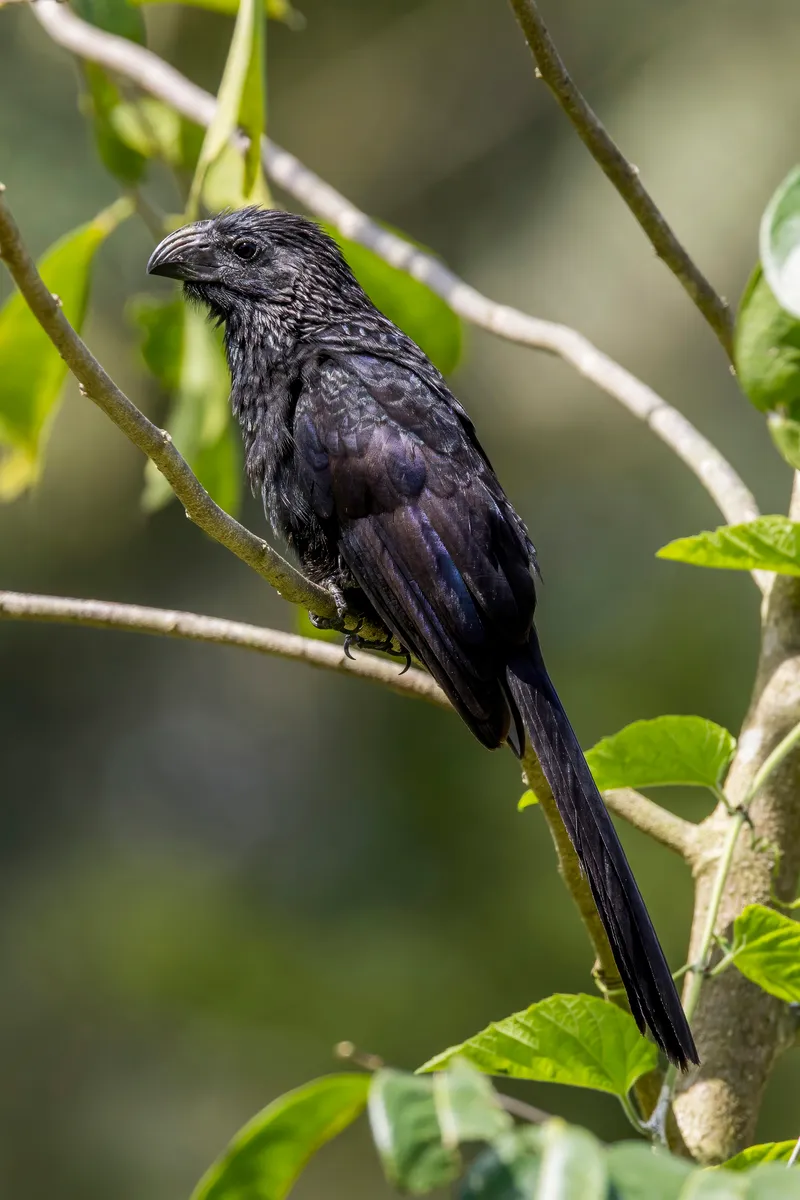
Photo: Wikimedia Commons
Overview
The Groove-billed Ani is one of those birds that immediately announces itself: glossy black with a comically oversized ridged bill, loose iridescent plumage, and a long floppy tail, it moves through thornscrub in small flocks that call constantly with a liquid, rising ti-coo. A member of the cuckoo family, it is a common summer resident in the Rio Grande Valley and one of the first birds many visitors learn to identify by sound — the liquid call carries well through dense brush. Anis are notoriously social, nesting communally and often roosting in tight groups.
Identification
All black (32–36 cm / 12.5–14 in) with iridescent green-purple gloss, a long graduated tail, and a large, laterally compressed bill with parallel horizontal grooves on the upper mandible — the feature that gives the species its name. The plumage often looks loose and somewhat disheveled. The tail is frequently held cocked or pumped when the bird walks.
The smooth-billed Ani — a closely related species — is extremely rare in South Texas and best distinguished by the bill: the Smooth-billed has a rounded, curved culmen ridge without grooves, while the Groove-billed shows parallel grooves along the upper mandible visible at moderate range. In the Valley, any ani is almost certainly Groove-billed.
Habitat & Range
Open thornscrub, woodland edges, agricultural land with hedgerows, and disturbed habitats near water. The Groove-billed Ani is remarkably tolerant of human-modified landscapes and is regularly found in suburban areas, farmland edges, and along roadsides where brushy cover is available.
In the U.S., primarily a summer resident in South Texas, with most birds arriving April and departing October. A small number may overwinter in the Valley in mild years. The range extends from South Texas through Central America and into northwestern South America.
Behavior & Diet
Forages in groups, often following cattle or other large animals to catch insects flushed by their movement — one of the behaviors that earns the bird its Spanish name, garrapatero (tick-eater). Diet includes large insects, lizards, frogs, and occasionally ticks picked from livestock. The flight is weak and undulating, with a few rapid wingbeats followed by a glide.
Communal nesting is the most remarkable aspect of the species' biology: groups of 2–4 pairs build a single large nest of sticks together, and all females lay in the same nest. All adults share incubation and chick-rearing duties. Communal nests can contain 10 or more eggs.
Where to See in South Texas
Best Time to See
May through October — Groove-billed Anis are summer visitors to South Texas, arriving from Mexico in late April and departing by November. The peak period is June through September, when family groups are active in dense brushy vegetation near water. Estero Llano Grande State Park, Santa Ana NWR, and the resaca edges near Brownsville are reliable spots. Anis are noisy and conspicuous when present — listen for a liquid, gurgling call and look for the distinctive bill shape.
Conservation Status
IUCN: Least ConcernCommon and stable throughout its range. The species' tolerance of disturbed and agricultural land has helped it maintain and expand populations in areas where native habitat has been reduced. In South Texas, population trends appear stable.
Fun Fact
Communal nesting in anis has an interesting evolutionary logic: each female in the group buries the eggs of other females under new nest material before laying her own on top. This means eggs laid last are on top — closest to warmth — and hatch first. The first-hatching female's chicks are therefore the most likely to survive. The result is a subtle arms race within the cooperative group that biologists have studied as a textbook example of conflict within cooperation.
In the News