Rio Grande Valley · Rare Resident
Clay-colored Thrush
Turdus grayi · Zorzal pardo
Rare resident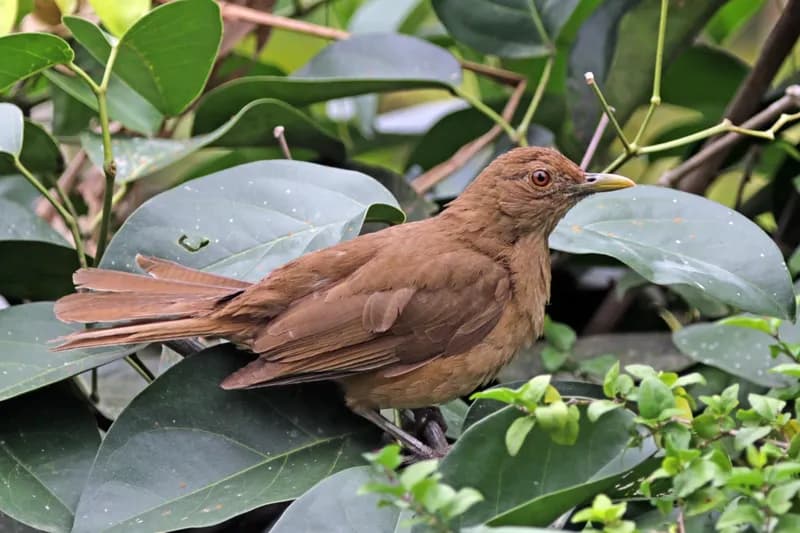
Photo: Wikimedia Commons
Overview
The Clay-colored Thrush is the national bird of Costa Rica — a plain, warm brown thrush with a magnificent voice. It has established a small breeding population in the Lower Rio Grande Valley, primarily around Bentsen SP and Quinta Mazatlán, having spread north from Mexico. To a casual observer it resembles a washed-out American Robin; to a birder, it is a genuinely exciting find — a neotropical species that has colonized the United States within living memory. The rich, melodious song — a series of rising and falling phrases repeated with unhurried confidence — is one of the finest thrush songs in the Americas.
Identification
A large thrush (23–27 cm / 9–10.5 in) with uniformly warm brown-gray upperparts, paler brown underparts, a buffy-white throat with faint brown streaking, and a yellowish-green bill. No bold markings anywhere — the overall impression is of a robustly built, plain brown bird. The eye is reddish-brown.
Closest in appearance to an American Robin with the rust stripped off. The robin has an orange breast; the Clay-colored Thrush is uniformly warm brown below. The yellowish-green bill (not yellow-orange like the robin's) is the most useful mark at a glance. The song — heard most often in spring and early summer mornings — is the most reliable identification cue.
Habitat & Range
Gardens, woodland edges, riparian forest, and dense thornscrub in the Rio Grande Valley. The species is closely associated with areas of shade and fruiting trees in both wild and urban settings — it adapts remarkably well to suburban parks and residential gardens. Bentsen SP and Quinta Mazatlán, with their mature tree canopy, are the most reliable sites.
Native range is from Mexico through Central America to Colombia. First recorded breeding in Texas in the 1990s; now a rare but annual resident in the Valley, with the breeding population slowly growing.
Behavior & Diet
Forages on the ground for earthworms, insects, and small fruits, often hopping through leaf litter in the manner of a typical thrush. Diet is strongly seasonal: invertebrates dominate in spring and summer; fruit (figs, berries, and other soft fruits) becomes important in fall and winter. Bold and confiding in gardens where it is not disturbed.
The song is typically delivered from a concealed or elevated perch in the canopy, often in the hour after dawn and sometimes continuing through the morning. The song season extends from late winter through early summer in South Texas.
Where to See in South Texas
Best Time to See
Winter (November through March) is when Clay-colored Thrushes are most reliably found in South Texas as rare visitors, though records occur in any month. The species is an established breeding resident in the Brownsville area and at Quinta Mazatlán, where a small population has taken hold. Check recent eBird reports for current sightings. The Brownsville cemetery and the grounds of Quinta Mazatlán are the most historically reliable spots for the small local breeding group.
Conservation Status
IUCN: Least ConcernAbundant and expanding throughout its range, benefiting from its adaptability to human-modified landscapes. In South Texas, the small breeding population is slowly increasing as birds colonize suitable habitat in parks and residential areas with mature trees. Conservation of riparian woodland and urban green spaces benefits the species.
Fun Fact
The Clay-colored Thrush is the national bird of Costa Rica — not because it is particularly colorful or rare, but because it is ubiquitous and beloved, its rich song woven into the soundscape of every Costa Rican town and village. Costa Ricans chose it for the very quality that birders in South Texas appreciate: that extraordinary voice pouring from an inconspicuous brown bird. In both places, you hear it before you see it.
In the News