Rio Grande Valley · Year-round Resident
Olive Sparrow
Arremonops rufivirgatus · Gorrión oliváceo
Resident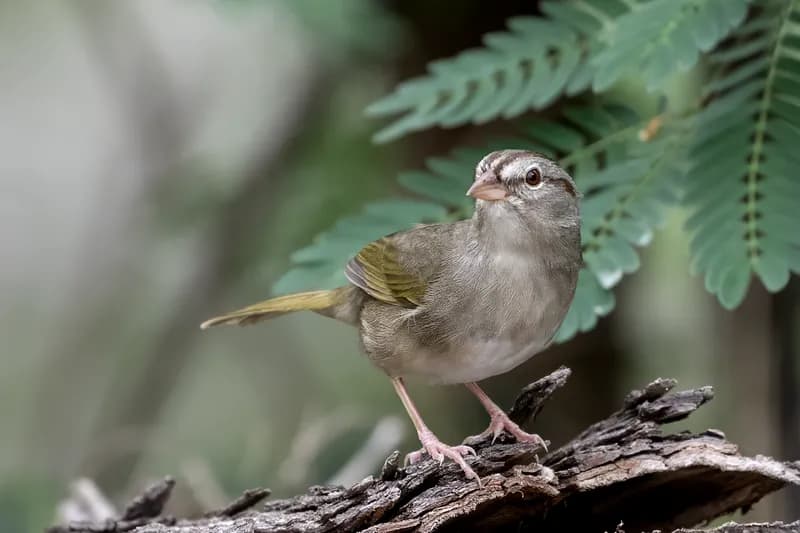
Photo: Wikimedia Commons
Overview
The Olive Sparrow is as much a part of the Tamaulipan thornscrub soundtrack as the rustling of dry leaves. Drab and skulking, it rarely ventures far from the deep shade of dense brush, and most visitors hear its dry, accelerating trill long before they catch a glimpse. It is one of the characteristic endemic birds of the lower Rio Grande Valley — the northern edge of a range that extends south through Mexico and Central America — and a quiet but dependable presence at nearly every RGV nature reserve.
Identification
A medium-sized sparrow, plain and olive-toned throughout — olive-green above, buffy white below — with two bold brown lateral crown stripes framing a pale central crown stripe. The face shows a faint brown eye stripe and a whitish supercilium, giving the bird a clean but understated expression. There are no wing bars, streaking on the breast, or other bold markings.
Roughly the size of a Song Sparrow. Sexes look alike. The plain, unstreaked underparts and olive wash to the upperparts distinguish it from any other sparrow regularly found in the Valley. The most reliable identification cue is the song: a series of dry chips that accelerates into a rapid trill, delivered persistently from within dense cover.
Habitat & Range
In South Texas, Olive Sparrows are tied almost exclusively to dense Tamaulipan thornscrub — the spiny, subtropical brushland of mesquite, acacia, brasil, granjeno, and cactus that characterizes the Rio Grande Plain. They strongly favor the shadiest, most tangled understory and avoid open ground. Gardens with mature native plantings occasionally attract them to the edges of towns.
The U.S. range is essentially confined to the lower Rio Grande Valley, from Webb County east to Cameron County. The species is far more widespread in Mexico and through Central America to Costa Rica, inhabiting a variety of dry scrub and forest-edge habitats.
Behavior & Diet
Olive Sparrows forage almost entirely on the ground beneath dense cover, scratching through leaf litter for seeds, berries, and invertebrates — a double-scratch with both feet simultaneously, the classic sparrow technique. They are remarkably reluctant to fly, preferring to run into brush when disturbed rather than take wing.
They are year-round residents and do not migrate. Pairs maintain territories and breed from March through August, building a domed grass nest low in a shrub or cactus. Males sing persistently in spring and early summer from a perch just inside the brush edge — their clearest concession to visibility. Patience and stillness near a singing bird are usually rewarded with a brief but satisfying look.
Where to See in South Texas
Santa Ana National Wildlife Refuge
Alamo
Salineño Wildlife Preserve
Salineño
Bentsen-Rio Grande Valley State Park
Mission
Resaca de la Palma State Park
Brownsville
Listen for the accelerating chip-trill from dense brush. Stand quietly near a singing bird and scan the shrub edges — they will occasionally pop up briefly.
Best Time to See
March through June — Olive Sparrows are year-round residents but are most reliably found during the breeding season when males sing from exposed perches within or just above dense brush. The accelerating chip-trill song is the easiest detection method. Bentsen-Rio Grande Valley SP, Santa Ana NWR, and Resaca de la Palma have good populations. Stand quietly near a thicket edge and wait — they will occasionally emerge. Pishing can coax them into brief view.
Conservation Status
IUCN: Least ConcernThe species is stable across its broad range in Mexico and Central America. In South Texas, ongoing habitat loss from brush clearing, agriculture, and development is the primary local pressure. Protected reserves in the Rio Grande Valley — Santa Ana, Bentsen, Resaca de la Palma — are critical for maintaining the U.S. population.
Fun Fact
Despite being one of the most common birds in the Valley's thornscrub, the Olive Sparrow is routinely missed by visiting birders — not because it's rare, but because it simply refuses to come out. Learning its song is the single most effective upgrade a visiting birder can make before arriving in the Rio Grande Valley.
In the News