Rio Grande Valley · Year-round Resident
Long-billed Thrasher
Toxostoma longirostre · Cuitlacoche piquilargo
Resident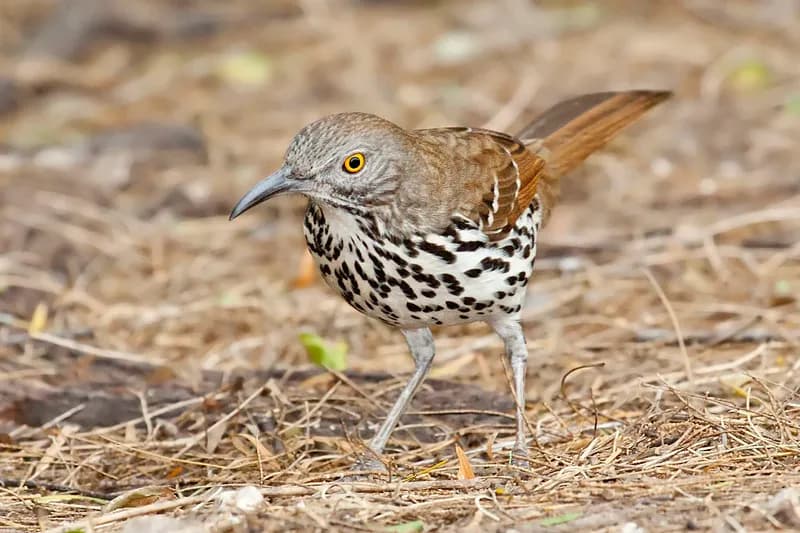
Photo: Wikimedia Commons
Overview
The Long-billed Thrasher is the Valley's own thrasher — nearly endemic to the Tamaulipan thornscrub of South Texas and northeastern Mexico, and rarely found outside it. It is a common year-round resident in dense brush, where it forages by tossing leaf litter with its long, curved bill in the manner of its relatives. Its song is rich, varied, and almost ceaseless in spring — a rival to the mockingbird in output if not always in polish. Given good habitat and patience, it is one of the more reliably found resident birds at any Valley hotspot.
Identification
A large, long-tailed thrasher (26–29 cm / 10–11.5 in) with brown upperparts, white underparts with heavy dark brown streaking on breast and flanks, a long strongly downcurved bill, and bright orange eyes. The face shows a strong buffy-white supercilium and malar stripe bordering a dark cheek. Two white wingbars are visible on the folded wing.
The Brown Thrasher — which occasionally wanders into the Valley — is the most similar species: it has a shorter, less strongly curved bill, streaked (not spotted) breast pattern, and yellow (not orange) eyes. The Long-billed's heavy spotting, orange eye, and very long bill are diagnostic within the Valley's resident species.
Habitat & Range
Dense Tamaulipan thornscrub and woodland edges in South Texas — the same brushy habitat favored by Olive Sparrow, White-tipped Dove, and Audubon's Oriole. Unlike the mockingbird, it strongly prefers thick, tangled cover and tends to stay inside the brush rather than singing from exposed perches. Areas with deep leaf litter under dense brush produce the best foraging conditions.
Range is essentially restricted to South Texas and the adjacent Mexican states of Tamaulipas and Nuevo León. Year-round resident throughout; does not migrate.
Behavior & Diet
Forages primarily on the ground by raking leaf litter aside with the long bill in a side-to-side sweeping motion, uncovering beetles, ants, grasshoppers, spiders, and other invertebrates. Also takes berries and small fruit, which become a larger component of the diet in fall and winter.
The song is delivered from an exposed perch at the top of a shrub or tree and consists of a long, varied series of musical phrases, many repeated two or three times — structurally similar to the mockingbird but with a lower pitch and more liquid quality. Singing is most intense February through June.
Where to See in South Texas
Best Time to See
February through June — Long-billed Thrashers are year-round residents of Tamaulipan thornscrub, but spring is by far the best time to see them. Males sing persistently from exposed perches at the tops of shrubs from February onward, making them far easier to locate than at any other season. Bentsen-Rio Grande Valley SP, Santa Ana NWR, and Sabal Palm Sanctuary all hold resident populations. At other times of year, listen for the song from dense brush and wait at edges.
Conservation Status
IUCN: Least ConcernLeast Concern, with a stable population in its limited range. The species' near-endemic restriction to Tamaulipan thornscrub makes it sensitive to large-scale clearing of this habitat type for agriculture and development. Brush retention on private lands is important for long-term population stability.
Fun Fact
Like the Northern Mockingbird, the Long-billed Thrasher is a mimic — but a subtle one. It borrows phrases from other species and works them into its own extended song, often repeating each phrase two or three times before moving to the next. Careful listeners have identified fragments of Olive Sparrow, White-eyed Vireo, and other thornscrub residents woven into the thrasher's song — a practice of auditory sampling that has no obvious function but continues throughout its long singing season.
In the News