Rio Grande Valley · Year-round Resident
Audubon's Oriole
Icterus graduacauda · Bolsero de Audubon
Resident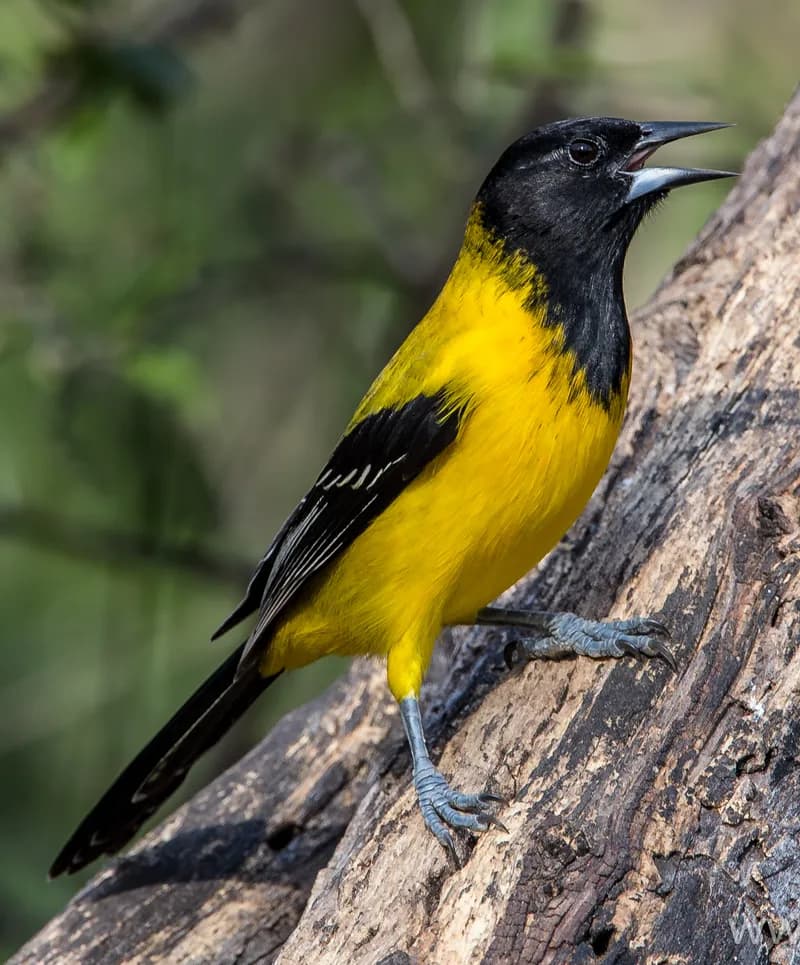
Photo: Wikimedia Commons
Overview
Audubon's Oriole is, by any measure, one of the most beautiful birds in South Texas — a large oriole with a lemon-yellow body, jet-black hood, back, wings, and tail, and the slow, mournful whistle of a bird that seems to be composing as it goes. It is shy by oriole standards, preferring to remain deep in thornscrub or riparian woodland rather than advertising itself in the open like the showy Altamira. Named for John James Audubon — though Audubon himself never saw one — it is nearly endemic to the Tamaulipan thornscrub of South Texas and northeastern Mexico and is a target species for visiting birders throughout the year.
Identification
A large oriole (22–24 cm / 8.5–9.5 in) with a distinctive pattern: lemon-yellow body contrasting with entirely black head, back, wings, and tail. The wings show faint yellowish edging on the wing coverts. Both sexes are similar; juveniles are duller, with an olive-yellow tone replacing the adult's bright lemon and greenish-black on the head.
The black back distinguishes Audubon's from the Scott's Oriole (yellow back, black chest and head) and the Altamira Oriole (orange and black, never all-black upperparts). The song — a series of slow, clear, whistled notes, each slightly different, delivered unhurriedly — is the most distinctive voice in the Valley's oriole guild.
Habitat & Range
Dense Tamaulipan thornscrub and riparian woodland in South Texas and adjacent Mexico. Unlike the Altamira Oriole, which occupies woodland edges and suburban trees, Audubon's strongly prefers the interior of dense brush — it is a bird of the thicket, not the edge. Areas with large trees mixed into thornscrub produce the best habitat. The species does not migrate and is a year-round resident throughout its range.
U.S. range is essentially limited to the Lower Rio Grande Valley and adjacent areas of South Texas. The Mexican range extends south through Tamaulipas and Nuevo León to San Luis Potosí. Nowhere common; patchy and local even within its restricted range.
Behavior & Diet
Forages for insects, spiders, and fruit within the vegetation canopy, moving deliberately through the interior of dense shrubs and trees. Less aerial than some orioles; less likely to hawk insects in open air. Readily comes to feeders offering orange halves and grape jelly where these are set out near dense cover.
Nesting occurs in spring and summer; the nest is a woven hanging pouch typical of orioles, suspended from a branch in dense brush. Both sexes sing — an unusual trait in orioles; the female's song is quieter but structurally similar to the male's deliberate whistle series. Pairs appear to be monogamous and may use the same territory across multiple years.
Where to See in South Texas
Best Time to See
Year-round — Audubon's Orioles are permanent residents of dense South Texas brush, but they are secretive and far more often heard than seen. The best window is March through June, when males sing persistently from within thickets, allowing you to locate and patiently observe them. Salineño Wildlife Preserve and the dense thornscrub around Santa Ana NWR are the most reliable sites. Patience and a willingness to stand quietly near a singing bird are the main requirements.
Conservation Status
IUCN: Least ConcernLeast Concern globally but listed as a Species of Greatest Conservation Need in Texas. The species' restricted range, low densities, and dependence on dense native thornscrub make it vulnerable to large-scale habitat clearing. Preservation of intact thornscrub on both public and private lands is the most critical conservation action for this species.
Fun Fact
Audubon's Oriole was formerly called the “Black-headed Oriole” — a descriptive name that was changed in 1983 to honor John James Audubon. The irony is that Audubon himself apparently never observed the species alive; the original description was based on a specimen collected in northeastern Mexico. In South Texas, it is one of the few birds named for Audubon that he may never have encountered in the field.
In the News