Rio Grande Valley · Year-round Resident
Altamira Oriole
Icterus gularis · Bolsero de Altamira
Resident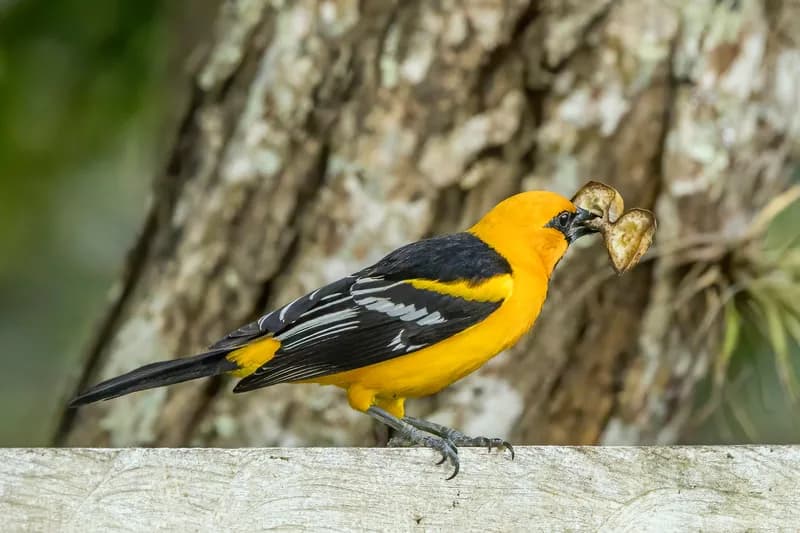
Photo: Wikimedia Commons
Overview
The Altamira Oriole is the largest oriole in the United States, and South Texas is the only place in the country where it lives as a year-round resident. Named for the town of Altamira in Tamaulipas, Mexico, where the species was first described, it is a bird of tropical riparian forest that reaches the very northern edge of its range in the Rio Grande Valley. Deep flame-orange and jet black, it is one of the most visually striking birds in North America — and its pendulous, woven nest is among the most extraordinary structures any bird builds.
Identification
Adults are a rich, deep orange — a richer, darker tone than the similar Hooded or Baltimore Oriole — with a solid black back, wings, tail, and face extending from the lores through the throat. A single bold white wing bar breaks up the dark wing. The bill is long, slightly decurved, and bluish-gray at the base. Both sexes share the same pattern, with females slightly duller and the black less saturated.
Size is the most reliable first impression: at about 24 cm (9.5 in) it is noticeably larger and longer-billed than any other oriole in Texas. Immatures show olive-yellow tones with a dusky face and may suggest a large female Orchard Oriole, but the size and bill shape are distinctive. The song — a series of rich, slurred whistles — is loud and carries well through riparian canopy.
Habitat & Range
In South Texas, Altamira Orioles favor tall riparian forest along the Rio Grande and its resacas, particularly where large native trees — ebony, anacua, Texas ebony, and sabal palm — provide canopy for nesting and foraging. They adapt readily to shaded parks, nature center grounds, and suburban streets with mature trees, making them unusually easy to find in developed areas of the Valley.
The U.S. breeding range is essentially the lower Rio Grande Valley from Starr County east to Cameron County. The species is widespread from northeastern Mexico through Central America to northwestern Costa Rica, inhabiting tropical deciduous and semi-evergreen forest, forest edges, and open woodland with scattered trees.
Behavior & Diet
Altamira Orioles are omnivores, taking insects and spiders gleaned from foliage, ripe fruit, and nectar. They visit feeders reliably for orange halves, grape jelly, and sugar-water — Bentsen State Park and Santa Ana NWR both maintain feeders where they are near-daily visitors. Foraging takes place mostly in the canopy and mid-story, but birds will descend to lower vegetation for fruit.
The nest is the species' most remarkable feature. The female weaves a hanging basket of plant fibers, bark strips, grasses, and Spanish moss over several weeks, producing a pouch that typically hangs 25 to 65 cm (10 to 26 inches) from a branch tip. Pairs are monogamous and often return to the same territory year after year, sometimes building a new nest adjacent to an old one. Breeding runs from April through July in South Texas.
Where to See in South Texas
Best Time to See
Year-round — Altamira Orioles are permanent residents of the Rio Grande Valley. They are easiest to find during the breeding season (April through July), when males sing persistently and the distinctive hanging nests are visible before the leaves fully fill in. Bentsen-Rio Grande Valley State Park and Santa Ana NWR both have reliable territory pairs. Visiting early morning in spring maximizes chances of seeing males in active song display.
Conservation Status
IUCN: Least ConcernThe species is stable across its broad Latin American range. In South Texas, the main pressure is loss and fragmentation of riparian forest — the tall native trees the species depends on for nesting. The network of protected reserves along the Rio Grande (Bentsen, Santa Ana, Resaca de la Palma) is essential to sustaining the U.S. population.
Fun Fact
The Altamira Oriole's nest is one of the longest woven structures built by any bird in North America — a hanging pouch that can reach 65 cm (26 inches), longer than a standard ruler. The female constructs it almost entirely alone from plant fibers, taking weeks to complete the intricate basket before laying her eggs inside.
In the News