Upper Rio Grande · Rare Resident
White-collared Seedeater
Sporophila morelleti · Semillero de collar
Rare Resident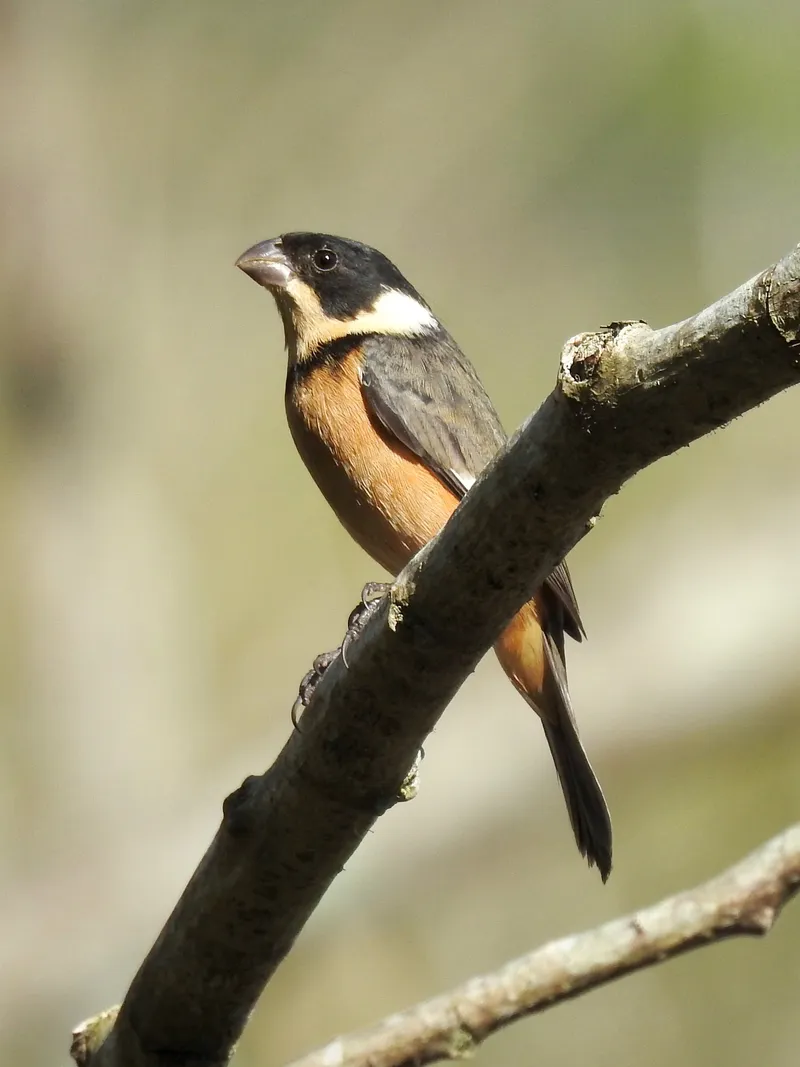
Photo: Wikimedia Commons
Overview
The White-collared Seedeater is one of the most sought-after birds in the United States — a tiny, candy-colored finch at the very northern edge of a range that extends through Central America. In South Texas it is a rare, local resident along the upper Rio Grande, primarily in tall riparian grass and cane thickets near the river. Numbers fluctuate year to year, and finding the species requires patience and timing. Salineño is consistently the most reliable U.S. site. A singing male in the Rio Grande cane is a genuine Texas birding milestone.
Identification
A tiny finch (4.5 inches) with a round head, short heavy bill, and chunky body. Males are distinctive: black cap, back, and wings; white throat; white collar across the upper breast; buffy-white underparts; white wing bars. The bill is thick and rounded at the tip — typical of seed-crackers. Females are plain brownish-buff with wing bars and faint streaking, much less distinctive.
Males give a high, sweet, warbling song — surprisingly melodious for such a small bird. Females and immatures are best located by associating with males or by searching cane edges where the species forages for grass seeds.
Habitat & Range
In South Texas, White-collared Seedeaters inhabit tall grass and cane (Arundo donax) thickets along the Rio Grande — particularly the transition zone where cane meets lower shrubby vegetation. The birds forage for grass seeds at the base of cane and in adjacent weedy areas.
The U.S. population is restricted to a narrow stretch of the Rio Grande in Webb and Zapata counties. The species ranges widely through Mexico and Central America south to Panama, where it is locally common in grassy and weedy habitats.
Behavior & Diet
White-collared Seedeaters are granivores, feeding almost exclusively on small grass seeds — clinging to seed heads and extracting seeds with the specialized short, rounded bill. They forage low in cane and grass, often disappearing into dense vegetation and remaining invisible for long periods.
Males sing persistently from exposed perches atop cane stems — the best way to locate the species. Outside of breeding season, small flocks may form, and birds can be found in mixed-species flocks with other small finches and sparrows at weedy margins.
Where to See in South Texas
Check local eBird reports before making a special trip — the species is irregular and numbers vary by year. Listen for the sweet warbling song along the riverbank cane at Salineño.
Best Time to See
May through August — White-collared Seedeaters are most reliably found during the breeding season when singing males perch atop cane stems at Salineño Wildlife Preserve. Check current eBird reports before making a dedicated trip, as the U.S. population fluctuates and the birds can be scarce or absent even at known sites. The sweet, rolling song is distinctive and audible from some distance; listen along the rio Grande riverbank cane first, then search for the singer.
Conservation Status
IUCN: Least ConcernStable across its broad Latin American range. The tiny U.S. population in Texas is at the range edge and is sensitive to habitat changes along the Rio Grande. Loss or spraying of river-edge cane habitat directly impacts the few sites where this species occurs in the U.S.
Fun Fact
The White-collared Seedeater has one of the most melodious songs of any bird its size in North America — a rich, rolling warble that sounds too large to come from such a small body. Males sing from cane tops for minutes at a stretch during breeding season, and the song is often the only clue that the species is present at a site.