Rio Grande Valley · Resident (naturalized)
Red-crowned Parrot
Amazona viridigenalis · Loro tamaulipeco
Resident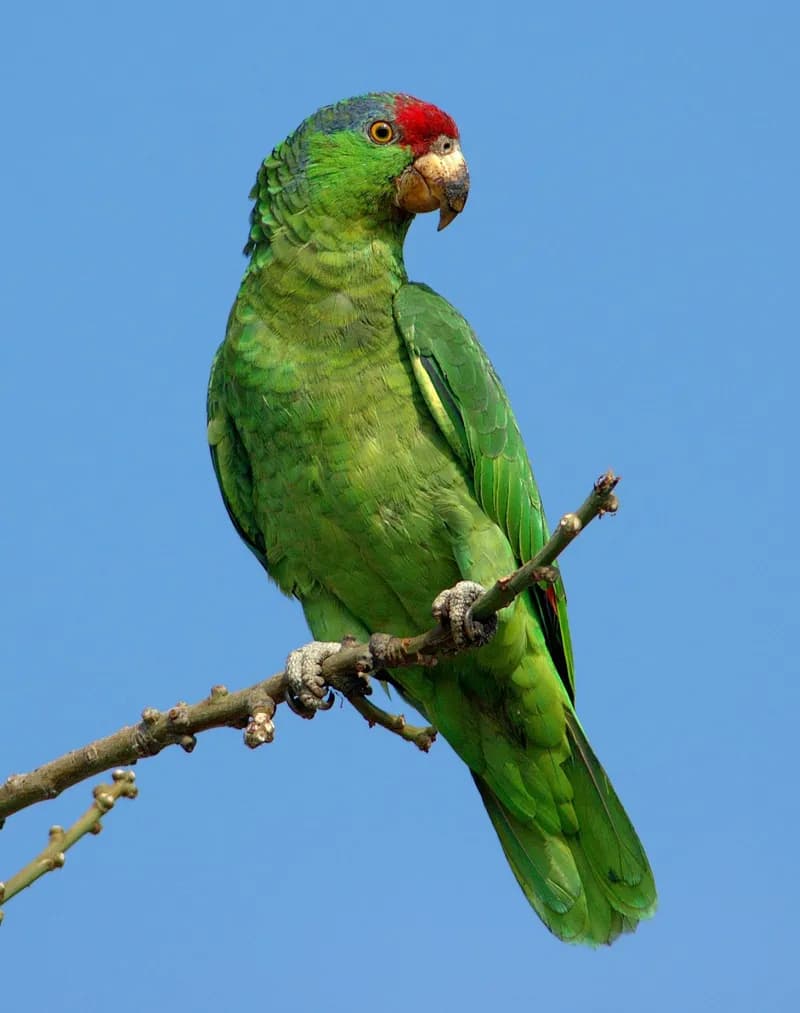
Photo: Wikimedia Commons
Overview
The Red-crowned Parrot holds a unique place in conservation history: this Endangered Mexican species has established a self-sustaining naturalized population in the Rio Grande Valley — where it is now believed to be more numerous than in its native range in northeastern Mexico. Decades of trapping for the pet trade devastated the wild Mexican population. The Texas birds, descended from escaped and released pets beginning in the 1970s, are now ABA-countable and have become an unexpected conservation story. Seeing a flock of Red-crowned Parrots is one of the Valley's most exciting birding experiences.
Identification
A stocky, medium-sized parrot (13 inches) — overall bright green with a vivid red forehead and crown. Blue-lilac feather tips on the hindcrown create a subtle color gradient at the back of the head. Red wing patch is visible in flight. Bill is pale yellowish; eyes are orange. Tail is squared and green with yellowish tips.
In the Valley, the main confusion species is the Yellow-headed Parrot, another naturalized amazon with more yellow on the head. Red-crowned has only the red forehead and lacks yellow. Green Parakeets are slimmer and longer-tailed. The rolling, harsh calls of Red-crowned Parrots are distinctive once learned.
Habitat & Range
In South Texas, Red-crowned Parrots favor urban and suburban areas with large trees, especially near water. They roost communally in palm groves and tall hardwoods. They are most concentrated in the McAllen, Harlingen, and Brownsville areas, with the largest known concentration in the state around Brownsville's Resaca de la Palma park.
The native range is limited to lowland forest in Tamaulipas, Nuevo León, and Veracruz in northeastern Mexico, where wild populations have been severely reduced by trapping and habitat loss. The Texas population may now represent the largest population of the species in the world.
Behavior & Diet
Red-crowned Parrots are frugivores and seed-eaters, consuming fruits, seeds, flowers, and grain. In South Texas they feed heavily on citrus fruits, palm fruits, and ornamental trees, and are frequently encountered at fruiting fig trees. They travel in pairs or small groups during the day, joining larger flocks at communal roosts at dusk.
Nesting occurs in tree cavities. Both parents share incubation and chick-rearing. The species is strongly pair-bonded, with couples remaining together year-round. Contact calls maintain flock cohesion during flight and foraging.
Where to See in South Texas
Evening roost flights are spectacular — ask locals where the current roost is located. Quinta Mazatlán staff can usually direct visitors to active flocks in the area.
Best Time to See
Year-round — Red-crowned Parrots are permanent residents of the Valley, but there are two daily windows that reliably produce views. Dawn (30 minutes before sunrise): flocks leave their roost sites heading to feeding areas, calling loudly as they go. Dusk (30–60 minutes before sunset): flocks return to communal roosts, often in large numbers that can be heard from a distance. Quinta Mazatlán in McAllen maintains an active parrot flock; staff can direct visitors to current roost locations.
Conservation Status
IUCN: EndangeredEndangered in its native Mexican range due to trapping and deforestation. The naturalized Texas population is self-sustaining and ABA-accepted. Some conservationists argue the Texas birds may serve as a genetic reservoir if the Mexican population collapses entirely.
Fun Fact
Christmas Bird Counts in the Brownsville area regularly record 1,000+ Red-crowned Parrots — more than any count anywhere in the world, including the bird's native Mexico. The species that was disappearing from its homeland has found, entirely by accident, a thriving second home 200 miles north of where it evolved.
In the News