Rio Grande Valley · Year-round Resident
Inca Dove
Columbina inca · Tortolita cola larga
Resident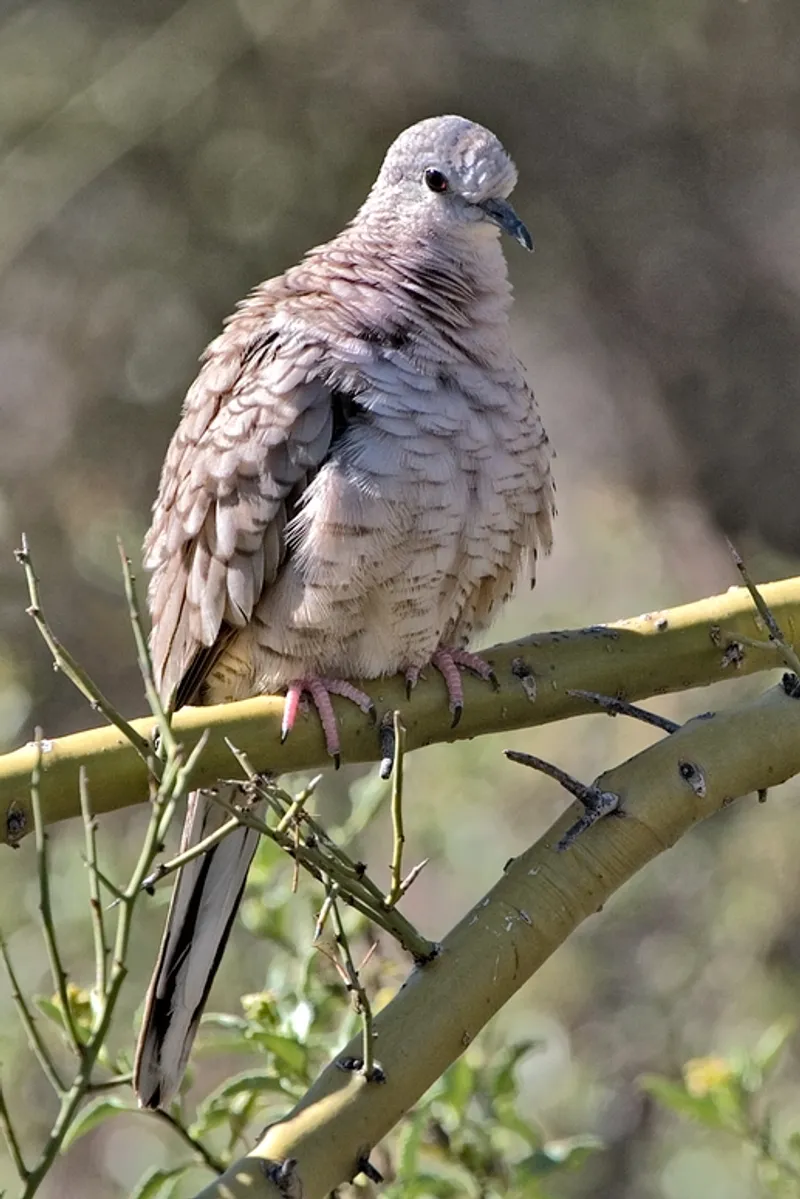
Photo: Wikimedia Commons
Overview
The Inca Dove is a familiar and abundant small dove of urban and suburban South Texas — a bird you are likely to encounter in hotel parking lots, sidewalk cafés, and the lawns of birding hotspots before you ever reach a trail. Small, long-tailed, and covered in a neat scaly pattern, the Inca Dove is one of the most characteristic birds of the Rio Grande Valley's developed areas. It thrives alongside human settlement and is rarely found far from towns or irrigated land.
Identification
A small, slender dove with a distinctive scaly appearance — each feather on the breast, back, and neck is outlined in dark brown, creating a layered scale effect unique among Valley doves. The long, rounded tail is a key feature: white outer tail feathers are conspicuous in flight and when fanned during displays. Bill is thin and dark; eyes red with a narrow red eye ring.
In flight, the rufous patches in the wings flash prominently — similar to Common Ground Dove, which shares the same habitats. Ground Dove is stockier and shorter-tailed; Inca Dove is slimmer with the longer tail and cleaner scaly pattern. The call — a monotonous no hope, no hope — is one of the most persistent sounds in any RGV town.
Habitat & Range
Inca Doves are birds of urban and suburban environments — gardens, lawns, parks, roadsides, and any area with short grass or bare ground for foraging. They favor areas with water access and dense shrubs or trees for roosting and nesting. In South Texas they are essentially resident wherever towns, farms, or disturbed land offer suitable habitat.
The U.S. range extends from South Texas through the Southwest to California. The species has expanded northward in Texas over recent decades. It is found throughout Mexico and Central America south to Costa Rica.
Behavior & Diet
Inca Doves forage on the ground for grass seeds, weed seeds, and grain — often in small flocks that walk steadily through short grass, bobbing their heads as they pick up seeds. They readily come to bird feeders with millet or cracked corn scattered on the ground.
In cold weather, Inca Doves form tight huddles of up to a dozen birds, stacking in pyramid-shaped clusters on branches to conserve warmth — an endearing and unusual behavior called pyramid roosting. Nesting occurs year-round in South Texas; the species may raise multiple broods per year.
Where to See in South Texas
Virtually guaranteed anywhere in the Valley — look for them on the ground at any park, garden, or hotspot visitor center. They practically greet you at the gate.
Best Time to See
Year-round — Inca Doves are permanent residents of the Rio Grande Valley and among the most easily encountered birds on any visit. They are virtually guaranteed at any park, garden, or nature center feeders in the Valley. The repetitive no-hope, no-hope call is a constant background sound throughout the day. Early morning and late afternoon are most active, when birds feed on open ground before retreating to shade.
Conservation Status
IUCN: Least ConcernCommon and stable. The Inca Dove has benefited from urbanization and agricultural development across its range. Population trends in Texas show a long-term expansion northward over recent decades.
Fun Fact
When temperatures drop, Inca Doves practice “pyramid roosting” — stacking in layers two or three birds high on a single branch, the lower birds providing warmth to those above. Groups of up to twelve birds have been recorded in these tight clusters, which resemble an avian totem pole in the early morning chill.
In the News