Rio Grande Valley · Year-round Resident
Red-billed Pigeon
Patagioenas flavirostris · Paloma piquirroja
Resident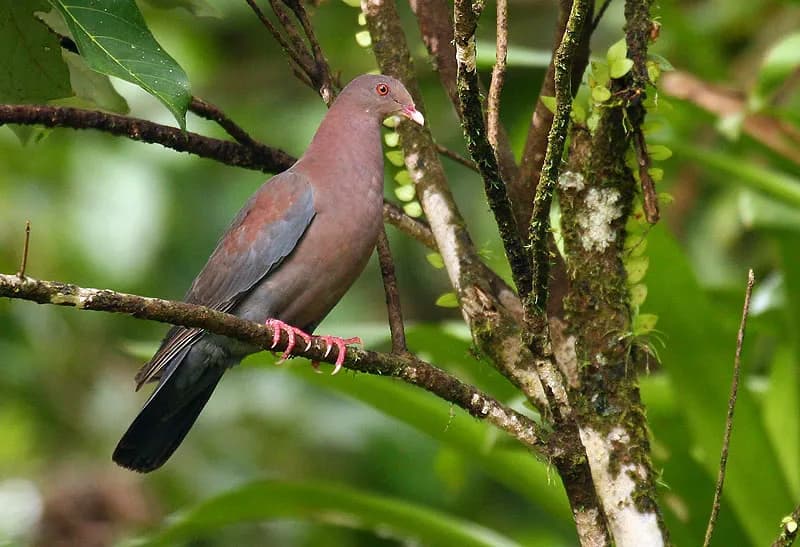
Photo: Wikimedia Commons
Overview
The Red-billed Pigeon is a large, dark, wine-colored pigeon of the Rio Grande riparian corridor — a tropical species that barely reaches the United States in South Texas. It is most reliably observed flying over the Rio Grande at dawn from Bentsen State Park's hawk watch platform, where birds cross the river in the early morning light before most other birders have arrived. Its deep, resonant cooing fills the river woodland in the early morning hours and is one of the characteristic sounds of the riparian zone.
Identification
A large, stocky pigeon — noticeably bigger than a Rock Pigeon — with overall dark purplish-maroon or wine-red plumage. The back and wings are dark grayish-brown; the head, neck, and breast are the richest wine-red. The diagnostic feature is the bill: red or reddish-orange at the base, whitish at the tip. Eyes are orange-red.
In flight, the large size and uniformly dark coloration distinguish it from all other pigeons and doves in the Valley. The cooing call — a deep, repeated who-WHOOO-who — is the most reliable way to confirm the species in dense canopy where birds are difficult to see.
Habitat & Range
In South Texas, Red-billed Pigeons occupy the tall riparian forest along the Rio Grande — cottonwood, willow, hackberry, and Texas ebony woodland that lines the river corridor. They require mature trees with a full canopy and avoid open or disturbed areas.
The U.S. range is restricted to a narrow strip along the lower Rio Grande, primarily from Webb County east to Hidalgo County. The species is far more widespread in Mexico and through Central America south to Costa Rica.
Behavior & Diet
Red-billed Pigeons are frugivores, feeding heavily on small fruits, berries, and seeds from trees and shrubs in the riparian canopy. They also consume grain and other plant material. Foraging occurs mainly in the upper canopy and mid-levels of tall trees.
They build simple flat stick nests in trees, typically at moderate heights. The species is a year-round resident in South Texas and does not migrate, though some local movement occurs in response to food availability. Males call persistently throughout the breeding season from within the canopy.
Where to See in South Texas
Bentsen-Rio Grande Valley State Park
Mission
Salineño Wildlife Preserve
Salineño
Santa Ana National Wildlife Refuge
Alamo
The hawk watch platform at Bentsen SP at dawn is the classic spot. Listen for the deep cooing from the canopy; scan the riverside trees at first light.
Best Time to See
April through September — Red-billed Pigeons are breeding-season residents of the riparian corridor along the Rio Grande. The classic strategy is to arrive at the Bentsen SP hawk watch platform before dawn and watch birds silhouetted against the brightening sky as they fly over the river. By mid-morning birds disappear into the canopy. The deep, repetitive coo is heard throughout the day from river-edge trees at Salineño and Santa Margarita Ranch.
Conservation Status
IUCN: Least ConcernStable across its Latin American range. In South Texas, loss of mature riparian woodland along the Rio Grande is the main threat to the small U.S. population. Continued protection of riverside habitat at Bentsen, Santa Ana, and Salineño is essential.
Fun Fact
The Red-billed Pigeon is most reliably seen in South Texas not by searching the canopy — but by arriving at Bentsen SP's hawk watch platform before sunrise and watching birds fly over the river as they commute between roosting and feeding areas. The birds are often out of sight in the canopy by mid-morning.
In the News