Rio Grande Valley · Resident (naturalized)
Green Parakeet
Psittacara holochlorus · Perico verde
Resident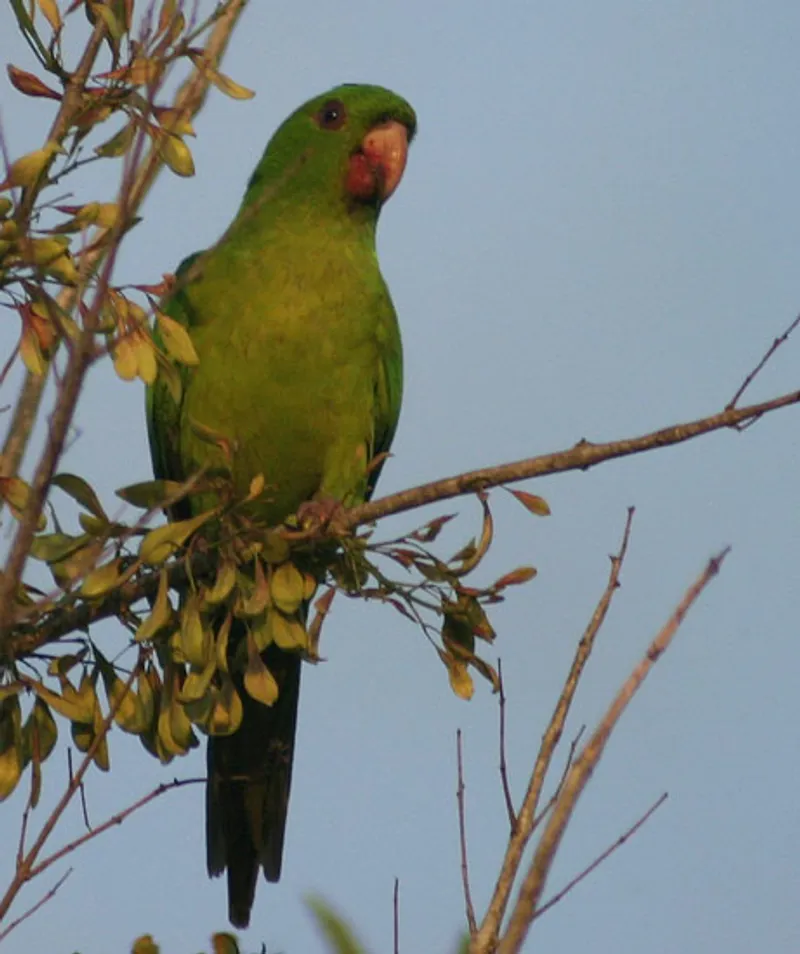
Photo: Wikimedia Commons
Overview
The Green Parakeet is one of two naturalized parrot species that have become established residents of the lower Rio Grande Valley. Originally native to northeastern Mexico, wild-caught birds that escaped or were released from the pet trade in the 1970s established a feral population that has now grown to several thousand birds in the McAllen-Brownsville corridor. The ABA (American Birding Association) officially accepted the Texas population as a countable species in 2017. Their raucous calls and acrobatic flights over Valley neighborhoods at dawn and dusk are now a defining feature of the urban soundscape.
Identification
Almost entirely bright green — a relatively large parakeet (13 inches) with long pointed tail. Yellow-green on the underparts; brighter green above. The face shows occasional scattered orange-red feathers, especially around the lores, though much less than some other green parakeet species. Bill is pale and heavy. In flight, yellowish underwing coverts contrast with greener flight feathers.
The main confusion species in the Valley is the Monk Parakeet, which is smaller and grayer on the face and breast. Green Parakeets travel in noisy flocks and are often heard before they are seen — a loud, harsh kree-kree in flight is characteristic. Flying flocks show rapid, direct wingbeats.
Habitat & Range
In the Rio Grande Valley, Green Parakeets inhabit urban and suburban areas with large trees — palm groves, city parks, neighborhoods with mature fig, citrus, and native trees. They roost communally in large numbers and range widely to forage each day. Cliff faces and tall structures are used for nesting.
The naturalized Texas population is concentrated in Hidalgo and Cameron counties. The native range is in eastern and southern Mexico from Tamaulipas south through Central America.
Behavior & Diet
Green Parakeets are highly social and feed in flocks, consuming fruits, seeds, flowers, grain, and cultivated crops. They can cause significant damage to orchards and gardens. Figs, palm fruits, and sorghum are favored foods in the Valley.
Large communal roosts — sometimes thousands of birds — form at dusk in palm groves and other tall trees. The pre-roost gatherings, with their swirling green flocks and deafening noise, are a spectacle in their own right. Nesting occurs in cliff cavities, buildings, and bridges.
Where to See in South Texas
Look for flocks flying overhead at dawn and dusk in any McAllen or Brownsville neighborhood. Local birders can point you to current roost sites, which shift seasonally.
Best Time to See
Year-round — Green Parakeets are permanent residents of the McAllen and Brownsville urban areas. The easiest way to find them is to be in downtown McAllen or any park with mature trees at dawn or dusk, when communal flocks fly noisily between roost and foraging sites. The loud, chattering calls carry well and flocks of dozens to hundreds are visible from the street. Christmas Bird Count data regularly show thousands of birds in the valley — this is one of the most reliable exotic-species experiences in the U.S.
Conservation Status
IUCN: Least ConcernThe native population in Mexico is stable. The naturalized Texas population has grown substantially and is self-sustaining. Some concern exists about competition with native cavity-nesters, though cliff-nesting reduces this overlap. ABA-countable since 2017.
Fun Fact
The Green Parakeet population in South Texas is large enough that coordinated Christmas Bird Counts regularly record thousands of individuals in the McAllen area — making it one of the most numerous parakeet species counted anywhere in North America each winter. The colony grows a little larger every year.
In the News