Texas Coast · Year-round Resident
American Oystercatcher
Haematopus palliatus · Ostrero americano
Resident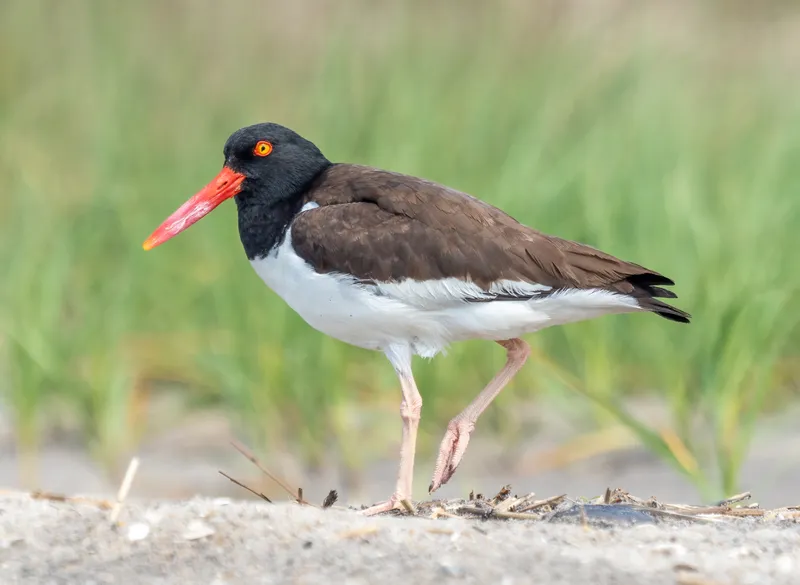
Photo: Wikimedia Commons
Overview
The American Oystercatcher is one of the most visually striking shorebirds on the Texas coast — a large, boldly patterned bird with a jet-black hood, brown back, white underparts, and a vivid orange-red bill that looks like it was designed by a graphic designer. Found on coastal beaches, tidal flats, and oyster reefs year-round, it announces its presence with a loud, piping call that carries far down the beach. Watching one work an oyster bed — prying shells open with that remarkable bill — is a memorable spectacle.
Identification
A large shorebird (18 inches) with distinctive two-tone plumage: black hood and upper breast, dark brown back and wings, white belly and flanks. The bill is the defining feature — long, bright orange-red, laterally compressed, and knife-like at the tip. Eyes are bright yellow with a red orbital ring. Legs are pale pinkish.
In flight, white wing stripes and white rump are conspicuous. The loud, repeated kleeeepcall is often the first indication of the bird's presence. No other shorebird on the Texas coast shares this combination of large size, black-and-white pattern, and orange bill.
Habitat & Range
American Oystercatchers are coastal specialists, restricted to beaches, tidal mudflats, barrier islands, and shallow bays with oyster reefs. They nest on the ground above the tideline on open beaches or shell ridges. In South Texas, they are found along the Laguna Madre coast and on South Padre Island.
The U.S. range spans both coasts — from New England south along the Atlantic Coast, around the Gulf, and up the Pacific Coast to Baja California. The Texas Gulf Coast hosts a significant breeding population. Winter birds may be joined by migrants from more northerly populations.
Behavior & Diet
As the name suggests, oystercatchers specialize in bivalves — oysters, mussels, clams — which they open by either hammering the shell until it cracks or by inserting the bill through a gap and severing the adductor muscle. Individual birds tend to specialize in one technique or the other. They also eat marine worms, crabs, and other invertebrates.
Pairs are strongly monogamous and faithful to nest sites, sometimes using the same territory for many years. They are vigilant and noisy in defense of the nest, running loudly toward intruders. Both parents share incubation and chick-rearing; chicks are precocial and follow parents to foraging areas while still learning to open shells.
Where to See in South Texas
Laguna Atascosa National Wildlife Refuge
Rio Hondo
South Padre Island Birding & Nature Center
South Padre Island
Walk the South Padre Island beaches and scan oyster reefs at low tide. The loud call often locates the bird before you see it. Look for pairs near the tideline.
Best Time to See
Year-round — American Oystercatchers are present on the barrier island coast throughout the year. October through March is the most productive period, when shorebird diversity is highest along the Laguna Madre and jetty traffic is lower. Walk the South Padre Island jetties at low tide and scan oyster reefs along the bay side. Their loud, piping call is the easiest way to find them before you see them.
Conservation Status
IUCN: Least ConcernStable but sensitive to coastal development and disturbance at nest sites. Beach driving, foot traffic, and predation by feral animals threaten nesting success on Gulf coast barrier islands. Oyster reef habitat is declining in several bays, affecting foraging availability.
Fun Fact
Young oystercatchers are fed by their parents for several months after hatching — they cannot open oysters independently until they are fully grown. The technique is learned, not innate, and juvenile birds practice on empty shells. Newly independent birds may spend their first year foraging mainly on easier prey like marine worms before mastering the bivalve-opening skill.
In the News