Texas Gulf Coast · Winter Visitor
Piping Plover
Charadrius melodus · Chorlitejo melodioso
Winter Visitor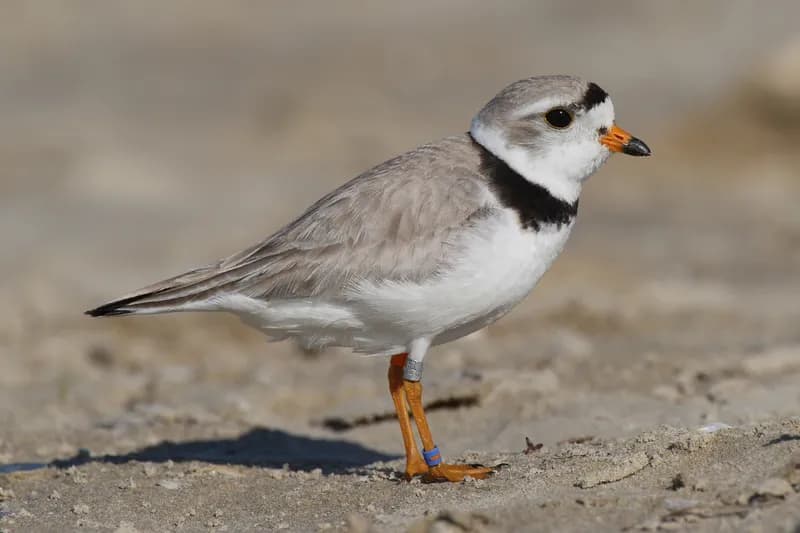
Photo: Wikimedia Commons
Overview
The Piping Plover is one of North America's most endangered shorebirds — and the Texas Gulf Coast is one of the most important places on the continent for it. While the species breeds on Great Plains rivers, Great Lakes beaches, and Atlantic Coast barrier islands, it winters almost exclusively along Gulf and Atlantic coastlines. Texas hosts a significant share of the global wintering population, with Padre Island National Seashore and the Laguna Madre tidal flats providing critical habitat. Small, pale, and sand-colored, a Piping Plover on a white Texas beach can be nearly invisible until it moves.
Identification
A small, plump plover — about the size of a House Sparrow — with upperparts the exact pale sandy color of a dry Gulf beach. In winter plumage (when seen in Texas), the breast band is faint or absent, the bill is dull orange with a dark tip, and the legs are dull orange-yellow. The white underparts, pale sandy back, and dark-tipped orange bill distinguish it from other small plovers.
In flight, look for a narrow white wing stripe and a white rump. The call — a soft, whistled peep-lo or peep-peep-lo— is musical and distinctive, more melodious than other small plovers. Wilson's Plover is larger with a much heavier bill; Snowy Plover is similarly small and pale but has a dark bill, dark legs, and an incomplete breast band with distinct dark patches on the sides of the breast.
Habitat & Range
On the Texas coast in winter, Piping Plovers use sandy beaches, shell ridges, tidal flats, and the hypersaline tidal flats of the Laguna Madre — one of only two hypersaline lagoons in the world. These wind-swept, sparsely vegetated flats, with their abundant invertebrates and low disturbance, are among the highest-quality wintering habitats for the species anywhere.
Three breeding populations exist: the endangered Great Lakes population (smallest and most at-risk), the threatened Northern Great Plains population (breeds on alkali lakes and river sandbars), and the threatened Atlantic Coast population (breeds on barrier island beaches). All three winter on Gulf and Atlantic coasts, with Texas hosting birds from all three populations.
Behavior & Diet
Piping Plovers forage in the classic plover style: run a few steps, pause, tilt forward to pick up a prey item, then run again. On the Texas coast they feed on small invertebrates — marine worms, amphipods, small mollusks, and insects — found in the surf zone, along tidal wrack lines, and on exposed tidal flats. They often forage at the edge of the wave wash where invertebrates are briefly exposed.
On wintering grounds, Piping Plovers establish and defend individual feeding territories along the beach. They roost communally at high tide on shell ridges and upper beach areas. Their pale coloration provides camouflage against the beach substrate — a bird standing still can be extraordinarily difficult to see even at close range.
Where to See in South Texas
Laguna Atascosa National Wildlife Refuge
Rio Hondo
South Padre Island Birding & Nature Center
South Padre Island
Padre Island National Seashore
Corpus Christi
Packery Channel & North Padre Island flats
Corpus Christi
Best window: October through April. Scan sandy beaches and exposed tidal flats carefully — their camouflage is exceptional. The tidal flats of the Laguna Madre accessible from Laguna Atascosa NWR are among the most reliable winter sites.
Best Time to See
October through April — Piping Plovers are strictly winter visitors to South Texas, arriving from northern breeding grounds in late summer and departing in April. Peak numbers are on the Laguna Madre tidal flats, especially accessible from the Laguna Atascosa NWR shoreline and the South Padre Island beaches. Their camouflage is extraordinary on a pale sand beach — the melodious peep-lo call is often what reveals them first. Scan sandy beaches and bare tidal flats methodically.
Conservation Status
U.S. Federally ThreatenedListed as Threatened under the Endangered Species Act (Great Lakes population listed as Endangered). Threats include beach development and disturbance, predation at nesting sites, and storm events. Wintering habitat loss along the Gulf Coast is an increasing concern. The Coastal Bend and Lower Rio Grande Valley tidal flats are recognized as critical wintering habitat, and their protection is essential for the species' long-term recovery.
Fun Fact
Individual Piping Plovers return to the same wintering beach year after year — banded birds have been resighted at the same Texas locations for six or more consecutive winters. This site fidelity means that the loss or degradation of even a single high-quality wintering beach can affect the same individual birds season after season.
In the News