Texas Gulf Coast · Year-round Resident
Mottled Duck
Anas fulvigula · Pato moteado
Resident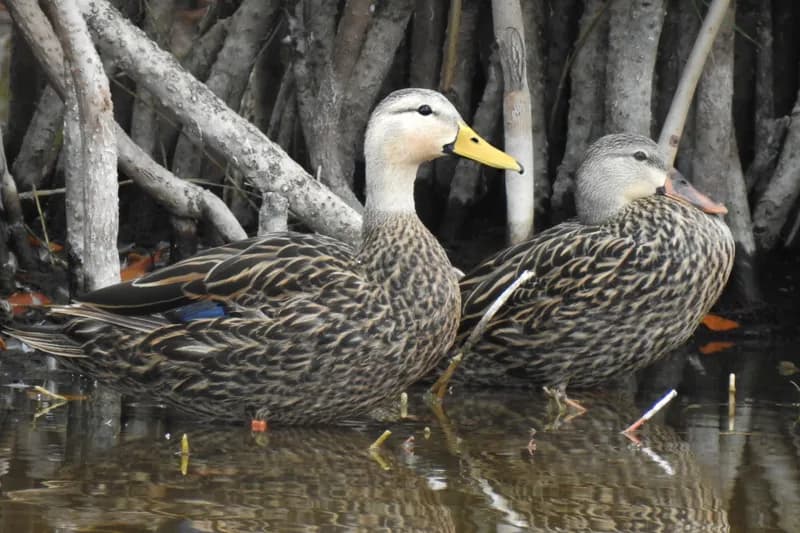
Photo: Wikimedia Commons
Overview
The Mottled Duck is the only dabbling duck that breeds year-round along the Gulf Coast, and South Texas is at the heart of its range. Unlike most North American ducks that winter here and breed elsewhere, Mottled Ducks are permanent residents of the coastal marshes, resacas, and prairie potholes stretching from Corpus Christi south to the Rio Grande. They occupy an ecological niche that no other native duck fills on the Texas coast — and they face a conservation challenge unique to their sedentary lifestyle: ongoing hybridization with feral Mallards.
Identification
At a glance, Mottled Ducks resemble a dark female Mallard — which is precisely what makes identification tricky in areas where feral Mallards are present. Key features: the body plumage is a warm tawny-brown, heavily mottled and scaled with dark centers; the head and neck are paler buff with a finely streaked pattern; and the bill is bright yellow in males, olive-yellow in females — clean and unmarked, lacking the Mallard's dark saddle or orange patches.
In flight, the iridescent blue-purple speculum is bordered by black lines with little or no white — unlike the Mallard's white-bordered speculum. The body is noticeably darker overall than a female Mallard. Hybrids with Mallards are common and can show intermediate characters; a pure Mottled Duck with a yellow bill and no white speculum border is a reliable identification.
Habitat & Range
Mottled Ducks are coastal marsh specialists. In South Texas they inhabit the brackish and freshwater marshes of the Laguna Madre system, the resacas and oxbow lakes of the Rio Grande delta, seasonal prairie ponds, and the tidal flats and bay margins along the Gulf Coast. They favor dense emergent vegetation — bulrush, cattail, and cordgrass — for nesting and loafing.
The species is non-migratory, with a range confined to the Gulf Coast from central Texas south through the Mexican states of Tamaulipas and Veracruz, and a disjunct population in peninsular Florida. Texas birds do not move far from their breeding areas, making the protection of coastal wetland habitats especially critical.
Behavior & Diet
Like other dabbling ducks, Mottled Ducks feed by tipping forward in shallow water to reach submerged vegetation and invertebrates, and by grazing on aquatic plants and seeds along muddy margins. The diet includes aquatic insects, mollusks, crustaceans, small fish, and plant material such as seeds of bulrush and panic grass. They are most active at dawn and dusk.
Nesting begins as early as February, earlier than most waterfowl. The female constructs a grass-lined nest in dense marsh vegetation, typically laying 8–10 eggs. The male deserts the female after incubation begins — typical dabbling duck behavior. Ducklings are precocial and can feed themselves within hours of hatching; the female leads them to water immediately.
Where to See in South Texas
Laguna Atascosa National Wildlife Refuge
Rio Hondo
Estero Llano Grande State Park
Weslaco
South Padre Island Birding & Nature Center
South Padre Island
Coastal marshes along the Laguna Madre
Cameron County
Present year-round. Scan marshy edges and resacas; compare carefully with any female Mallard-type ducks, watching for the clean yellow bill and dark body.
Best Time to See
Year-round — Mottled Ducks are non-migratory permanent residents of the Gulf Coast. Winter (November through February) is the best season to observe them: Mallards and other migrant ducks join the resident Mottled Ducks, making side-by-side comparison easy and the overall duck diversity highest. Estero Llano Grande, the ponds at Laguna Atascosa, and any freshwater wetland in the Valley hold resident pairs year-round.
Conservation Status
IUCN: Least ConcernGlobally stable but under pressure along the Gulf Coast from habitat loss, coastal development, and — critically — hybridization with feral Mallards released by hunting operations. Hybrid birds can dilute the Mottled Duck gene pool over generations. Texas Parks and Wildlife Department actively discourages the release of pen-raised Mallards in the Mottled Duck's range for this reason.
Fun Fact
The Mottled Duck's breeding season is one of the earliest of any North American duck — nests with eggs have been found in February along the Texas coast, months before most migratory waterfowl have even left their wintering grounds. This head start on the breeding season is one of the key adaptations of a species that never needs to migrate.
In the News