Rio Grande Valley · Rare Resident
Masked Duck
Nomonyx dominicus · Pato enmascarado
Rare resident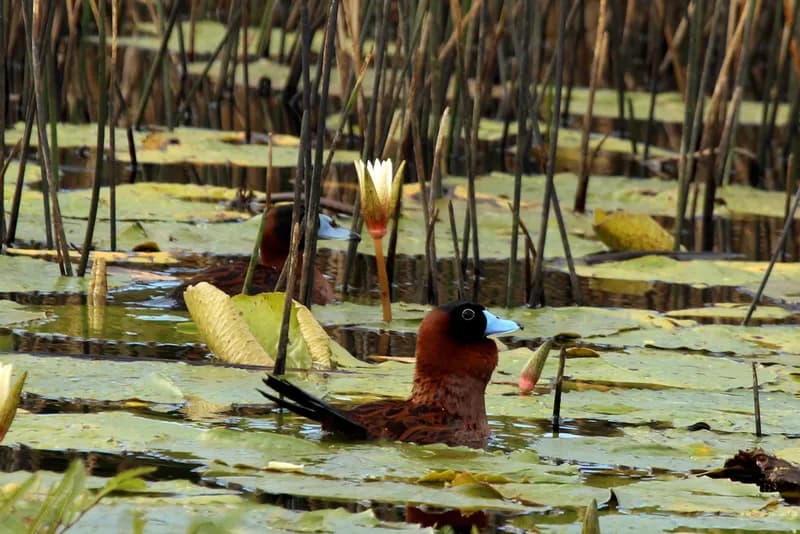
Photo: Wikimedia Commons
Overview
The Masked Duck is a true gem of Rio Grande Valley birding — a small, secretive stiff-tailed duck that disappears into dense marsh vegetation and can be virtually impossible to find even when present. It is the only member of the genus Nomonyx and the sole relative of the Ruddy Duck found in the Valley. Numbers in South Texas fluctuate dramatically depending on conditions, and in good years — when water levels are right and emergent vegetation is dense — Estero Llano Grande or Santa Ana NWR can produce reliable sightings. In bad years, the species can go undetected for months.
Identification
A small (30–36 cm / 12–14 in) stiff-tailed duck that often holds the stiff tail cocked upward like a Ruddy Duck. Breeding male: warm chestnut body, black face mask, bright blue bill. Non-breeding male and female: brown overall with two pale horizontal stripes on each side of the face — a distinctive pattern not shared by Ruddy Duck. The female also has the striped face, though less bold than the male's.
Distinguished from the Ruddy Duck by the facial stripes (Ruddy has a plain cheek), the smaller size, and the tendency to remain skulking in thick vegetation rather than loafing in open water. White wing patches visible in flight also separate it from Ruddy Duck at any age.
Habitat & Range
Dense freshwater marshes with abundant emergent vegetation — cattails, bulrushes, water hyacinth — at the water's edge. Strongly tied to vegetated margins; rarely seen in open water. The species is more reluctant to take flight than most ducks and will dive or run into vegetation when disturbed rather than flushing into the air.
In the United States, essentially restricted to the Rio Grande Valley as an irregular rare resident. Broader range extends through the Caribbean and from Mexico through Central America to Peru and Brazil. Movements are poorly understood but the species appears to be partially nomadic, appearing irregularly at sites in response to water and vegetation conditions.
Behavior & Diet
Forages by diving for aquatic seeds, aquatic invertebrates, and plant material, submerging cleanly from the surface like the closely related Ruddy Duck. The stiff tail is held cocked upward when the bird is alert or displaying. Secretive by nature, it spends much of its time concealed within emergent vegetation, making detection a matter of patience and often luck.
Best found by scanning the edges of vegetation beds from a fixed observation point, watching for the bird to emerge briefly into an open channel or pool. Early morning light and calm conditions improve the chances of seeing one before it retreats into cover.
Where to See in South Texas
Best Time to See
Irregular year-round — Masked Ducks are one of the most unpredictable birds in South Texas, appearing and disappearing without warning. When present, they favor managed wetlands with dense emergent vegetation at the edges. Estero Llano Grande State Park and Santa Ana NWR are the most reliable sites. Sit quietly at a pond edge at dawn and scan vegetation margins — the bird will occasionally emerge briefly before retreating. Always check eBird for recent confirmed sightings before making a special trip.
Conservation Status
IUCN: Least ConcernGlobally considered Least Concern, though populations are poorly monitored due to the species' secretive habits and patchy distribution. Loss of freshwater marshes throughout its range is the primary threat. In South Texas, maintenance of managed wetlands at the major refuges provides critical habitat for this elusive species.
Fun Fact
The Masked Duck is placed in its own monotypic genus, Nomonyx, separate from the Ruddy Duck and Old World stiff-tails in Oxyura. Molecular studies suggest the two lineages diverged early and independently evolved the stiff-tail display behavior. The Masked Duck's closest living relative is the Ruddy Duck — the only other stiff-tail found in the Americas — making their overlap in South Texas a rare meeting of the two American stiff-tail lineages.
In the News