Rio Grande Valley · Rare Resident
Northern Jacana
Jacana spinosa · Jacana norteña
Rare resident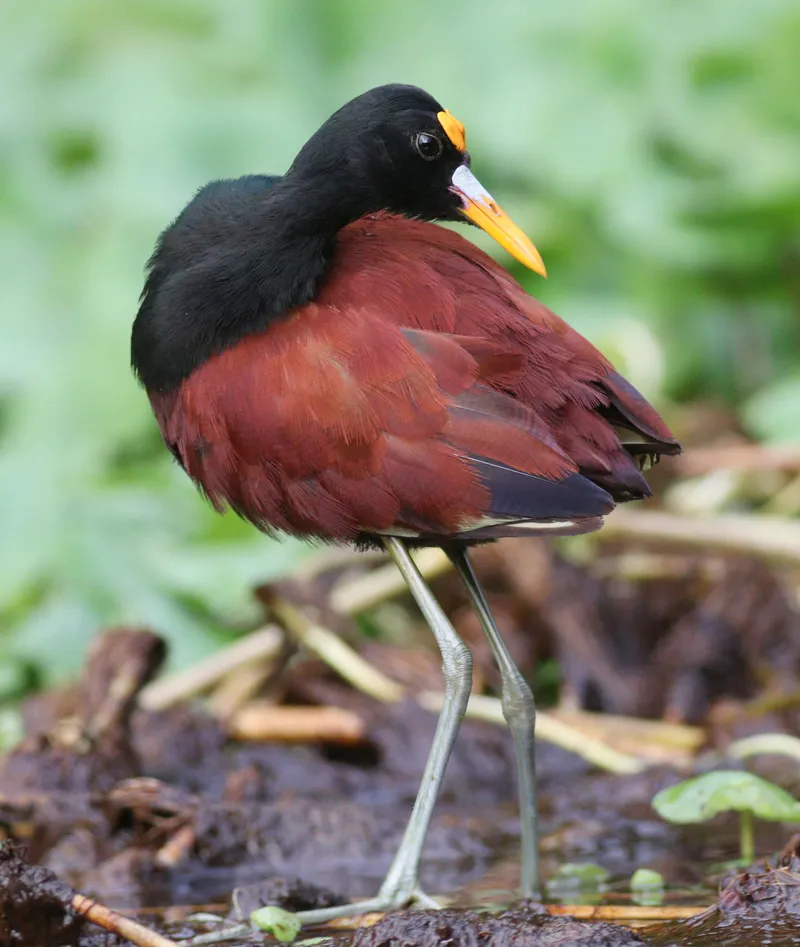
Photo: Wikimedia Commons
Overview
The Northern Jacana is one of those birds that stops you in your tracks the first time you see it: a chestnut-and-black shorebird casually walking across floating lily pads on impossibly long toes, as if gravity were optional. Popularly called the “lily-trotter,” its extraordinary feet distribute its weight across the surface of floating vegetation in a way that most birds — and all humans — could only envy. In South Texas it is a rare find, occurring irregularly at marsh sites with floating aquatic vegetation, and any report draws birders from across the Valley.
Identification
A medium-sized (19–23 cm / 7.5–9 in) wader with uniquely long toes and claws. Adults are unmistakable: dark chestnut body, black head, neck, and breast, yellow frontal shield and bill, and bright yellow flight feathers visible in flight. The frontal shield is red with a yellow tip. Immatures are brown above, white below, with a yellow-green bill and a distinct pale supercilium.
In flight, the entirely yellow-green wing is striking and diagnostic — no other shorebird in the region has this. The call is a loud, rattling series of notes, harsh and insistent, often given when alarmed. The outrageously long toes are visible even in flight and clinch the identification.
Habitat & Range
Freshwater marshes and ponds with floating vegetation — water hyacinth, lily pads, and similar mats of floating plant material. The jacana walks across this vegetation to forage, requiring a substrate that most other birds cannot use. Vegetated margins and emergent plants at the water's edge are also used.
In the U.S., limited to the Rio Grande Valley as a rare resident, first documented breeding in Texas in 1967. The main range extends from central Mexico through Central America to western Panama, with a separate population in the Greater Antilles. The species may be extending its U.S. presence as aquatic vegetation improves in managed wetlands.
Behavior & Diet
Picks insects, spiders, small fish, and seeds from the surface of floating vegetation and the underside of lily pads. Extremely territorial; females defend large territories containing the nests of several males — an unusual “polyandrous” mating system where one female pairs with multiple males, each of whom incubates eggs and raises chicks independently.
The male's parental care is extraordinary: when threatened, he tucks the chicks under his wings with only their legs dangling visibly, and walks away — the ultimate camouflage through concealment. He can carry up to four chicks this way.
Where to See in South Texas
Best Time to See
Year-round but unpredictable — The Northern Jacana is a rare and local resident in South Texas, primarily at Resaca de la Palma State Park, which is the most reliable U.S. site. Numbers fluctuate: birds are sometimes absent for weeks then suddenly visible for months. Check recent eBird reports before visiting. When present, they are conspicuous — their extraordinary long toes distribute weight across lily pads and their bright yellow flight feathers flash when they open their wings.
Conservation Status
IUCN: Least ConcernLeast Concern globally, with a stable population across its main range. In Texas, the small and irregular population is sensitive to changes in marsh vegetation and water levels. Preservation of wetlands with floating aquatic vegetation is the most direct conservation action for this species at the northern edge of its range.
Fun Fact
In the Northern Jacana's polyandrous system, sex roles are reversed from the typical bird pattern: females are larger than males (one of the few shorebirds where this is true), compete aggressively with other females for territories, and take no part in incubation or chick-rearing. Males do everything — build the floating nest, incubate the eggs, and carry the chicks under their wings when threatened. The female's only contribution is the eggs themselves.
In the News