Rio Grande Valley · Year-round Resident
Black-bellied Whistling-Duck
Dendrocygna autumnalis · Pijiji alas blancas
Resident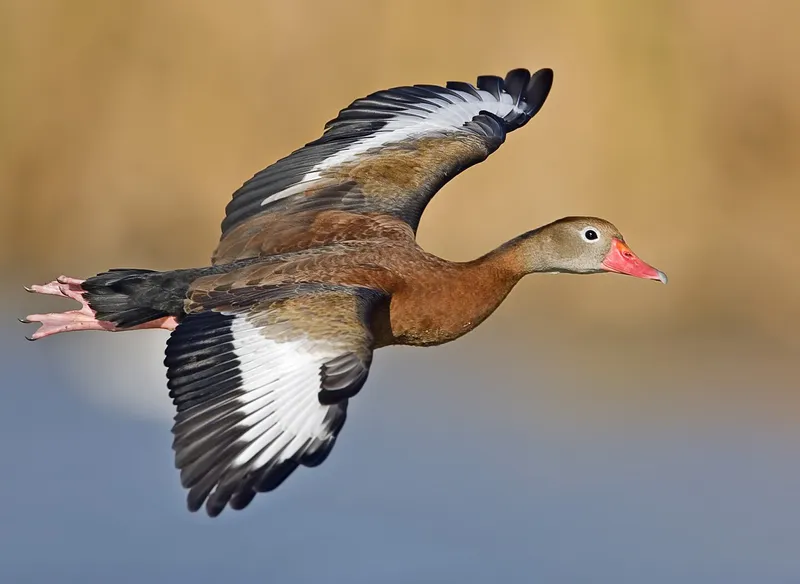
Photo: Wikimedia Commons
Overview
The Black-bellied Whistling-Duck is one of South Texas's great ornithological success stories. Once a local rarity, this colorful, loud, and sociable duck has expanded dramatically across the region over the past three decades — it now breeds in suburban ponds, city parks, and golf courses as readily as in the wildlife refuges. Flocks of dozens flying low over resacas at dusk, calling their characteristic whistled squeal, have become a quintessential sight and sound of the Rio Grande Valley. Unlike most ducks, they are long-legged, upright-standing birds that perch readily in trees.
Identification
A large (48–53 cm / 19–21 in), long-legged duck with an upright posture that reads almost goose-like at a distance. Adults are unmistakable: chestnut body, black belly, gray face, bright coral-pink bill and legs, and in flight a bold white wing stripe on black wings. The head is plain gray with a dark cap. Juveniles are duller, with a gray bill and less distinct belly marking.
In flight the white wing patches flash prominently — unlike any other duck in the region — and the species' high-pitched multi-note whistle (pe-chee-chee or similar) confirms identification instantly. Flocks often fly at low altitude with slow, deliberate wingbeats, calling constantly.
Habitat & Range
Ponds, resacas, flooded fields, marshes, and any freshwater body with nearby trees for nesting. Remarkably adaptable — nests in tree cavities (and readily accepts nest boxes) in both wild and urban settings. The species has expanded its range considerably northward in Texas, now breeding well north of the Rio Grande Valley.
Native range extends from the southern United States through Central America to northern Argentina. Year-round resident throughout South Texas, with numbers augmented by local movements and some influx from Mexico in fall and winter.
Behavior & Diet
Feeds on seeds, grain, aquatic plants, and some invertebrates, often grazing in agricultural fields at night. Highly gregarious: flocks of hundreds gather at favored roost sites, and the species nests semi- colonially when nest boxes or tree cavities are concentrated. Unlike most ducks, both sexes share incubation and chick-rearing duties, and pairs may remain together across multiple seasons.
Nest boxes erected for Wood Ducks are readily adopted, which has contributed to the species' dramatic population growth in Texas. Clutch size is unusually large — 12 to 16 eggs is typical — and “dump nesting” (multiple females laying in the same box) can produce clutches of 30 or more.
Where to See in South Texas
Best Time to See
Year-round — Black-bellied Whistling-Ducks are permanent residents of South Texas and one of the most easily observed waterbirds in the Valley. They are most abundant April through October, when flocks of 50–500 birds roost and feed on resacas and pond edges. Any park pond, resaca, or wetland in the Valley will typically hold birds. Estero Llano Grande and Resaca de la Palma are especially productive. The birds are not shy — flocks often allow close approach.
Conservation Status
IUCN: Least ConcernPopulation is stable and expanding in the United States. The species' adaptability to suburban environments, willingness to use nest boxes, and tolerance of human presence have made it one of the few North American waterfowl species increasing in both range and numbers.
Fun Fact
Black-bellied Whistling-Ducks are among the most monogamous of waterfowl — pairs often stay together for multiple breeding seasons, and both parents brood and care for the ducklings together. This is unusual in ducks, where males typically abandon the female after incubation begins. The species' family bonds are strong enough that juveniles from earlier broods sometimes help their parents raise subsequent clutches.
In the News