Rio Grande Valley · Rare Resident
Tropical Parula
Setophaga pitiayumi · Chipe tropical
Rare resident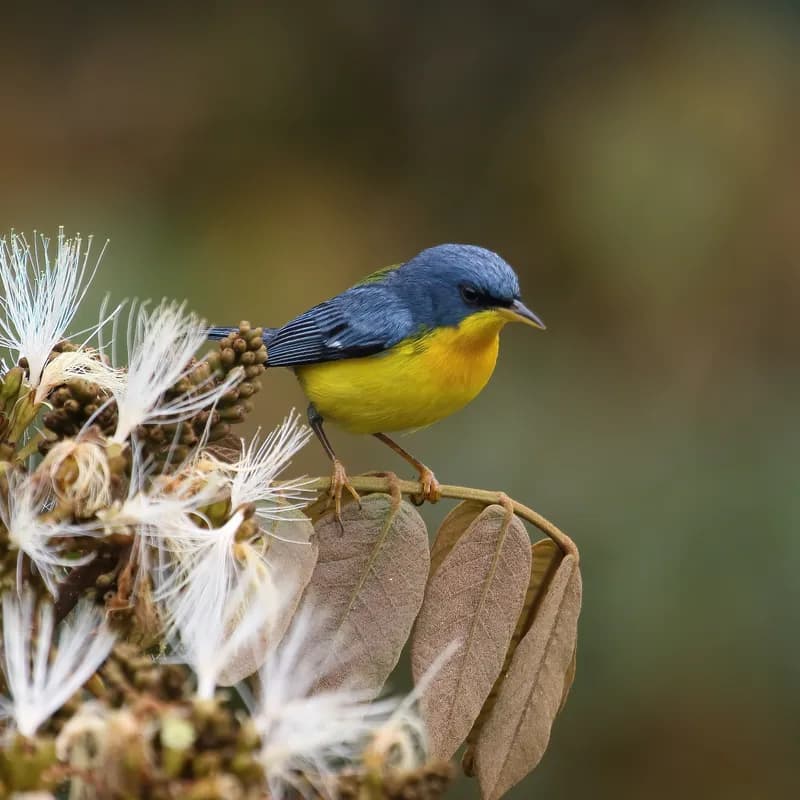
Photo: Wikimedia Commons
Overview
The Tropical Parula is one of the most sought-after warblers in the United States — a tiny jewel of blue-gray and gold that barely enters the country in the riparian forests of the Lower Rio Grande Valley. Nearly identical to the familiar Northern Parula, it is distinguished by the absence of the dark breast band and by its intimate association with Spanish moss, which it uses almost exclusively as nesting material. Where Spanish moss drapes the oaks and ebony trees along the Rio Grande, a patient observer in late spring or summer stands a real chance of finding one working through the canopy with its buzzy, rising trill.
Identification
A very small warbler (10–11 cm / 4 in) with blue-gray upperparts and a bright yellow throat and breast. A yellow-green back patch is visible at close range. Two white wing bars and white eye arcs above and below the eye are useful marks. The bill is small and sharply pointed. Both sexes are similar, though males tend to show a richer orange wash across the breast.
The key distinction from the Northern Parula — which can overlap during migration — is the clean, unbroken yellow breast: no dark necklace, no chestnut breast band. The song is a buzzy, rising trill that climbs the scale before ending abruptly, very similar to the Northern Parula's but subtly higher-pitched and less emphatic at the finish.
Habitat & Range
Riparian forest and Spanish moss-draped woodlands along the Rio Grande. The species is so closely tied to Spanish moss that its presence in the Valley is almost entirely determined by where the moss grows — primarily in the shaded, humid conditions beneath mature oaks, ebony, and anaqua trees. Bentsen SP and Santa Ana NWR, with their extensive old-growth riparian canopy, are the most consistent U.S. sites.
The Tropical Parula's main range extends from Mexico through Central and South America to Argentina. Its presence in the U.S. is limited to the extreme southern tip of Texas, where a small number of pairs breed annually. The species is a rare but regular resident; numbers fluctuate from year to year depending on local conditions.
Behavior & Diet
An active, acrobatic forager that gleans insects and spiders from the outer foliage and hanging strands of Spanish moss. It often hangs upside down from the tips of branches in the manner of a chickadee. Diet is almost entirely invertebrates during the breeding season; small berries and fruit supplements the diet when available.
Nesting begins in April or May. The nest is tucked inside a clump of Spanish moss, making it exceptionally difficult to locate. Clutch size is typically three to four eggs. The male sings persistently from the canopy throughout the breeding season — his buzzy trill is the most reliable way to detect a breeding pair.
Where to See in South Texas
Best Time to See
March through July— Tropical Parulas are breeding residents of the lower Rio Grande Valley, present from March through August. The breeding season is the most reliable window, when males sing persistently from within Spanish moss-draped riparian forest. Salineño Wildlife Preserve and the mature gallery forest at Santa Ana NWR are the best U.S. sites. Check eBird before visiting — numbers fluctuate and this is one of the Valley's harder-to-find specialties.
Conservation Status
IUCN: Least ConcernWidespread and common throughout its broad tropical range. In South Texas, however, the breeding population is small and local, dependent on the continued health of riparian woodland and the availability of Spanish moss. Loss of old-growth trees along the Rio Grande is the primary threat to the U.S. population. Protection and restoration of native riparian forest directly benefits this species.
Fun Fact
The Tropical Parula builds its nest entirely inside a hanging clump of Spanish moss — essentially hollowing out a living curtain of plant material into a hidden nursery. This makes the nest nearly impossible to find even when the bird is singing right overhead. The dependence is mutual in a sense: Spanish moss itself thrives in the same humid riparian microclimate the parula requires, so the two are inextricably linked in the Valley's most sheltered woodland corridors.
In the News