Rio Grande Valley · Summer Resident
Botteri's Sparrow
Peucaea botterii · Zacatero de Botteri
Summer Resident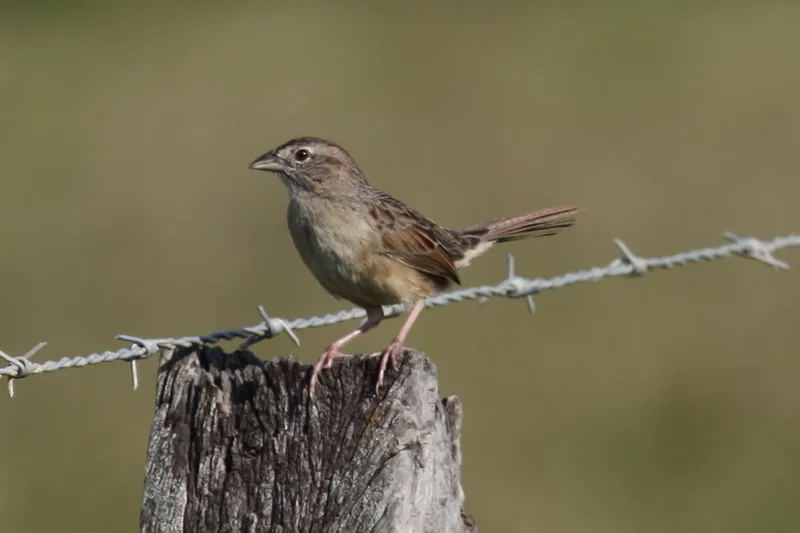
Photo: Wikimedia Commons
Overview
Botteri's Sparrow is one of those birds that demands patience and attention — a nondescript, secretive sparrow that arrives in the coastal prairies of South Texas each spring specifically to breed, then disappears south again in fall. Without its song, it is nearly impossible to locate; with it, the bird's presence in a patch of Tamaulipan coastal grassland is immediately obvious. The Texas population represents a northern outpost of a species more widely distributed in Mexico and Central America, tied closely to specific grassland habitats that are themselves becoming increasingly rare.
Identification
A large, plain sparrow with a flat-headed, heavy-billed look. Upperparts are streaked brown and buff; underparts are plain pale buff with faint streaking on the upper breast and little to no streaking on the flanks. The face is plain with a weak supercilium and malar stripe; the tail is long and slightly rounded. There is no distinctive facial pattern to grab the eye — it is, by design, as invisible as possible in tall grass.
The most similar species in its range is Cassin's Sparrow, which overlaps in some grassland habitats. Botteri's is warmer-toned, less distinctly streaked on the back, and lacks the Cassin's Sparrow's whitish tail corners. The song is the most reliable distinguishing feature: Botteri's gives a series of dry tit or chipnotes accelerating into a distinctive bouncing-ball rattle, quite different from Cassin's sky-lark display song.
Habitat & Range
In South Texas, Botteri's Sparrow is closely tied to Tamaulipan coastal tallgrass prairie — the moist, dense grasslands of the lower Rio Grande delta, dominated by grasses such as gulf cordgrass (Spartina spartinae), Seacoast bluestem (Schizachyrium scoparium), and weedy forbs. It requires tall, dense grass with relatively open ground at the base — neither closely grazed pasture nor dense shrubland will do. The Sabal Palm Sanctuary near Brownsville and the coastal grasslands of Cameron and Willacy counties are the most reliable sites.
Breeding range in the U.S. is limited to southern Arizona (a different subspecies in desert grassland) and the lower Rio Grande Valley of Texas. Birds winter in Mexico; Texas birds are essentially absent from October through April.
Behavior & Diet
Botteri's Sparrows feed primarily on grass seeds and small invertebrates, foraging low in or near the base of tall grass. They are ground-feeding birds that rarely venture into the open, preferring to move through dense grass cover. Outside the breeding season they are largely silent and almost never seen.
Singing males perch on grass stems or low shrubs, often at the top of the tallest available vegetation, where they deliver their accelerating rattling song persistently through the breeding season from May into August. The nest is a grass cup on or near the ground, well hidden in thick grass. The species is monogamous and territorial, with males defending a patch of grassland from other males through song and occasional direct chases.
Where to See in South Texas
Laguna Atascosa National Wildlife Refuge
Rio Hondo
South Padre Island Birding & Nature Center
South Padre Island
Sabal Palm Sanctuary
Brownsville
Coastal prairies of Cameron & Willacy counties
Lower Rio Grande Valley
Present May through September. Learn the song before you go — without it, finding this bird is largely luck. Walk the edges of tall coastal grassland at dawn and listen for the distinctive bouncing-ball rattle.
Best Time to See
May through September — Botteri's Sparrows are strictly breeding-season visitors to South Texas, arriving from Mexico in late April and departing by October. They are only reliably found when singing, which makes early June the optimal window — males sing persistently from low perches in tall coastal grassland at dawn. Learn the song before you go: the distinctive bouncing-ball rattle is the only reliable way to locate this cryptic species. The Sabal Palm Sanctuary grasslands and coastal prairies of Cameron County are the most accessible sites.
Conservation Status
IUCN: Least ConcernGlobally stable across its broad Mexican and Central American range, but the U.S. Texas population is of conservation concern due to the dramatic decline of native coastal tallgrass prairie. Agricultural conversion, development, and overgrazing have reduced available breeding habitat substantially. Maintaining and restoring native grassland in Cameron and Willacy counties is the key conservation need for this population.
Fun Fact
The species is named for Matteo Botteri, a Croatian-born botanist and naturalist who collected specimens in Mexico and Veracruz in the 1850s. Botteri never visited Texas — the bird that bears his name in the United States is known from a state he never set foot in, during a time when much of the Rio Grande Valley had yet to be systematically surveyed by ornithologists.
In the News