Rio Grande Valley · Rare Resident
Muscovy Duck
Cairina moschata · Pato real
Rare resident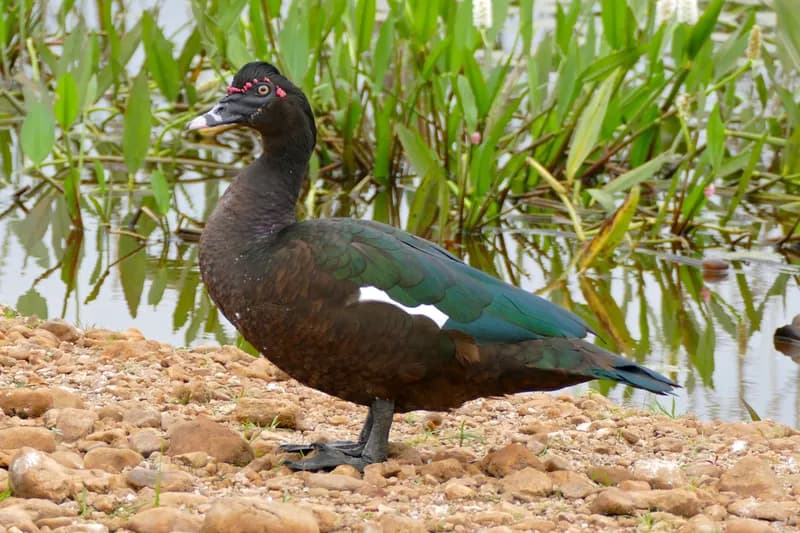
Photo: Wikimedia Commons
Overview
Mention “Muscovy Duck” to most Texans and they picture the warty, black-and-white bird waddling around a city park pond — but that familiar feral bird is a heavily domesticated descendant, not what birders count. The true wild Muscovy Duck is a genuinely rare U.S. bird, barely reaching the country along a short stretch of the Rio Grande in Starr County. Dark, glossy, and shy of people, it perches and roosts in trees overhanging the river rather than loafing on park ponds. Salineño Wildlife Preserve is by far the most reliable place in the United States to see one — scan the river from the riverbank at dawn, when birds are most active moving between roosting and feeding areas.
Identification
A large (66–84 cm / 26–33 in), long-necked duck. Wild-type birds are almost entirely dark: blackish plumage with a bottle-green and bronze iridescent sheen, set off by a bold white patch on the upper wing coverts that flashes in flight and is often visible at rest. The bare facial skin is limited to a small patch of dull red or blackish skin around the eye and the base of the bill — nothing like the swollen, bright-red, wart-covered face of the familiar feral bird.
The identification challenge is really a distinction, not a search: the pied black-and-white or all-white feral birds seen on resacas and park ponds throughout the Valley are the same species, but selectively bred over centuries and countable only as domestic escapees, not wild birds. A dark bird with a modest facial patch, seen along the river itself rather than a city pond, is the one worth getting excited about.
Habitat & Range
Wooded stretches of the Rio Grande with large trees overhanging the water — the species nests in tree cavities and roosts in the canopy, unlike most ducks. It rarely strays far from the river corridor itself.
The naturally occurring wild population barely reaches the U.S., limited to a short reach of the Rio Grande in Starr County. The broader wild range extends from Mexico south through Central America and into South America, where it is common and widespread — the rarity here is purely a matter of the U.S. sitting at the extreme northern edge of the species' range.
Behavior & Diet
An unusually capable percher for a duck, with strong claws that let it grip bark and branches — it spends much of the day loafing or roosting in trees along the river rather than swimming in the open. Forages by dabbling and grazing for aquatic plants, seeds, and small aquatic animals, typically at the water's edge or in shallows near cover.
Generally quiet and wary of people, flushing well before most other waterfowl. Most active at dawn and dusk, when birds move between riverside roost trees and feeding areas — the best window for spotting one from the bank.
Where to See in South Texas
Best Time to See
Year-round, best at dawn. Wild Muscovy Ducks are present along the Salineño stretch of the Rio Grande throughout the year, with no strong seasonal pattern, but they are most active and easiest to catch in the open early in the morning before the day heats up. Stand at the riverbank and scan both the water and the overhanging trees on both banks — including the Mexican side, where the same population ranges freely. As with any rare, localized bird, check eBird for recent reports before a special trip.
Conservation Status
IUCN: Least ConcernGlobally secure — the species is common and widespread through the Neotropics, and the IUCN rates it Least Concern. The U.S. population is a tiny, geographically marginal outlier with no formal listing of its own, but it faces a quieter threat: as feral domestic-type Muscovy Ducks spread through Texas towns and parks, keeping the wild river population genetically and behaviorally distinct becomes harder to track over time.
Fun Fact
Every park-pond Muscovy Duck in Texas — and every farmyard Muscovy raised for meat worldwide — is descended from this same wild species, domesticated by Indigenous peoples in South America long before European contact. It is one of only two duck lineages ever domesticated (the other being the Mallard, ancestor of virtually every other domestic duck breed), which makes the truly wild, undomesticated form on the Rio Grande a genuinely different bird from the one most people picture.