Rio Grande Valley · Historical / Vagrant
Brown Jay
Cyanocorax morio · Chara papán
Historical / vagrant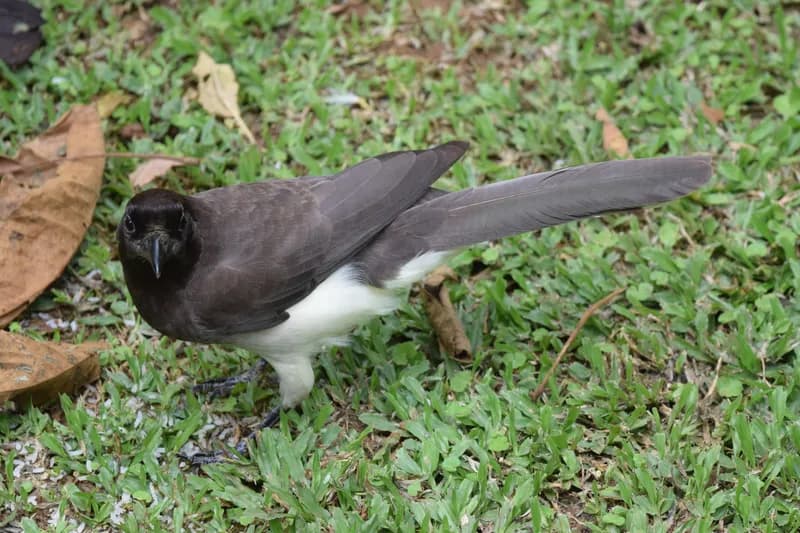
Photo: Wikimedia Commons
Overview
For decades, the Brown Jay was one of the signature reasons serious birders made the long drive to Salineño: a large, loud, unmistakable jay found nowhere else in the country, holding on at the extreme northern tip of its range along the Rio Grande near Salineño and Falcon Dam. That is no longer the case. Sightings grew sparser through the 2000s and 2010s, and the species is now considered effectively gone from the United States — this page exists to document a former South Texas specialty and the small chance of its return, not to point anyone toward a findable bird.
Identification
A large, long-tailed jay (38–43 cm / 15–17 in) — noticeably bigger than a Green Jay — with dark sooty-brown upperparts, head, and breast that contrast sharply with a clean white belly and undertail. The bill, legs, and eye are black in adults (young birds show yellow bare parts that darken with age). Sociable and vocal, it moves in loose, noisy family groups and gives a harsh, far-carrying keeowor rattling call that, historically, was often the first clue to its presence. Formerly placed in its own genus, Psilorhinus, before molecular studies folded it into Cyanocorax alongside the Green Jay.
Habitat & Range
Riparian forest and adjacent brushy woodland along the Rio Grande — historically the same stretch of river corridor near Salineño and Falcon Dam favored by other river specialties like Red-billed Pigeon and Audubon's Oriole.
The species remains common through Mexico and Central America; the U.S. population was always a small, marginal extension of that range at the very northern edge, rather than a self-sustaining core population. That marginal status is exactly what made it vulnerable to disappearing from the U.S. side of the river even while it remains secure just to the south.
Behavior & Diet
An omnivorous, highly social jay that historically moved through the canopy and understory in cooperative family groups, often with helpers assisting at the nest. Diet includes large insects, small vertebrates, fruit, and seeds. Where it remains common further south, it is a bold, noisy presence readily drawn in by pishing or playback — the kind of bird that is hard to miss where it occurs, which makes its quiet disappearance from Texas all the more notable.
Where to See in South Texas
Honestly: there is no place in South Texas where a Brown Jay is currently expected. Salineño, its last regular U.S. stronghold, is the only site worth listing here, and it is listed for historical context and the outside chance of a returning bird — not as a reliable destination. Any Brown Jay seen in Texas today would be an exceptional record worth reporting to eBird and the Texas rare-bird alert.
Best Time to See
Not currently expected. There is no reliable season or window for finding a Brown Jay in South Texas today. If one turns up, it would most likely be along the Salineño-to-Falcon Dam stretch of the river where the historical population held on longest. Check eBird rare-bird alerts rather than planning a trip around this species.
Conservation Status
IUCN: Least ConcernGlobally secure — the species remains common through Mexico and Central America and carries no elevated global conservation concern. Its disappearance from the U.S. is a local, range-edge story rather than a rangewide decline; the causes (habitat change along the river, or simply the normal contraction of a marginal population at the edge of its range) are not fully understood.
Fun Fact
The Brown Jay was long placed in its own monotypic genus, Psilorhinus, on the assumption it was only distantly related to the more colorful Cyanocoraxjays like the Green Jay. Molecular studies overturned that: the Brown Jay actually sits within the Green Jay's own genus, making these two very differently colored birds — one a South Texas icon still common today, the other a South Texas ghost — closer relatives than their appearance would ever suggest.