Texas Gulf Coast · Winter Visitor
Whooping Crane
Grus americana · Grulla blanca
Winter Visitor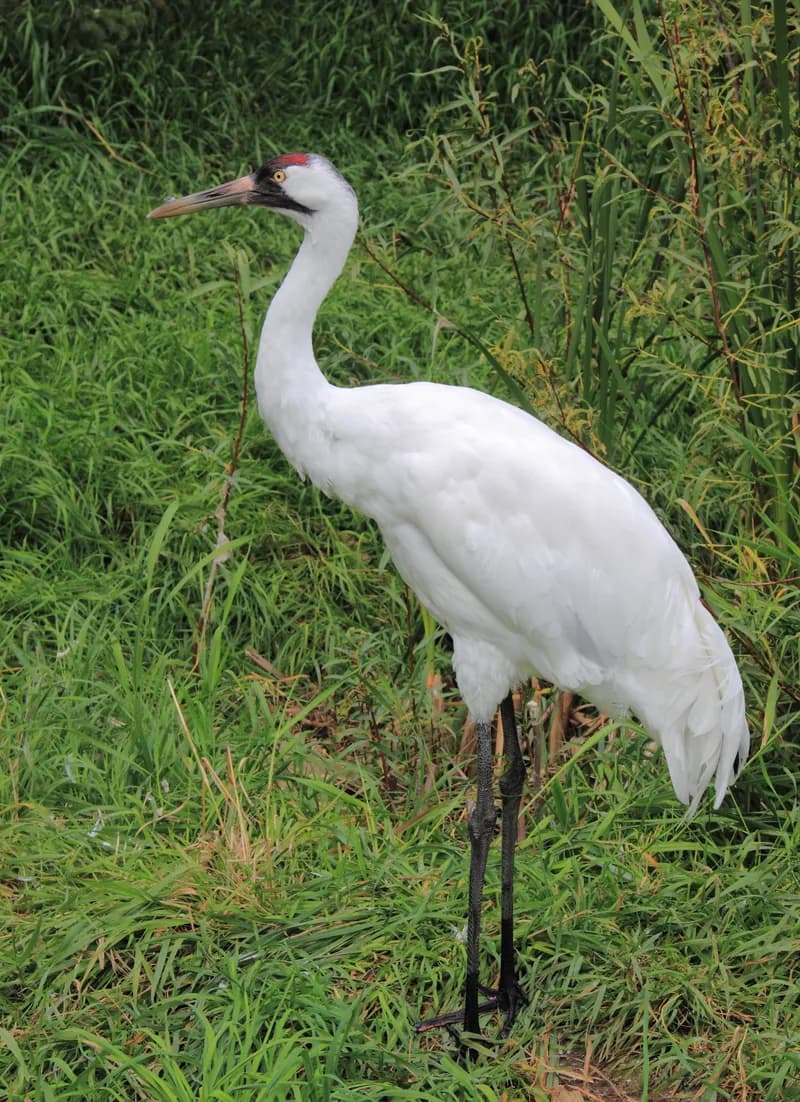
Photo: Wikimedia Commons
Overview
The Whooping Crane is North America's tallest bird and one of conservation's greatest comeback stories. After plummeting to just 15 wild birds in 1941 — pushed to the brink by hunting, habitat loss, and egg collection — the species has recovered through decades of intensive protection and international cooperation. Each autumn, the entire wild Wood Buffalo–Aransas flock migrates roughly 2,500 miles from its remote nesting grounds in Canada's Northwest Territories to winter along the Texas Gulf Coast, particularly at Aransas National Wildlife Refuge near Rockport. Seeing one in the wild remains one of the most stirring experiences in North American birding.
Identification
Unmistakable: snow-white plumage with black wingtips that flash dramatically in flight, a bare red crown, and a black mask across the face. Standing nearly 5 feet tall (150 cm) with a wingspan of 7–8 feet (210–230 cm), Whooping Cranes tower over every other bird in the marsh. Long dark legs and a long neck complete the silhouette — in flight they extend neck and legs straight, unlike herons which fold the neck back.
Juveniles are washed rusty-brown, gradually molting to white over their first year. The call — a resonant, bugling ker-loo — carries more than a mile and is often heard well before the birds come into view. In mixed flocks with Sandhill Cranes, the size and colour contrast is immediately obvious.
Habitat & Range
Whooping Cranes nest exclusively in the remote freshwater wetlands and sedge meadows of Wood Buffalo National Park, straddling the Alberta–Northwest Territories border in Canada. In Texas, they winter in the shallow tidal bays, salt marshes, and coastal flats of the central Gulf Coast — particularly the San Antonio Bay system surrounding Aransas NWR. The refuge was established in 1937 partly with this species in mind.
During migration, birds follow a broad corridor through the Great Plains, stopping at prairie wetlands and river sandbars across the Central Flyway. Occasional stray individuals and small groups are seen well south of the main wintering area, including rare sightings in the Rio Grande Valley during passage.
Behavior & Diet
On their Texas wintering grounds, Whooping Cranes are opportunistic omnivores. Blue crabs are a dietary staple, supplemented by clams, crayfish, fish, frogs, snakes, and plant material including wolfberries (Lycium carolinianum) — the waxy red berries abundant in coastal Texas scrub. Pairs and family groups hold and defend individual territories along the bay shore throughout winter.
Whooping Cranes mate for life. Pairs perform elaborate unison-call and dance displays — leaping, bowing, and wing-spreading — that reinforce pair bonds. They typically raise a single chick per year; both parents incubate the clutch of two eggs, but usually only one chick survives to fledging. Young birds remain with their parents through the first winter, migrating and wintering as a family group.
Where to See in South Texas
Aransas National Wildlife Refuge
Austwell
Rockport Harbor Boat Tours
Rockport
Goose Island State Park
Rockport area
Intracoastal Waterway Viewing Areas
Fulton / Rockport
Best viewing window: November through March. Guided boat tours from Rockport Harbor offer the closest views of birds feeding in San Antonio Bay.
Conservation Status
IUCN: EndangeredThe Wood Buffalo–Aransas flock has grown from 15 birds in 1941 to approximately 500–600 today — a remarkable recovery, but the species remains one of the most endangered birds in North America. The entire wild population winters in a relatively small area, making it acutely vulnerable to severe storms, oil spills, and freshwater inflow changes affecting blue crab abundance. Ongoing captive breeding programs provide a crucial safety net.
Fun Fact
In the 1980s, biologists placed Whooping Crane eggs into Sandhill Crane nests to create a cross-fostered population. The cranes hatched successfully — but bonded so completely with their Sandhill Crane foster families that they attempted to mate with Sandhill Cranes and ignored other Whooping Cranes entirely. The experiment was discontinued, a hard lesson in the limits of surrogate parenting.
In the News