South Texas · Year-round Resident
Crested Caracara
Caracara plancus · Caracara norteño
Resident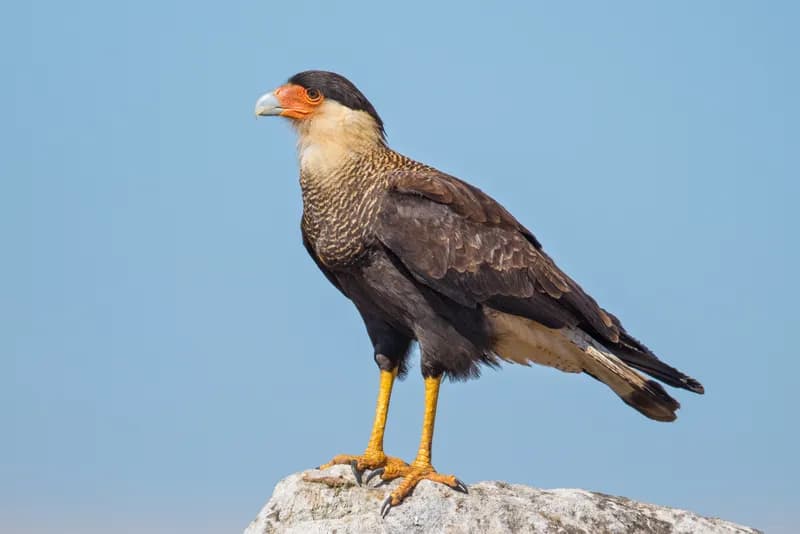
Photo: Wikimedia Commons
Overview
The Crested Caracara is a falcon by taxonomy but behaves more like a vulture. Long-legged and bold, it walks on the ground with easy confidence, scavenges roadkill alongside Black and Turkey Vultures, and patrols open country from fence posts and utility poles across South Texas. It is one of the most distinctive raptors in the region — immediately recognizable by its flat-topped black crest, bold black-and-white plumage, and vivid orange face — and a common sight in open pastures and brushlands year-round.
Identification
A large raptor (55–60 cm / 22–24 in) with a flat-topped crest, bold black-and-white barred breast, and a bright orange-red bare face that intensifies in color when the bird is excited. The bill is pale and hooked. In flight, the pattern is striking: white wing patches near the tips contrast sharply against dark flight feathers, and the tail shows a white base with a dark terminal band — visible even at considerable distance.
Often seen walking on the ground, a behavior unusual for raptors, and frequently encountered perched on fenceposts and utility poles. Immatures are brown where adults are black, with a streaked (not barred) breast and a pinkish (not orange) face.
Habitat & Range
Open country specialist: Crested Caracaras use open pastures, agricultural fields, brushy savannas, and roadsides throughout South Texas. They avoid dense forest. The U.S. range includes South Texas, south-central Florida, and southern Arizona; the main Texas population centers on the coastal prairies and brushlands from Corpus Christi south to the Rio Grande.
The species ranges from the southwestern United States and Mexico south through Central America and most of South America to Tierra del Fuego. It is also the most widespread member of the caracara group in the neotropics, where it occupies nearly every open-country habitat type.
Behavior & Diet
True dietary opportunists: Crested Caracaras eat carrion (often alongside vultures), large insects, reptiles, frogs, small mammals, eggs, and nestlings. They are kleptoparasites, stealing food from other birds, and will wade into shallow water for fish or frogs. Unlike most raptors, they walk and run on the ground with ease, using long legs to move through grass and debris.
Nesting takes place from January to April in South Texas; they build large stick nests in live oaks, palms, or tree chollas, often reusing the same site across years. Typically one to three eggs per clutch. Both sexes share incubation and care for the young.
Where to See in South Texas
Best Time to See
Year-round — Crested Caracaras are permanent residents of South Texas open country and among the easiest raptors to find. Drive the back roads of Hidalgo, Starr, and Brooks counties and scan fence posts and overhead lines. Early mornings are most productive when birds are actively foraging on the ground. The Laguna Atascosa auto tour loop and King Ranch tours reliably produce caracaras year-round.
Conservation Status
IUCN: Least ConcernPopulation is stable or increasing in Texas following legal protection under the Migratory Bird Treaty Act. Formerly persecuted as a perceived threat to livestock and game birds. Road mortality is a significant local threat, as the species frequently feeds on roadkill in traffic.
Fun Fact
Despite being classified in the falcon family (Falconidae), Crested Caracaras are far more closely related to parrots than to hawks. Genetic studies revealed that falcons split from the lineage leading to parrots and songbirds — meaning the falcon's aerial hunting style evolved independently from the hawks and eagles it superficially resembles.
In the News