Texas Gulf Coast · Year-round Resident
White-tailed Hawk
Geranoaetus albicaudatus · Aguililla coliblanca
Resident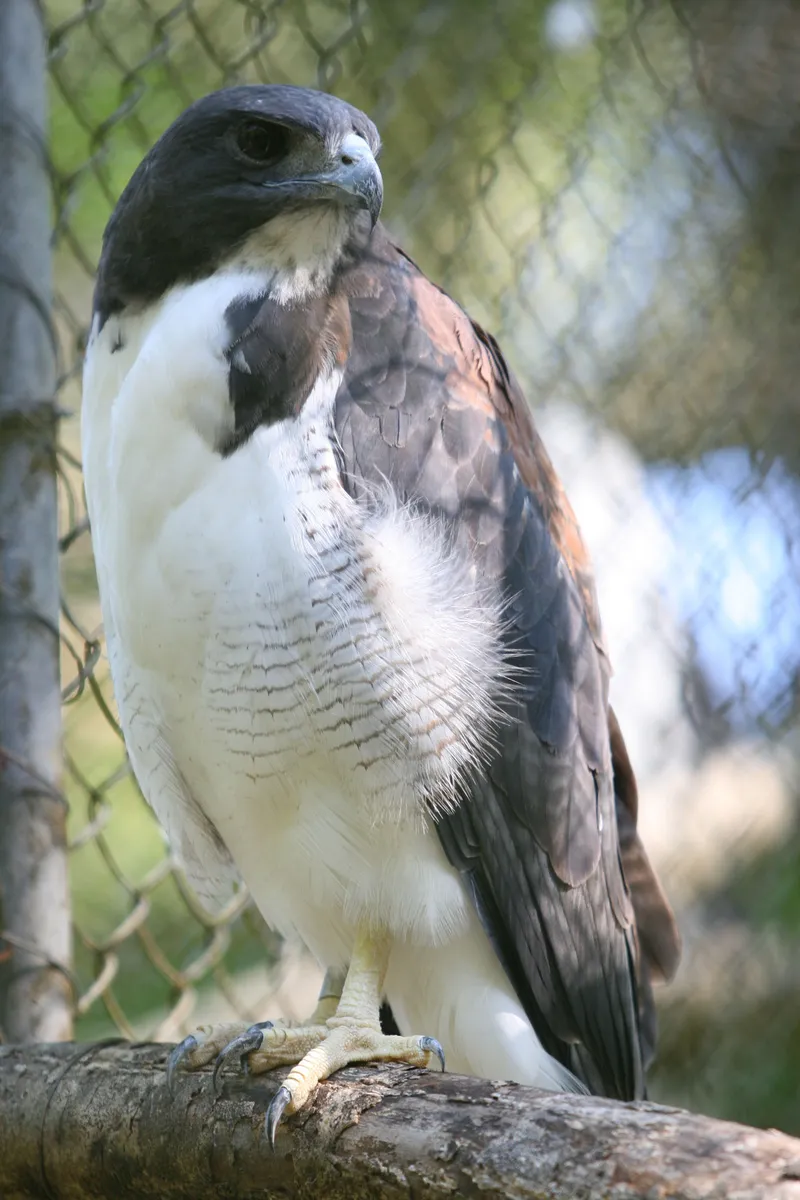
Photo: Wikimedia Commons
Overview
The White-tailed Hawk is one of the most handsome raptors in North America, and South Texas is the only place in the United States where it can be reliably found. A large, powerful buteo of open coastal prairie, it is a conspicuous presence on utility poles and fence posts across the brushy grasslands between Corpus Christi and the Rio Grande — soaring overhead on long, broad wings with the diagnostic clean white tail clearly visible.
Identification
Adults are striking: clean white underparts, dark gray back and wings, a bold rusty-red patch on the shoulder (scapulars), and a clean white tail with a single narrow black subterminal band. The wings are long and pointed for a buteo, angled back at the wrist in a distinctive kite-like posture when soaring. The face and chest are white, contrasting sharply with the dark upperparts.
Immature birds are variable and go through several plumage stages over three years — typically dark brown or blackish with a pale chest patch and showing the white tail early. The rusty shoulder patch is usually visible even in young birds. At all ages, the long wings and clean white tail are the most reliable field marks.
Habitat & Range
White-tailed Hawks are birds of open country — coastal prairie, brushy grassland, and savanna with scattered shrubs and trees for perching. In South Texas they are most abundant in the coastal prairie zone of Cameron, Willacy, and Kenedy counties, where flat grasslands and low brush provide ideal hunting habitat.
The U.S. range is essentially restricted to coastal Texas, from the Corpus Christi area south to the Rio Grande. The species is more widespread in Mexico, Central America, and South America, where it inhabits a variety of open and semi-open lowland habitats.
Behavior & Diet
An opportunistic predator of open country, the White-tailed Hawk takes small mammals, rabbits, snakes, lizards, large insects, and birds. One notable behavior: they are attracted to grass fires, gathering to catch fleeing prey at the fire's edge — a habit shared with some African raptors and a few other species.
They build large stick nests in low trees, shrubs, or yucca, typically 5–15 feet off the ground. Pairs are monogamous and tend to reuse the same nest site across years. Breeding occurs from February through June; clutch size is typically two eggs.
Where to See in South Texas
Laguna Atascosa National Wildlife Refuge
Rio Hondo
South Padre Island Birding & Nature Center
South Padre Island
Coastal prairie roads, Cameron & Willacy counties
Coastal Bend
Scan utility poles and fence posts along coastal prairie roads. In flight, the white tail and long angled wings are visible from a great distance.
Conservation Status
IUCN: Least ConcernStable across its range. In South Texas, conversion of native coastal prairie to agriculture and development is the primary local threat. The species adapts reasonably well to lightly farmed landscapes but depends on open habitat with available prey and nest sites.
Fun Fact
White-tailed Hawks are known to congregate around grass fires — sometimes dozens of birds — to catch small animals fleeing the flames. This fire-following behavior is well documented and makes them one of the few North American raptors to actively exploit wildfires as a hunting opportunity.
In the News