South Texas · Year-round Resident
White-tailed Kite
Elanus leucurus · Milano coliblanco
Resident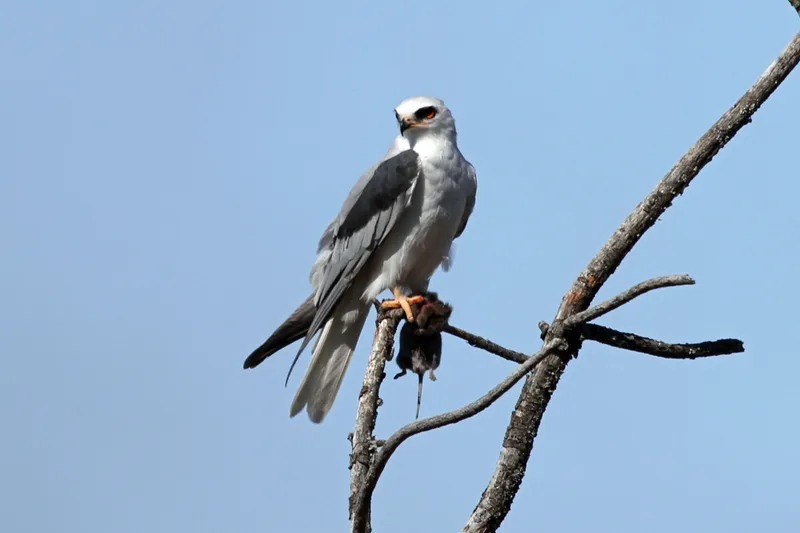
Photo: Wikimedia Commons
Overview
The White-tailed Kite is one of the most elegant and distinctive raptors in North America — a ghostly pale bird that hunts by hovering in place over open fields, wings beating rapidly and tail fanned, scanning the ground below for prey. No other North American raptor hovers with this degree of sustained precision. After near-extirpation in the early 20th century, populations have recovered strongly and the species is now a regular sight along the Texas coast.
Identification
Adults are pale gray above and white below, with bold black shoulder patches (lesser coverts) that are conspicuous at rest and in flight. The tail is white — the other name marker. Eyes are bright red, surrounded by black. At a distance, hovering birds appear almost entirely white, the black shoulder patches reducing to small dark marks.
Immatures are similar to adults but show buff-washed underparts and a brownish tinge to the back, fading to the adult pattern within the first year. In flight, the long pointed wings and white tail with no dark terminal band distinguish it from all other kites in the region.
Habitat & Range
White-tailed Kites favor open and semi-open country with sufficient prey: coastal prairie, agricultural fields, roadsides with grassy verges, and marsh edges. They avoid dense forest but use scattered trees and shrubs for nesting and roosting. In South Texas they are most reliably found on the coastal prairie of Cameron and Willacy counties.
In the U.S., they occur along the Pacific Coast from Washington to Baja California and across the Gulf Coast. The species ranges south through Mexico and Central America to southern South America.
Behavior & Diet
The White-tailed Kite's hunting method is its defining characteristic: sustained hovering at heights of 20–100 feet, wings flapping rapidly to maintain a stationary position, head angled down to scan the grass below. When prey is spotted, the bird drops — sometimes in stages, re-hovering before the final strike — and plunges feet-first to the ground.
Diet is strongly focused on small rodents, especially voles and mice, but also includes large insects and occasionally small birds or lizards. Communal winter roosts of dozens to hundreds of birds have been documented at some Texas sites, with birds arriving at dusk from surrounding territories.
Where to See in South Texas
Laguna Atascosa National Wildlife Refuge
Rio Hondo
South Padre Island Birding & Nature Center
South Padre Island
Coastal prairie roads, Cameron & Willacy counties
Coastal Bend
Scan open fields and roadsides for the hovering silhouette. Hovering birds are often obvious from a moving vehicle.
Best Time to See
Year-round — White-tailed Kites are permanent residents of South Texas open country and one of the easiest raptors to find. They hover in a distinctive manner — stationary in midair with wings angled and tail fanned — making them identifiable from a moving car. Winter is best, when numbers increase and birds sometimes gather in communal roosts of dozens. Scan open fields, coastal prairies, and roadsides in Cameron, Willacy, and Hidalgo Counties.
Conservation Status
IUCN: Least ConcernAfter significant declines in the early 20th century from egg collection and shooting, populations have recovered strongly. The species is now stable and expanding in Texas. Rodent prey availability and the presence of open grassland habitat are key limiting factors locally.
Fun Fact
White-tailed Kites are one of very few raptors that form large communal roosts outside the breeding season. Hundreds of birds may gather at a single roost site at dusk — a spectacular sight at locations where prey has been abundant during the day. Roost sites shift as prey populations fluctuate.
In the News