Rio Grande Valley · Rare Resident
Hook-billed Kite
Chondrohierax uncinatus · Milano pico garfio
Rare resident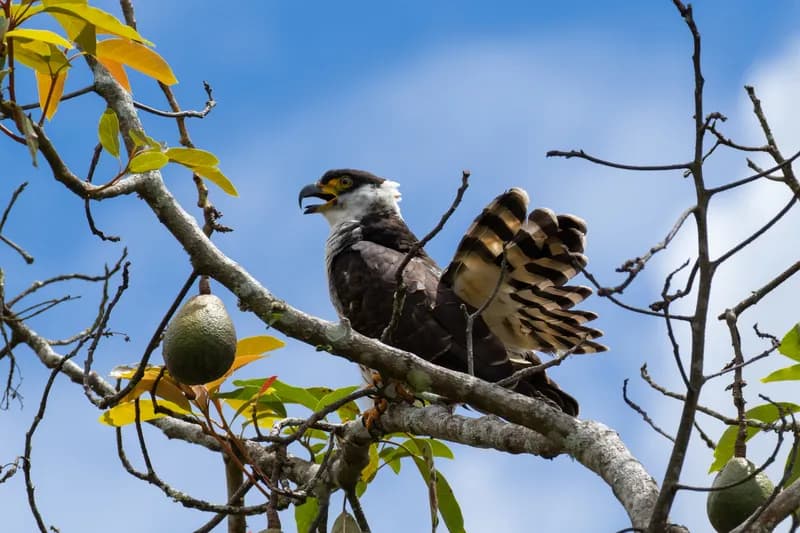
Photo: Wikimedia Commons
Overview
The Hook-billed Kite is one of the rarest regularly occurring raptors in the United States, found north of the Rio Grande only in a small patch of riparian forest in Starr County and at Bentsen-Rio Grande SP. It is a genuine rarity — sought by visiting birders who must invest patient hours at the hawk watch platform, scanning thermals above the river forest for the distinctive silhouette. The enormous hooked bill betrays the species' highly specialized diet: it is a snail specialist, and the outsized bill is an evolutionary tool for prying land snails from their shells.
Identification
A medium-sized raptor (38–43 cm / 15–17 in) with unusually variable plumage. Adults occur in a gray morph (male: gray above, finely barred gray and white below), a brown morph (female: brown above, barred rufous and white below), and a rare dark morph. All forms share the diagnostic feature: an enormously deep, strongly hooked bill visible at close range or in flight.
In flight, the best field marks are the combination of broadly banded tail and a characteristic “hunchbacked” silhouette — the large head and heavy bill weight the front of the bird, giving it a distinctive front-heavy look when soaring. The wings are relatively broad and rounded.
Habitat & Range
Dense riparian forest where large land snails (genus Rabdotus) are abundant. The Hook-billed Kite is a dietary specialist on arboreal land snails, and its occurrence in South Texas is closely tied to patches of mature riparian forest where snail populations are high. In the U.S., limited to the riparian corridor near Bentsen SP and Salineño.
The broader range extends from northeastern Mexico south through Central America and most of South America to Bolivia, with a separate island population in Cuba. The species is more widespread and approachable in areas of Mexico just south of the border.
Behavior & Diet
Essentially a snail specialist: Hook-billed Kites feed almost entirely on large arboreal land snails of the genus Rabdotus and related groups, which they pry from the shell or crush with the powerful hooked bill. This dietary specialization explains both the extraordinary bill morphology and the species' dependence on specific forest patches where snail populations are adequate.
Birds are most visible in the morning and late afternoon when they soar over the forest canopy to relocate between foraging areas. The best strategy in South Texas is early morning observation from the hawk watch platform at Bentsen SP, scanning the thermals that develop above the river forest.
Where to See in South Texas
Best Time to See
Year-round at Salineño — the Hook-billed Kite's most reliable territory in the U.S. is along the Rio Grande at Salineño Wildlife Preserve, where birds are present in every month. Early morning is best: arrive before 8 a.m. and scan the woodland edge above the river. September is a bonus window when birds are more likely to soar high on thermals alongside migrating raptors at Bentsen. Calm, sunny mornings after a cold front passage maximize soaring activity.
Conservation Status
IUCN: Least ConcernLeast Concern globally, but the U.S. population is tiny and highly vulnerable. Clearance of riparian forest and suppression of land snail populations — on which the kite depends entirely — are the primary local threats. The protected corridor at Bentsen SP is essential to its continued presence in the country.
Fun Fact
Different Hook-billed Kites within a population can have bills of radically different sizes — some individuals have bills nearly twice as deep as others of the same sex. Bill depth correlates with the size of snails taken: large-billed birds tackle bigger, thicker-shelled species while small-billed birds specialize on thinner ones. It is one of the clearest examples of within-species ecological specialization known in birds.
In the News