Rio Grande Valley · Year-round Resident
Ringed Kingfisher
Megaceryle torquata · Martín real
Resident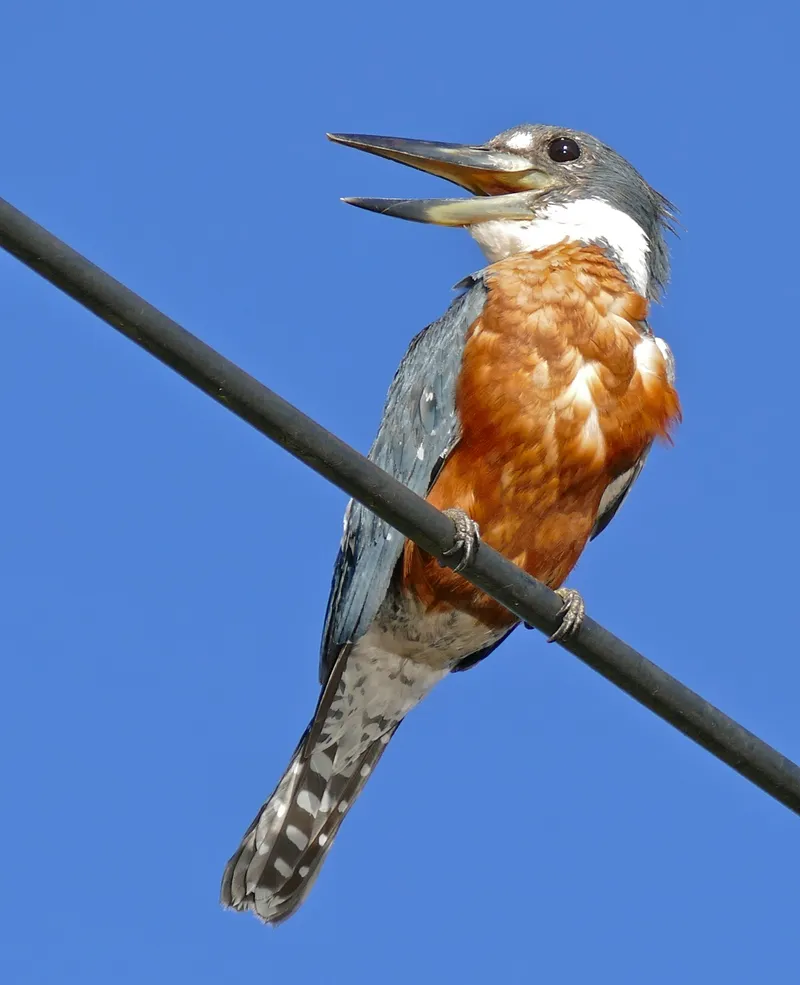
Photo: Wikimedia Commons
Overview
The Ringed Kingfisher is the largest kingfisher in the Americas — big enough to make a Belted Kingfisher look small by comparison. It barely reaches the United States in South Texas, where it is a year-round resident along the Rio Grande and its oxbow lakes. A noisy, conspicuous bird, it announces itself from a distance with a loud, rattling call and sits prominently on bare branches or wires overlooking open water. Where the Green Kingfisher hides in streamside vegetation, the Ringed dominates the riverfront from obvious, elevated perches.
Identification
A large kingfisher (40–41 cm / 16 in), noticeably bigger and heavier than the Belted Kingfisher, with a proportionally massive bill. Blue-gray above with a shaggy crest and white collar. The underparts differ by sex: the male has entirely rufous-chestnut underparts, while the female has a blue-gray breast band separating the white throat from the rufous belly. White underwing patches are visible in flight.
Separation from the Belted Kingfisher is straightforward: the Ringed is significantly larger and heavier, and the male's all-rufous underparts (no white below the breast) eliminate any confusion with a male Belted. The Ringed's rattling call is also deeper and more powerful than the Belted's.
Habitat & Range
The Ringed Kingfisher uses large rivers, resacas, and other substantial water bodies with fish. It prefers larger, deeper water than the Green Kingfisher and is most often seen along the main channel of the Rio Grande, at Salineño, and at large resacas in the Valley. It is far less tolerant of small, clear streams than the Green Kingfisher.
In the U.S., limited to the Lower Rio Grande Valley. The range extends through Mexico and Central America to South America south to Tierra del Fuego — making it one of the most widespread kingfishers in the Western Hemisphere.
Behavior & Diet
Like all kingfishers, the Ringed plunges headfirst from a perch or a brief hover to capture fish proportionally larger than those taken by either the Belted or Green Kingfisher. It patrols long stretches of river, calling frequently — the rattling call carries well and is often the first indication of the bird's presence.
Territorial and conspicuous, pairs maintain stretches of river year-round. Nesting occurs in long burrows excavated in earthen riverbanks, typically in March and April. The same bank sites may be reused across multiple years.
Where to See in South Texas
Best Time to See
Year-round — Ringed Kingfishers are permanent residents of the lower Rio Grande Valley and don't migrate. They are most easily seen along the Rio Grande itself, where they perch prominently on snags above the water and make loud, rattling calls audible from a distance. The Santa Ana NWR water features, the Rio Grande floodplain at Bentsen, and the water access at Salineño Wildlife Preserve are the best sites. Visit any time of year — October through April is ideal when the deciduous vegetation is thinner and birds are easier to spot.
Conservation Status
IUCN: Least ConcernThe South Texas population is small but stable. Water quality and the maintenance of fish-bearing waterways are the primary habitat requirements. Channelization of the Rio Grande and reservoir management that affects fish populations can impact local numbers.
Fun Fact
The Ringed Kingfisher only established itself as a U.S. breeding bird in 1970, when the first nest was documented near Laredo along the Rio Grande. Since then it has quietly expanded to become a year-round resident throughout the Lower Rio Grande Valley — one of the more recent natural range expansions of any U.S. bird species.
In the News