Rio Grande Valley · Year-round Resident
Green Kingfisher
Chloroceryle americana · Martín pescador verde
Resident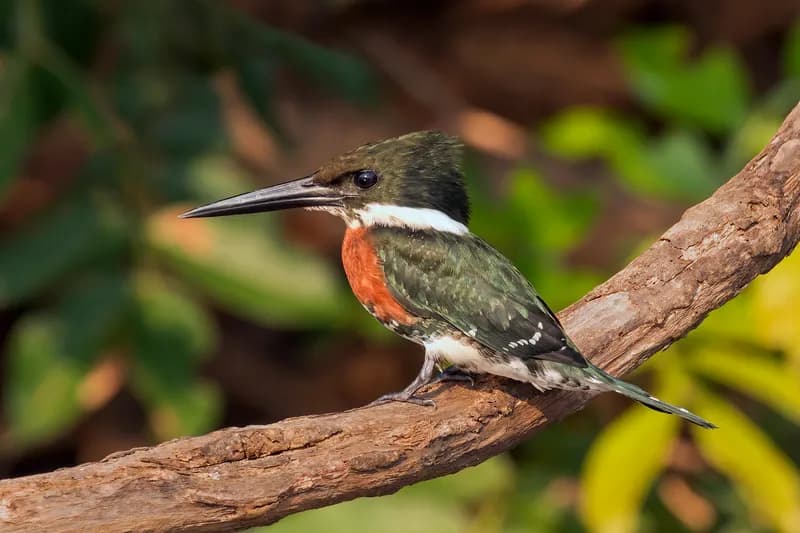
Photo: Wikimedia Commons
Overview
The Green Kingfisher is the smallest of the three kingfisher species in the Rio Grande Valley — barely larger than a sparrow — and easily the most secretive. Where the Ringed Kingfisher announces itself loudly from prominent perches over open water, the Green slips silently along clear stream margins, perching low over the surface and vanishing into overhanging vegetation at the first hint of disturbance. Finding one takes patience: scan the waterline carefully and look for the iridescent dark-green back of a tiny bird perching horizontally on a root or branch just above the water.
Identification
Tiny for a kingfisher (19–21 cm / 7.5–8 in), roughly sparrow-sized in body, though the long bill adds considerable length. Dark iridescent green above with white spotting on the wings and a white collar. Underparts differ by sex: the male has a rufous-orange breast band, while the female shows a white breast with greenish spotting or a faint incomplete band. Both sexes have yellow-green feet.
Separation from Belted and Ringed Kingfishers is straightforward by size — the Green is dramatically smaller — and by the dark iridescent green (not blue-gray) upperparts. The flight is fast and direct, low over the water surface, often accompanied by a sharp, dry chip call that is frequently the first indication of the bird's presence.
Habitat & Range
Green Kingfishers require clear or semi-clear water — they locate fish visually from a perch and cannot hunt effectively in turbid conditions. They use small streams, irrigation channels, clear resaca margins, and pond edges with overhanging vegetation. Larger, murkier water bodies are left to the Ringed Kingfisher.
In the U.S., found in South Texas and locally along the Guadalupe River drainage in south-central Texas. The range extends through Mexico and Central America and across most of South America east of the Andes, making it one of the most widely distributed kingfishers in the Western Hemisphere.
Behavior & Diet
Hunts by watching from a low perch just above the waterline — often a root, rock, or horizontal branch — and plunging nearly vertically for small fish, aquatic insects, and crustaceans. The dive is swift; the bird emerges, beats the prey against the perch, and swallows it headfirst. Flights between perches are low, fast, and direct, just above the water surface.
Nests in burrows excavated in earthen banks, similar to other kingfishers. Water clarity is the critical habitat variable: in droughted or disturbed conditions that increase turbidity, Green Kingfishers vacate stretches of water they previously held year-round.
Where to See in South Texas
Best Time to See
Year-round — Green Kingfishers are permanent residents along clear-water streams and resacas in the Rio Grande Valley. They are tiny (sparrow-sized) and easily overlooked, but sit conspicuously on low branches and rocks directly over the water. The most reliable sites are the slow-moving resacas at Santa Ana NWR and the clear streams at Estero Llano Grande. October through April is ideal — lower vegetation makes the birds easier to spot. Walk slowly along any resaca edge and scan low branches near the waterline.
Conservation Status
IUCN: Least ConcernCommon and stable throughout its broad range. In South Texas, water clarity is the critical limiting factor — sedimentation, agricultural runoff, and channelization that reduce water clarity all reduce available habitat. The species is sensitive to any disturbance that clouds its hunting waters.
Fun Fact
The Green Kingfisher is a master of stillness. It can sit motionless on a low perch for extended periods, watching the water with intense focus — its dark iridescent back blending into overhanging vegetation so effectively that it is regularly overlooked even by birders actively searching for it. Hearing the sharp chip call in flight is often the only indication one has passed by.
In the News