Rio Grande Valley · Year-round Resident
Gray Hawk
Buteo plagiatus · Aguililla gris
Resident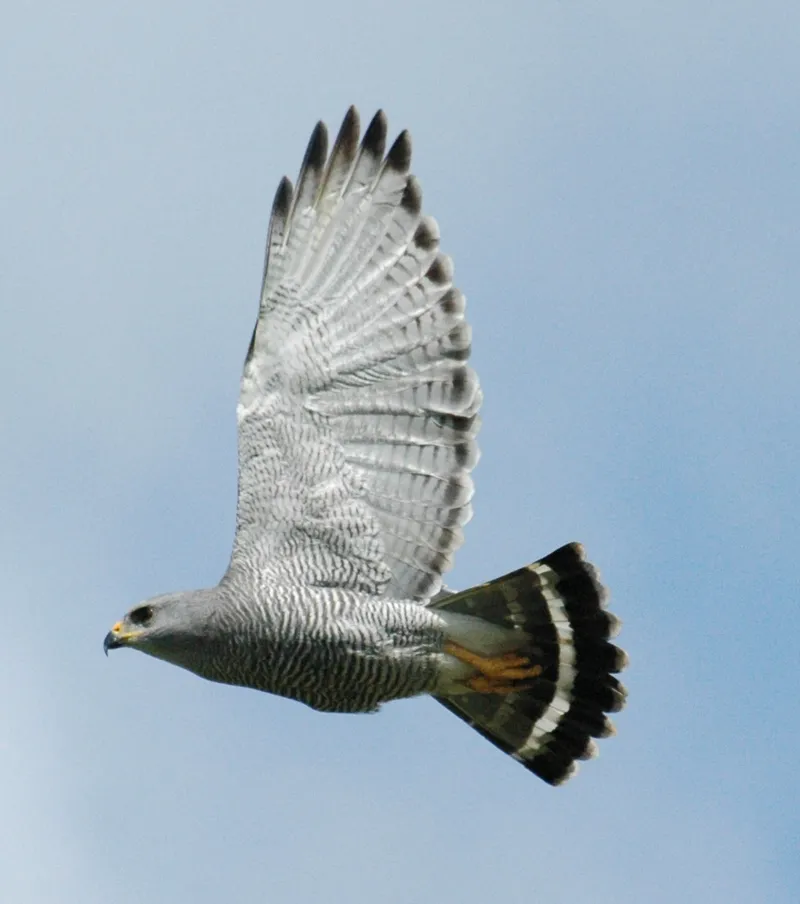
Photo: Wikimedia Commons
Overview
The Gray Hawk is a medium-sized buteo of the river corridor, reaching the northern limit of its range in the riparian forest of the Rio Grande Valley. It is a bird of the canopy — elegant and quietly commanding — more likely to be heard than seen until patience and keen ears locate it perching in dappled shade beneath the ebony and anacua canopy. The loud, keening call is one of the characteristic sounds of the Rio Grande riparian zone from spring through summer, carrying well across the river corridor on still mornings.
Identification
A relatively small buteo (46–56 cm / 18–22 in) with distinctive finely barred gray-and-white underparts and a plain gray back — the overall effect is a clean, subtly patterned hawk unlike any other buteo in South Texas. Adults show two broad white tail bands on a dark tail. The cere and legs are yellow-orange.
Immatures are brown above and streaked brown on the underparts, with a heavily streaked head and a bold white supercilium framing a dark cheek — a facial pattern distinctive enough to identify in the field. In flight, the adult's pale barred underparts and banded tail are the primary marks at distance.
Habitat & Range
In the U.S., Gray Hawks are almost entirely confined to riparian corridors with large mature trees. In South Texas, Bentsen-Rio Grande Valley SP and Santa Ana NWR provide the core habitat along the Rio Grande. A separate population breeds in riparian corridors of southern Arizona along the San Pedro and Santa Cruz rivers.
The broader range extends south through Mexico — where the species is more widespread in tropical and subtropical woodland — and through Central America to northwestern South America. Resident throughout its range; South Texas birds do not appear to migrate.
Behavior & Diet
Gray Hawks hunt from a perch in the forest interior and edge, taking lizards, small snakes, frogs, large insects, and small mammals. Unlike many buteos that hunt by soaring and stooping, the Gray Hawk tends to hunt from low to mid-canopy perches and pursues prey through vegetation with an agility that resembles an accipiter more than a typical buteo.
Nests are built high in large riparian trees; the species is territorial and typically returns to the same general area year after year. The drawn-out, descending call — often transcribed as a falling “keee-eer” — is the most reliable way to locate a bird in the dense canopy.
Where to See in South Texas
Best Time to See
April through August — Gray Hawks are summer breeders in South Texas, arriving in spring and departing by October. The best window is May and June, when pairs are established on nesting territories and calling frequently. Salineño Wildlife Preserve along the Rio Grande is the most reliable U.S. site, with one to two territorial pairs present most years. Arrive before 9 a.m. and listen for the distinctive wailing call along the wooded river corridor.
Conservation Status
IUCN: Least ConcernIn the U.S., the species is limited by availability of mature riparian woodland — a habitat type heavily impacted by water diversions, flood control, and development along the Rio Grande. Protection of the remaining riparian corridor at Bentsen, Santa Ana, and Resaca de la Palma is critical to sustaining the U.S. population.
Fun Fact
The Gray Hawk was once called the “Mexican Goshawk” — a reflection of its accipiter-like hunting style within dense riparian canopy. Despite being a true buteo by genetics, its short-winged, agile pursuit of prey through woodland closely resembles a Sharp-shinned or Cooper's Hawk rather than the slow, soaring style typical of its genus.
In the News