South Texas · Migrant
Broad-winged Hawk
Buteo platypterus · Busardo aliancho
Migrant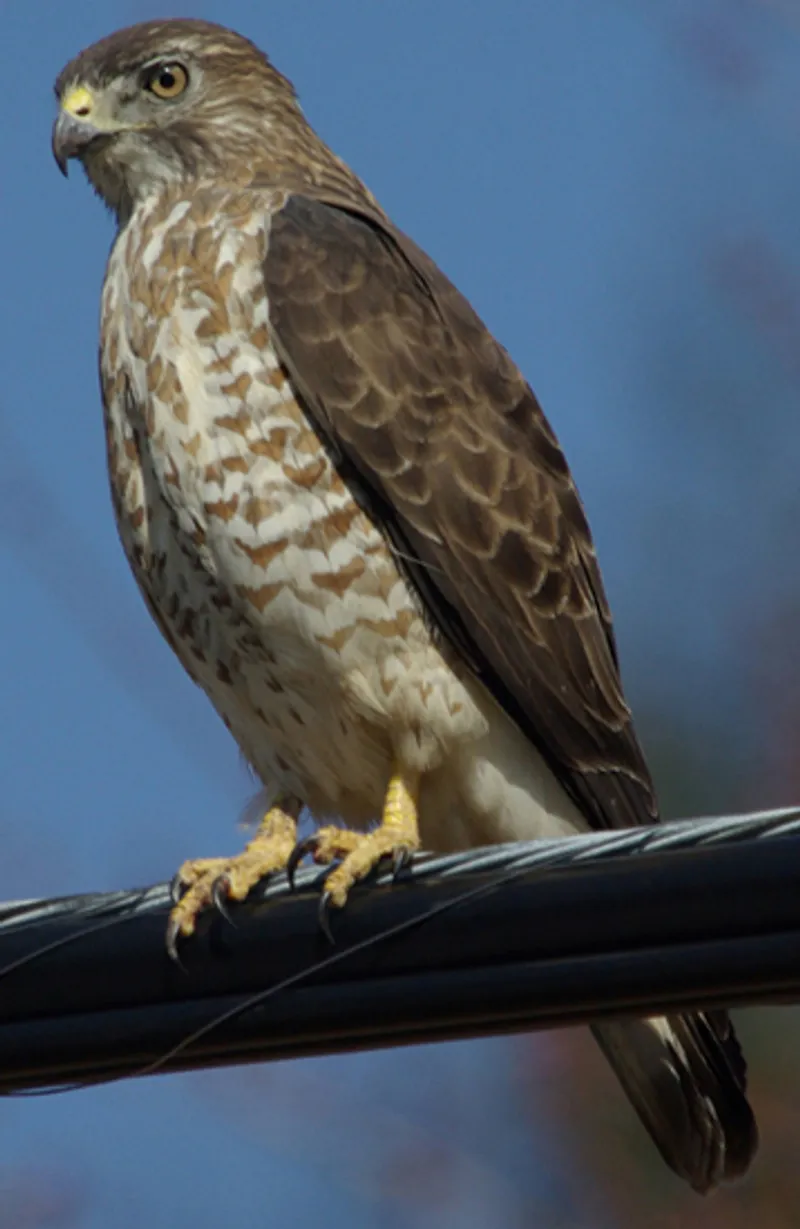
Photo: Wikimedia Commons
Overview
For most of the year the Broad-winged Hawk is a modest, compact buteo of eastern forest — quietly nesting in the canopy, easy to overlook. But in mid-September, it transforms the sky over South Texas into one of birding's great spectacles. Hundreds of thousands funnel through a narrow corridor along the Gulf Coast, concentrating at Hazel Bazemore County Park near Corpus Christi and continuing south past Bentsen SP. On a single peak day, over a million birds can pass through — spiraling in tight “kettles” on thermals before streaming southward toward Central and South America.
Identification
A compact, stocky buteo (34–44 cm / 13–17 in) with relatively pointed wings and a short tail. Adults show a brown back, barred rufous-and-white underparts, and a boldly banded tail with two or three broad black-and-white bands — the white bands roughly equal in width to the black. The underwing in flight shows a pale center with a dark border, and the wing tips are dark.
Immatures have a streaked brown breast and a finely banded tail. The most similar species encountered in migration is the Red-shouldered Hawk, which is larger with a longer tail and finer barring on the underparts. In kettle counts, the distinctive stubby silhouette and tail bands are the key features.
Habitat & Range
Breeds in mature deciduous and mixed forest across eastern North America from southern Canada to the Gulf States. During migration it funnels along ridgelines and the Gulf Coast — geography that concentrates soaring birds. The most spectacular concentrations in South Texas occur at Hazel Bazemore County Park (near Corpus Christi) in September, which regularly records the highest single-day hawk counts anywhere in North America.
After South Texas, birds continue south through Mexico and Central America to their wintering grounds in tropical lowland forest from southern Mexico to Bolivia.
Behavior & Diet
On the breeding grounds, feeds mainly on small mammals, frogs, and large insects taken from the forest floor. During migration, birds feed little — they rely on fat reserves and exploit thermals for the long journey south, minimizing energy expenditure by soaring rather than flapping.
Migration behavior is the spectacle: birds gather in rising thermals, circling upward in tight masses called kettles (sometimes containing thousands of individuals), before peeling off the top to glide south in long streams. Peak migration in South Texas occurs in the third week of September.
Where to See in South Texas
Also see: Hazel Bazemore County Park near Corpus Christi — the premier hawk watch site in North America for this species, with counts regularly exceeding 500,000 in a single day in September.
Best Time to See
Mid-September — Broad-winged Hawks migrate through South Texas in one of the most spectacular wildlife events in North America. The peak window is narrow: typically September 15–25, when kettles of thousands spiral overhead on thermals. Hazel Bazemore County Park near Corpus Christi is the premier watch site. In South Texas proper, Bentsen-Rio Grande Valley SP and roadside hawk watches can produce counts of hundreds on good days. Come early, bring a chair, and look for spiraling thermals of birds climbing the sky.
Conservation Status
IUCN: Least ConcernPopulations appear stable, though deforestation on the tropical wintering grounds is a long-term concern. The concentration of the migration through a narrow geographic corridor makes population monitoring relatively accessible — hawk-count data from Corpus Christi track broad trends effectively year over year.
Fun Fact
The Broad-winged Hawk count at Hazel Bazemore County Park in Corpus Christi recorded an estimated 1.1 million birds on a single day — September 20, 1999 — making it one of the largest single-day raptor counts ever documented anywhere in the world. Peak days today regularly reach 500,000 or more.
In the News