Rio Grande Valley · Resident (Reintroduced)
Aplomado Falcon
Falco femoralis · Halcón aplomado
Resident · Reintroduced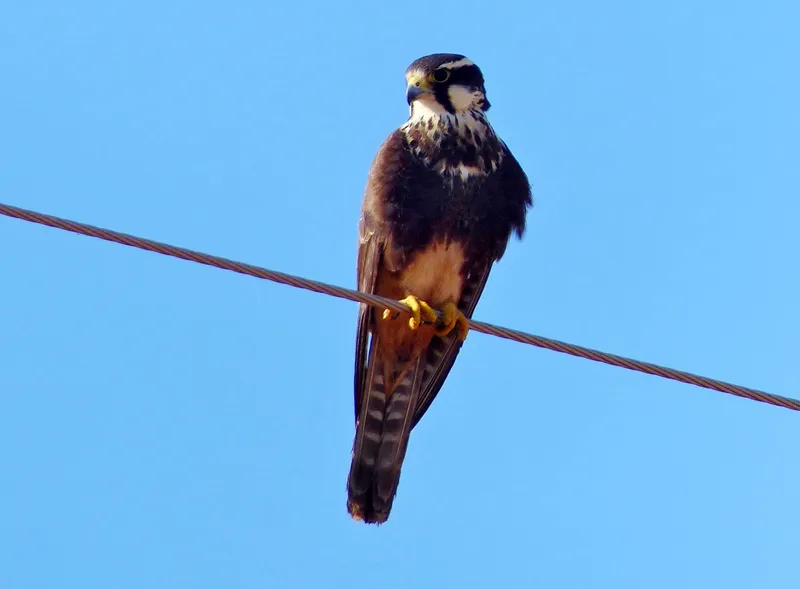
Photo: Wikimedia Commons
Overview
The Aplomado Falcon is one of the American Southwest's most dramatic conservation recoveries. Once a breeding bird across southern Texas, New Mexico, and Arizona, the species vanished from the United States entirely by the mid-20th century — driven out by a combination of habitat conversion, pesticide contamination, and nest disturbance. A reintroduction program begun in 1985 by the Peregrine Fund has gradually re-established a breeding population in South Texas, centered on Laguna Atascosa National Wildlife Refuge and the surrounding coastal prairies of Cameron and Willacy counties. Slender and boldly patterned, the Aplomado is as elegant as any falcon on the continent.
Identification
A slender, long-tailed falcon with an immediately striking facial pattern. Adults show dark slate-gray upperparts, a broad white supercilium arching back from the bill, and white cheeks and throat separated from the crown and nape by bold dark mustache stripes. The breast is washed cinnamon or buff, sharply demarcated from a dark belly band; the flanks and thighs are rich rufous — the species name femoralis refers to these prominently feathered legs. The tail is long and banded black-and-white.
Similar in size to a Peregrine Falcon but noticeably more slender with a proportionally longer tail — in flight the silhouette is almost kite-like. Females are larger than males, as in most raptors. Perched birds often look elongated and upright; in the open prairie they regularly use utility poles, fence posts, and yucca stalks as hunting lookouts, making them surprisingly easy to spot when present.
Habitat & Range
In South Texas, Aplomado Falcons occupy open coastal prairie and brushy savanna — the moist, wind-swept grasslands and shrub-dotted flats of Cameron and Willacy counties, stretching from the Laguna Madre shore inland to the lower resaca country. They favor areas with scattered shrubs, yucca, and low trees for nesting (they appropriate old stick nests of White-tailed Hawks and ravens rather than building their own) and open ground with good visibility for hunting.
The broader range extends through open habitats of Mexico, Central America, and South America as far south as Tierra del Fuego. In the U.S., the reintroduced Texas population is the only established breeding group; occasional individuals wander into New Mexico and Arizona.
Behavior & Diet
Aplomado Falcons are fast, agile hunters that take a wide range of prey: large insects (especially dragonflies and grasshoppers), small to medium-sized birds including sparrows, larks, and doves, as well as lizards and small mammals. Unlike the classic falcon stoop from height, Aplomados frequently hunt low and fast across open ground, using speed and surprise rather than altitude.
Pairs often hunt cooperatively — one bird flushes prey from cover while the other cuts off the escape route. Mates are strongly bonded and are regularly seen perching side by side. They are year-round residents where established, defending territories and returning to the same nest structures season after season. Clutch size is typically two to three eggs; both parents share incubation and chick-rearing duties.
Where to See in South Texas
Laguna Atascosa National Wildlife Refuge
Rio Hondo
South Padre Island Birding & Nature Center
South Padre Island
Coastal Prairie along FM 106
Cameron / Willacy counties
Salineño Wildlife Preserve
Salineño
Scan fence lines, utility poles, and yucca stalks along coastal prairie roads — perched birds are often conspicuous against the open sky. Pairs are frequently seen together year-round.
Best Time to See
October through April is best for reintroduced birds on Laguna Atascosa NWR and the Coastal Bend. The Laguna Atascosa auto tour route is the most accessible viewing area, where falcons often perch on native yucca stalks and fence posts in the open coastal prairie. Early morning drives are most productive. Pairs are present year-round in established territories — ask refuge staff for current sightings before visiting.
Conservation Status
U.S. Federally EndangeredListed as Endangered under the U.S. Endangered Species Act. The reintroduction effort — led by the Peregrine Fund in partnership with the U.S. Fish & Wildlife Service — has established dozens of breeding pairs in South Texas from zero in the late 20th century, making it one of the most successful raptor recovery projects in North American history. Continued habitat protection and nest monitoring remain essential for the population's long-term stability.
Fun Fact
John James Audubon collected an Aplomado Falcon specimen in Louisiana in the 1830s and painted it for The Birds of America. Within a century, not a single breeding pair remained north of the Mexican border. The bird Audubon held in his hands had disappeared from the United States entirely — until the Peregrine Fund began releasing captive-raised birds back into South Texas in 1985.
In the News