South Texas · Year-round Resident
Harris's Hawk
Parabuteo unicinctus · Aguililla rojinegra
Resident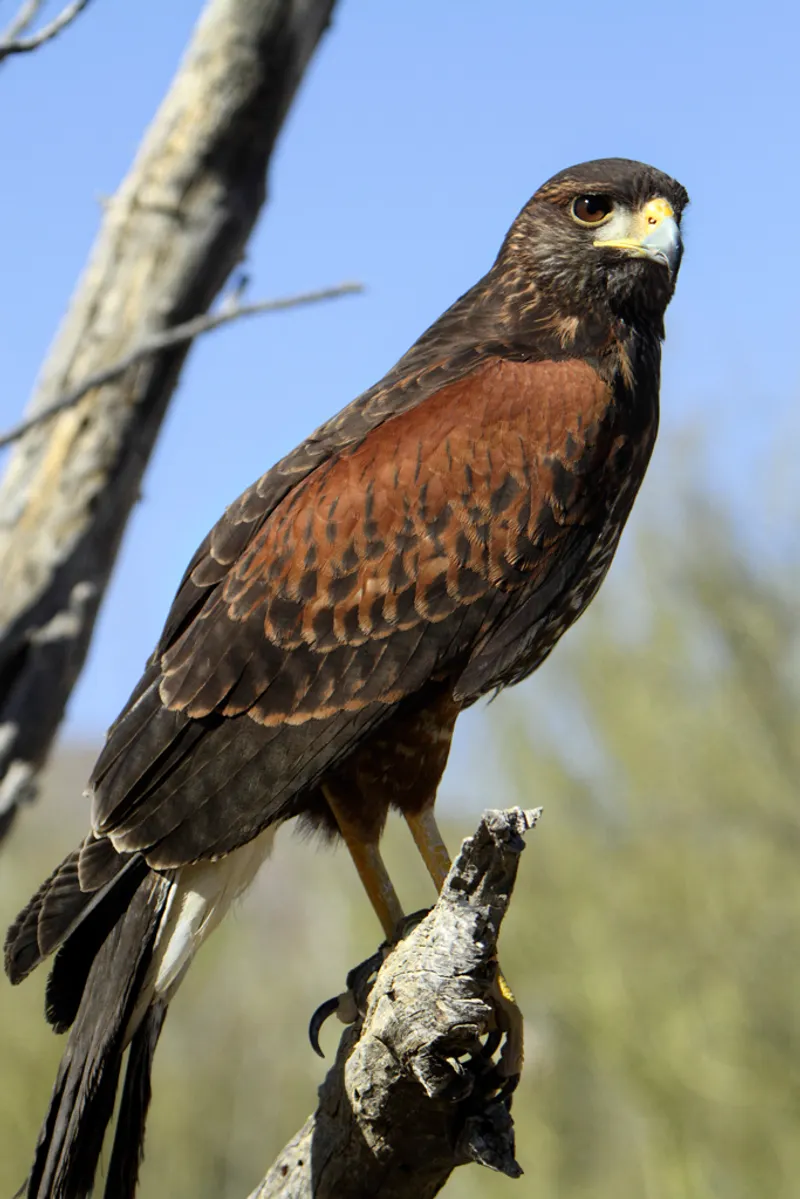
Photo: Wikimedia Commons
Overview
Harris's Hawk is the only hawk in the world known to hunt cooperatively in organized family groups — a behavior more reminiscent of wolves than raptors. Groups of two to six related birds coordinate to flush, pursue, and dispatch prey that a single hawk could not easily take alone. This remarkable social strategy, combined with rich two-toned plumage and a bold, curious personality, has made it a favorite among falconers and birdwatchers alike. It is a common and conspicuous sight across the brushlands and open country of South Texas year-round.
Identification
A large buteo (53–59 cm / 21–23 in) with distinctive two-toned plumage: rich chestnut-maroon shoulders and thigh feathering contrast strongly with a dark brown to black body and wings. The tail is white at the base and tip with a broad black band in between — a pattern visible at distance. The cere and legs are yellow-orange. Sexes are alike in pattern; females are noticeably larger.
In flight, the chestnut wing linings, white tail base, and white tail tip are diagnostic. Immatures are streaked brown below with some rufous tones on the shoulders — already showing the distinctive tail pattern. In South Texas, the combination of dark body and chestnut shoulders is unique among the hawks.
Habitat & Range
Harris's Hawks favor semi-arid open habitats: Tamaulipan thornscrub, desert scrub, brushy open country, and woodland edges throughout South Texas. They are tolerant of human presence and occur in suburban areas with large trees. Common across Hidalgo, Starr, Webb, and Jim Hogg counties, and along roadsides and open brush in virtually any part of the Valley.
The U.S. range also includes southern Arizona and southwestern New Mexico. The species extends through Mexico, Central America, and most of South America east of the Andes, from Colombia south to Chile and central Argentina.
Behavior & Diet
Pack hunting sets Harris's Hawk apart from all other raptors. Groups coordinate pursuits, with some birds flushing prey while others cut off escape routes; the group shares the kill. Prey includes jackrabbits, cottontails, squirrels, lizards, and birds. Family groups maintain year-round territories and may include offspring from previous years as helpers at the nest.
Nests are built of sticks in thorny trees or palms, often reused across multiple years. Multiple females may lay eggs in the same nest in some populations — a form of cooperative polyandry. The same family group can raise two or three clutches per year in South Texas.
Where to See in South Texas
Best Time to See
Year-round — Harris's Hawks are permanent residents of South Texas and don't migrate. They are easiest to find during the breeding season (February–July), when groups of 3–5 birds are conspicuous around nest sites and frequently perch on utility poles and mesquite trees along roadsides. Laguna Atascosa NWR auto tour road, the brushy areas around Estero Llano Grande, and any open country with scattered trees in Cameron and Willacy counties reliably produce sightings year-round.
Conservation Status
IUCN: Least ConcernSouth Texas populations are stable. Harris's Hawks are heavily used in falconry worldwide — their cooperative and trainable nature makes them popular with falconers — which has created a large captive breeding industry. Wild populations face pressure from habitat loss and illegal take in some parts of their range.
Fun Fact
Harris's Hawks have been observed “stack perching” — multiple birds occupy a single tall cactus or tree, each at a different height. Researchers believe each bird gains an unobstructed view over the surrounding scrub while the group minimizes crowding at the limited high perches available in open desert habitat.
In the News