Rio Grande Valley · Spring & Fall Migrant
Swallow-tailed Kite
Elanoides forficatus · Milano tijereta
Migrant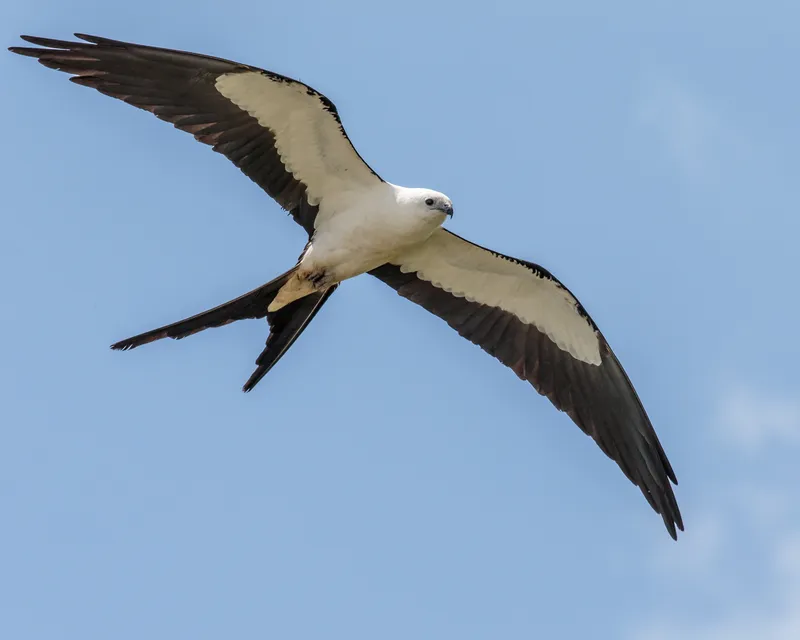
Photo: Wikimedia Commons
Overview
The Swallow-tailed Kite is, by many accounts, the most graceful bird in North America. Watching one bank and wheel overhead — black-and-white plumage flashing, the impossibly long forked tail swinging through arcs — is an experience that stops birders and non-birders alike in their tracks. South Texas lies along the main migration corridor between breeding grounds in the southeastern U.S. and wintering areas in South America; spring migrants move through from late April through May, and fall birds reappear in August. On good days, loose groups of a dozen or more may be seen soaring overhead at Valley hotspots.
Identification
Unmistakable. The combination of snow-white head and underparts contrasting with jet-black back, wings, and deeply forked tail is unique among North American birds. The tail is extraordinarily long — longer than the rest of the body — and the fork deepens even further in adults. In flight the black-and-white pattern and elegant sweeping wingbeats are distinctive from a great distance.
Sexes look alike. Juveniles are similar to adults but with slightly shorter tail streamers and fine streaking on the head and breast. No confusion species in its range.
Habitat & Range
Swallow-tailed Kites breed in the southeastern United States — primarily Florida, South Carolina, and neighboring states — in tall forest near wetlands. They winter in South America, mainly west of the Andes in Bolivia, Brazil, and surrounding countries. The migration route takes them across the Gulf of Mexico and through Mexico and Central America.
In South Texas, migrants may be seen over any habitat — woodland edges, open sky above river corridors, and parks — as they move through. The species does not breed in Texas, though occasional summer individuals linger.
Behavior & Diet
Swallow-tailed Kites are aerial specialists, spending most of their active hours on the wing. They catch large insects — dragonflies, cicadas, beetles — in flight, as well as tree frogs, lizards, and nestlings snatched directly from branches or leaves without landing. They have been observed drinking and bathing in flight by skimming water surfaces.
On migration they often travel in loose groups, riding thermals and soaring effortlessly for hours. Unlike most raptors they seem to genuinely enjoy aerial maneuvering — often seen playing in updrafts with no apparent foraging purpose.
Where to See in South Texas
Bentsen-Rio Grande Valley State Park
Mission
Santa Ana National Wildlife Refuge
Alamo
Estero Llano Grande State Park
Weslaco
Best window: late April through May (spring) and August (fall). Look up — migrants often appear overhead with no warning.
Conservation Status
IUCN: Least ConcernStable globally. The U.S. population was significantly reduced by habitat loss in the 19th and early 20th centuries, contracting from a formerly wider range to its current southeastern stronghold. Deforestation at wintering grounds in South America is an ongoing concern for the long-term population.
Fun Fact
Swallow-tailed Kites eat, drink, and bathe entirely in flight — they have been documented scooping water from the surface of ponds and rivers without landing. They also break twigs from trees while flying to build their nests high in the forest canopy, never touching the ground throughout the entire breeding cycle.
In the News